Summary The understanding was reached during 7th Round of Pak-China Foreign Ministers' Strategic Dialogue held in Beijing on Sunday
BEIJING (Dunya News) - Pakistan and China have once again underscored their uncompromising opposition to terrorism, agreeing to strengthen collaboration in counter-terrorism and security matters while jointly safeguarding the uninterrupted and secure progress of Belt and Road projects under the China-Pakistan partnership.
The resolve was restated during the Pakistan-China Strategic Dialogue held in Beijing on January 4, co-chaired by Deputy Prime Minister Ishaq Dar and Chinese Foreign Minister Wang Yi, as noted in a joint communiqué released on Monday.
The two sides reaffirmed that their friendship is vital for peace, stability, and prosperity in the region and for the two countries.
They reviewed the entire spectrum of Pak-China bilateral relations and discussed key issues at the regional and global levels.
PR No.0️⃣8️⃣/2️⃣0️⃣2️⃣6️⃣
— Ministry of Foreign Affairs - Pakistan (@ForeignOfficePk) January 5, 2026
Joint Press Communique of the Seventh Round of China-Pakistan Foreign Minister's Strategic Dialogue https://t.co/Zv39fYjgSJ
⬇️ pic.twitter.com/DiAEmTNC3c
Views were also exchanged on CPEC, trade, multilateral cooperation, and people-to-people exchanges.
The two sides agreed to befittingly celebrate the 75th anniversary of the establishment of Pak-China diplomatic relations.
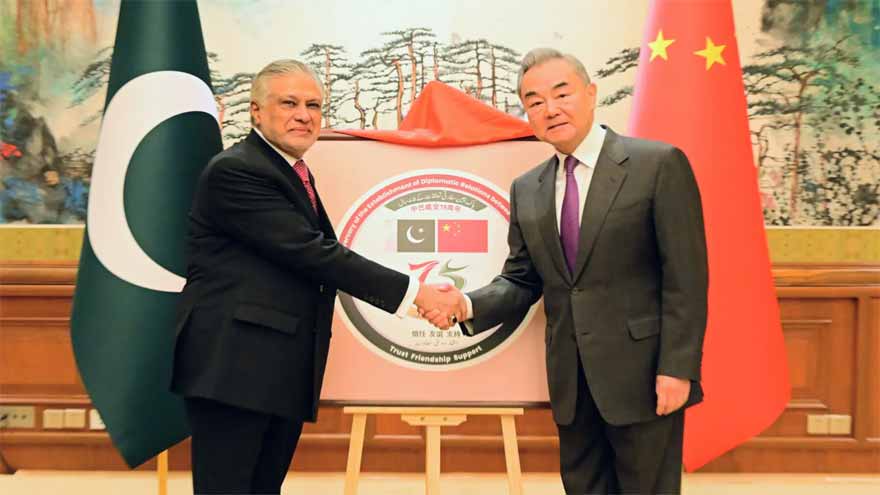
Meanwhile, Ishaq Dar and Wang Yi jointly unveiled the logo for the 75th anniversary of Pakistan-China diplomatic relations in Beijing.
FM Ishaq Dar meets Chinese counterpart, reviews regional developments
This marks the start of year-long celebrations to commemorate this historic milestone in a befitting and memorable manner.
Pakistan and China reaffirmed their shared commitment to the principles of the United Nations Charter and international law, while strongly rejecting unilateral actions and warning against any revival of fascism or militarism.
The two countries underscored the importance of a stable South Asian regional framework based on the UN Charter, international law, and universally accepted norms of international relations. They reiterated their opposition to unilateral measures and emphasized that lasting peace and stability in South Asia can only be achieved through dialogue, consultation, and the peaceful resolution of all unresolved disputes.
During the dialogue, Pakistan briefed China on the latest situation in occupied Kashmir, with China reiterating its position that the dispute should be settled peacefully in line with the UN Charter, relevant UN Security Council resolutions, and bilateral agreements.
Pakistan and China agreed to further strengthen cooperation under major international frameworks, including the Global Development Initiative, Global Security Initiative, Global Civilisation Initiative, and Global Governance Initiative. They reaffirmed their resolve to promote a fairer and more inclusive global governance system and to work together toward building a community with a shared future for humanity.
On regional and global issues, the two countries renewed their commitment to multilateralism, free trade, and the principles of the UN Charter, while opposing hegemonism, bloc politics, and actions that undermine national sovereignty.
China commended Pakistan’s role during its presidency of the UN Security Council and expressed full support for Pakistan’s upcoming rotating presidency of the SCO from 2026 to 2027.
On Palestine, both sides called for an immediate, unconditional, and lasting ceasefire in Gaza, reaffirmed support for a two-state solution with an independent Palestinian state, and pledged to work with the international community to promote peace and stability in the Middle East.