


Children of Gaza and hypocrisy of West
World
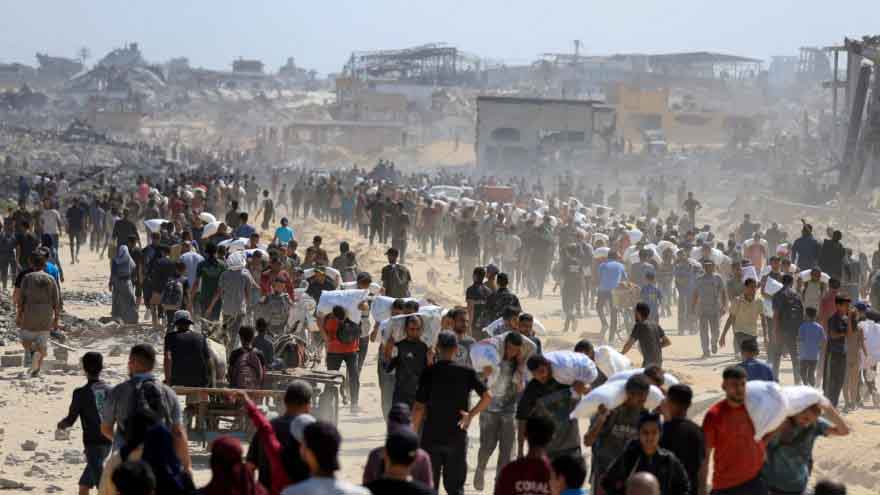
Each figure hides a face, a family, a story that will never be told again.

By Shah Nawaz
Nations don’t lose their moral center in one blinding flash. They unravel in smaller surrenders: through decisions in courtrooms, at checkpoints, in boardrooms, and on battlefields. Gaza is where that slow collapse is most visible today, seen not only in shattered buildings but in the steady erosion of our shared humanity.
For nearly two years, Gaza has lived through what no society should face: bombardments that never pause, families driven from their homes with nowhere to return, and hunger that tightens its grip each day. The toll is staggering: more than 63,000 Palestinians killed and over 160,000 wounded, according to United Nations humanitarian reports. But these are not just statistics.
Each figure hides a face, a family, a story that will never be told again.
The shocking part? None of this is hidden. The world has watched all of this in real time. Every strike is captured by satellite or phone camera. Aid agencies log every mass grave. The dead are counted, their wounds catalogued, their displacement mapped.
And still, the outrage has not been matched by consequence. Courts pass judgments, councils issue resolutions, rights groups raise alarms—but the machinery of war grinds on, seemingly untouched.
That is the bitter paradox: the crimes are recorded in detail for all to see, yet the world’s response has rarely been so hesitant. The International Court of Justice (ICJ) ordered Israel to facilitate life-saving aid and later to suspend its offensive in Rafah. Both rulings were clear. Yet the assault intensified, and convoys were blocked.
In New York, the U.N. Security Council demanded a ceasefire in Resolution 2728. On the ground, bombs fell the same night. Law, it seems, has become optional.
And still the theatre goes on. Leaders step before the cameras, voice their ‘deep concern,’ and then return to politics as usual. The performance is so hollow it borders on complicity. In Europe, a few cracks are appearing. A senior European Commission vice president has dared to call the war a genocide, proof that the word is no longer taboo in mainstream politics. But policy has not shifted. Alliances still outweigh accountability. Statements outpace consequences.
Scholars of genocide, those who study history’s darkest crimes, have moved beyond caution. The International Association of Genocide Scholars (IAGS) voted to declare that Israel’s campaign in Gaza meets the legal definition of genocide. Amnesty International has said the same. Even Israeli human rights groups, long accustomed to walking a delicate line, now speak of genocide without hesitation. They cite deliberate destruction of infrastructure, the use of starvation as a weapon, and the creation of conditions calculated to erase a people. These are not slogans but carefully weighed legal conclusions.
The siege has been waged not only with bombs and shells. It is waged with empty stomachs and barren pharmacies. In parts of Gaza, famine is no longer a distant threat; it has become a daily reality. Parents grind animal feed into flour to quiet their children’s cries. The health system, once held together by sheer determination, has finally buckled. Hospitals in the south have gone dark after repeated strikes or are drowning under wave after wave of wounded. Doctors perform amputations without anesthesia; patients die waiting for a drip bag. The territory has been transformed into a laboratory of human suffering.
Even with the evidence piled high—reports, resolutions, images from the ground—Gaza has become a mirror showing the world’s weariness. In many capitals, the killings are filed away as just another entry in a long, familiar conflict. Too many publics avert their eyes, muttering that the problem is too complex, too far away, too old. But complexity cannot excuse silence. If atrocity on this scale, visible minute by minute, is allowed to stand, then the very idea of universal rights collapses with it.
The language of geopolitics has further numbed conscience. “Security,” “deterrence,” “collateral damage”: words that sanitize the horror of a child starving, a hospital burning, a family buried under concrete. But Gaza does not speak in euphemisms. It speaks in funerals, in hunger lines, in rubble where schools once stood.
Some scholars insist that Gaza is an exception, the product of a conflict too complex to untangle. But that argument is precisely why the law exists: to draw boundaries even in war, to restrain even the angriest states, to remind us that the destruction of another people cannot buy survival. Hiding behind the excuse of complexity only deepens the betrayal. If those principles are abandoned here, they lose meaning everywhere.
And what of the silence in capitals? Perhaps the deepest wound is not the bombs but the politics. In every capital, interests are weighed like coins: Washington provides cover, Europe splits, Arab leaders weigh outrage against regime security. And all the while, Gaza buries its dead. What history will recall is not the paperwork of resolutions, but the emptiness of a world that refused to act.
The children of Gaza are now children of none. Claimed by no protector, defended by no state, they live suspended between rubble and exile, between survival and oblivion. Their existence forces a question upon us: what kind of civilization leaves its most vulnerable to die in plain view?
The answer is not found in new weapons or sharper statements. It lies in courage: courage to suspend expulsions and sieges, to open aid corridors without condition, to treat Palestinian lives with the same urgency granted elsewhere. It lies in coherence: applying the same standards of law whether the aggressor is friend or foe.
Back the same courts and humanitarian benchmarks that were invoked when Russia invaded Ukraine; the rule of law cannot be applied selectively, switched on or off depending on the passport in question. And it lies in conscience: admitting that silence, too, is a form of complicity.
If humanity collapses, it will not be with a bang but with a shrug. Gaza is where that shrug has already been rehearsed. The question now is whether we continue rehearsing indifference—or finally remember that justice, to mean anything, must belong to everyone.
