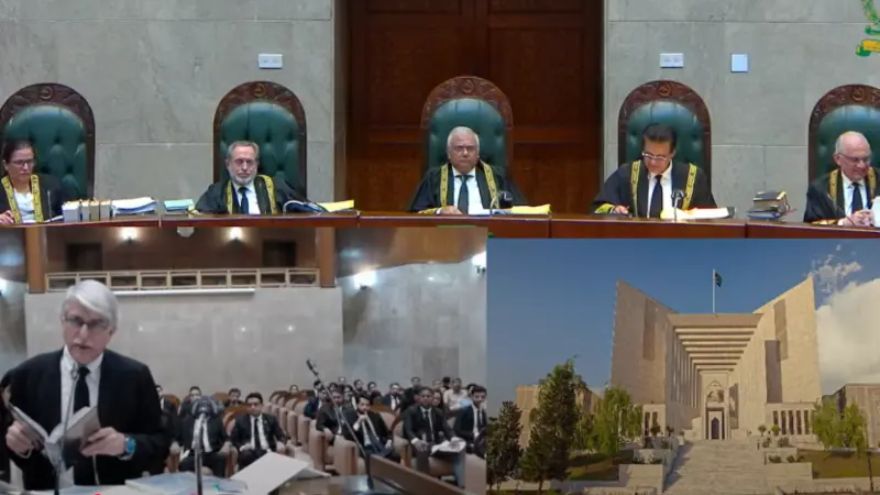
Summary Supreme Court bench debates whether the chief justice retains authority to form a full court amid hearings on petitions challenging Pakistan’s 26th Constitutional Amendment.
ISLAMABAD (Web Desk) – The Supreme Court’s Constitutional Bench (CB) on Tuesday engaged in a detailed debate on whether the Chief Justice of Pakistan (CJP) retains the authority to form a full court, as hearings continued on a series of petitions challenging the 26th Constitutional Amendment.
The amendment, passed during an overnight parliamentary session in October 2024, introduced sweeping changes to judicial appointments and the CJP’s tenure, sparking intense debate within legal and political circles.
The eight-member bench, headed by Justice Aminuddin Khan, also includes Justices Jamal Khan Mandokhail, Muhammad Ali Mazhar, Ayesha A. Malik, Syed Hasan Azhar Rizvi, Musarrat Hilali, Naeem Akhtar Afghan and Shahid Bilal Hassan. Senior lawyer and former Supreme Court Bar Association (SCBA) president Abid Shahid Zuberi argued that the CJP still holds the inherent power to form a full court, asserting that “directions can be issued for its constitution.”
Justice Aminuddin asked whether the CJP could indeed form a full court comprising all judges of the CB, while Justice Ayesha Malik observed that only the committee constituted under the Supreme Court Rules had the authority to form benches, not a full court. “The committee’s powers cannot be equated with those of the chief justice,” she remarked.
Zuberi cited past precedents, arguing that benches are constituted under Order 11 of the Supreme Court Rules 2025, and maintained that the CJP’s inherent powers remain intact. Justice Mandokhail, however, pointed out that nowhere in the new rules was it explicitly stated that the CJP alone forms benches, asking how Article 191A – which outlines the constitutional authority of the apex court – could be set aside.
26th Amendment
The 26th Amendment altered the judicial structure by setting the CJP’s tenure at three years and shifting the power of appointment to a parliamentary committee. The committee, consisting of legislators, selects the CJP from among the three most senior Supreme Court judges, forwarding the name through the prime minister to the president for final approval. The amendment also introduced constitutional benches in the Supreme Court and high courts, with the senior-most judge of each bench serving as presiding officer.
The new provisions empower the Judicial Commission of Pakistan (JCP) to assess judges’ performance annually and report to the Supreme Judicial Council. Additionally, the amendment sets a national target for the complete eradication of Riba (interest) from Pakistan by 1 January 2028.
Petitioners’ demands
The petitions, filed by several bar associations, political parties and individual lawyers – including the PTI, Jamaat-e-Islami, and seven former SCBA presidents – challenge both the process and the content of the 26th Amendment. They argue that the legislation undermines judicial independence and was passed under “procedural impropriety”, alleging that votes were coerced or obtained under duress.
Petitioners have also requested the formation of a 16-member full court, corresponding to the number of Supreme Court judges in October 2024, when the amendment was enacted. They further seek to have the Practice and Procedure Act 2024 and the Supreme Court (Number of Judges) Act 2024 struck down, claiming both derive from an “unconstitutional amendment”.
Streaming and proceedings
Tuesday’s hearing, which was live-streamed on the Supreme Court’s YouTube channel, began nearly 40 minutes late due to nationwide internet disruptions. Pakistan Telecommunications Limited attributed the connectivity issues to repairs on a submarine cable.
During the session, a brief exchange occurred between Justice Mandokhail and Justice Ayesha Malik regarding the procedure used to adopt the Supreme Court Rules 2025. Justice Mandokhail said the rules were made “in the presence of all 24 judges”, while Justice Ayesha countered that not all judges were present, noting her written objection.
Attorney General for Pakistan Mansoor Usman Awan intervened, urging that the matter not be discussed in open court as it concerned the judiciary’s internal proceedings.
As the arguments concluded, Justice Aminuddin adjourned the hearing until 11:30am on Wednesday, with the bench set to first decide whether the petitions should be heard by a full court or continue before the existing eight-member Constitutional Bench.