Summary Pakistani military spokesperson links renewed terrorism in Khyber Pakhtunkhwa to political-criminal networks and Afghan-based militants, detailing nationwide anti-terror operations and warning facilit
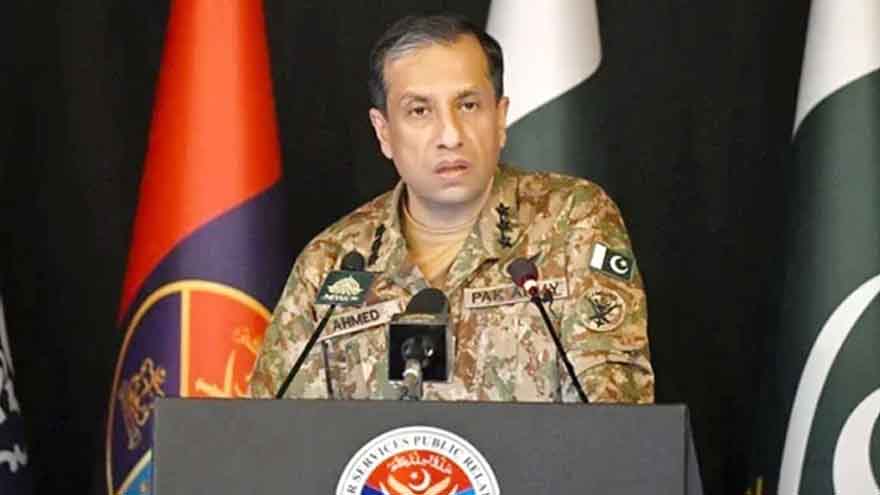
PESHAWAR (Dunya News) – Inter-Services Public Relations (ISPR) Director General Lieutenant General Ahmed Sharif Chaudhry said on Friday that terrorists and their facilitators were “deliberately provided space” in Khyber Pakhtunkhwa (KP) under a well-planned scheme, leading to a resurgence of militancy in the province.
Speaking at a press conference at the Peshawar Corps Headquarters, Lt Gen Chaudhry said a “political-criminal nexus” was responsible for the worsening security situation in KP, adding that governance gaps were being filled “with the blood of security personnel.”
The conference aimed to provide an overview of the province’s security environment and the measures taken to restore peace.
ROOTS OF RISING MILITANCY
Lt Gen Chaudhry said that five major reasons lay behind the persistence of terrorism in Pakistan: the incomplete implementation of the National Action Plan (NAP), politicisation of terrorism, India’s use of Afghanistan as a base for anti-Pakistan operations, the availability of modern weapons and safe havens to terrorists in Afghanistan, and the nexus between crime and militancy supported by local political elements.
He added that the governance crisis in KP had deepened the problem. “The people of Khyber Pakhtunkhwa are paying the price of this nexus with their blood,” he said, stressing that the state and its security institutions remained steadfast in their fight against terrorism.
According to the DG ISPR, in 2024 alone, more than 14,500 intelligence-based operations (IBOs) were conducted across KP, resulting in the killing of over 700 terrorists. During the same year, 577 people embraced martyrdom, including 272 army personnel, 140 policemen and 165 civilians.
In 2025, until mid-September, 10,115 IBOs had already been conducted, neutralising 917 terrorists. A total of 516 lives were lost in these operations – among them 311 army soldiers, 73 policemen and 132 civilians. The DG ISPR said, “The scale of our daily operations – forty intelligence-based raids a day – reflects our resolve and commitment.”
AFGHAN FACTOR AND REGIONAL SECURITY
The military spokesperson said India was exploiting Afghan territory to orchestrate terrorist activities in Pakistan. “Evidence clearly shows that Afghanistan is being used as a base of operations for terrorism in Pakistan,” he said.
He added that between 2024 and 2025, 161 Afghan nationals involved in terrorism were killed in Pakistan, while 135 foreign militants were eliminated during cross-border infiltration attempts. At least 30 of those who carried out suicide attacks in the last two years were Afghan citizens.
Lt Gen Chaudhry reiterated that Pakistan’s demand from Kabul was “rational and just” – that Afghan soil must not be used for terrorism against Pakistan. “Afghanistan is a neighbouring, Islamic country with cultural and historic ties to Pakistan, but our people’s security cannot be mortgaged to any other state,” he asserted.
He further noted that after the US withdrawal from Afghanistan in 2021, a large cache of weapons had fallen into the hands of terrorists. These arms, he said, were recovered during operations in KP.
GOVERNANCE, NAP, AND LAW ENFORCEMENT
Recalling the 2014 Army Public School attack, the DG ISPR said that the tragedy had united all political parties to devise the NAP as a national framework to combat extremism. However, he lamented that “successive governments did not implement the plan in letter and spirit.”
He disclosed that in 2021, several points from the NAP were removed, though progress had already been made on them. The current government, he added, had renamed it the “Revised National Action Plan – Vision Istehkam” but had yet to ensure full execution.
Criticising the administrative weaknesses in KP, he said that while Punjab and Sindh had maintained better governance, the KP police, despite its bravery, had been left with a force strength of just 3,200 personnel. “Is that number enough to confront terrorism?” he asked.
He also highlighted judicial gaps, saying that despite thousands of counter-terrorism cases, not a single terrorist had been convicted as of August 2025. Around 34 cases remained pending, he noted.
POLITICS AND THE NARRATIVE WAR
Lt Gen Chaudhry condemned efforts to build what he called a “misleading narrative” in favour of dialogue with terrorists. “Are we to talk to those who killed our children and played football with their heads?” he asked. “If every problem could be solved through dialogue, wars would never have taken place.”
He reiterated that “appeasement of terrorists and their facilitators is not a policy,” adding that the state would act decisively against anyone aiding foreign-backed militants. “Facilitators of terrorists have three choices: surrender them to the state, support security forces in anti-terror operations, or be ready for action themselves,” he warned.
The DG ISPR said that Pakistan’s security institutions would continue to engage with Afghanistan through diplomatic channels as well as allied nations including Saudi Arabia, the UAE, China, Turkey, and the United States to curb cross-border militancy. “Every kind of non-state actor exists in Afghanistan, from TTP to IS-K and BLA. They fight for money, not belief or ideology,” he added.
NATION’S RESOLVE
Reaffirming the resolve of the armed forces, he said, “The Pakistani nation stands united like a solid wall against terrorists and their facilitators. Our martyrs’ blood will never go in vain.”
He paid tribute to the “brave sons of Khyber Pakhtunkhwa” who, he said, had written “a glorious history of sacrifice and valour with their blood.” He concluded by saying that the armed forces would continue to perform internal security duties within the constitutional framework and ensure the safety of every citizen.