Summary How AI tools are easing the load at home for India’s women
REUTERS - Priyanshi Durbha has spent more than a decade helping companies adopt emerging technologies like AI into their workflows. But the 37-year-old Bengaluru resident says her most transformative AI moment didn't happen at work — it happened in her kitchen.
One weekend earlier this year, overwhelmed by grocery lists and the mental math of planning protein-packed meals for a marathon-running husband and a picky five-year-old, she asked ChatGPT to help her plan some meals with what she had in the pantry.
“When it threw up a tabular plan for breakfast, lunch, and dinner, I pinned it to the fridge and thought, 'I can conquer the world,'” she says.
Her experience mirrors a broader shift. India is rapidly emerging as one of the world’s fastest adopters of AI, with 92% of its skilled workforce already using AI tools at work, according to Microsoft and LinkedIn’s 2024 Work Trend Index — far ahead of the global average of 75%. The country is also OpenAI’s second-largest market, CEO Sam Altman revealed earlier this year, after the United States.
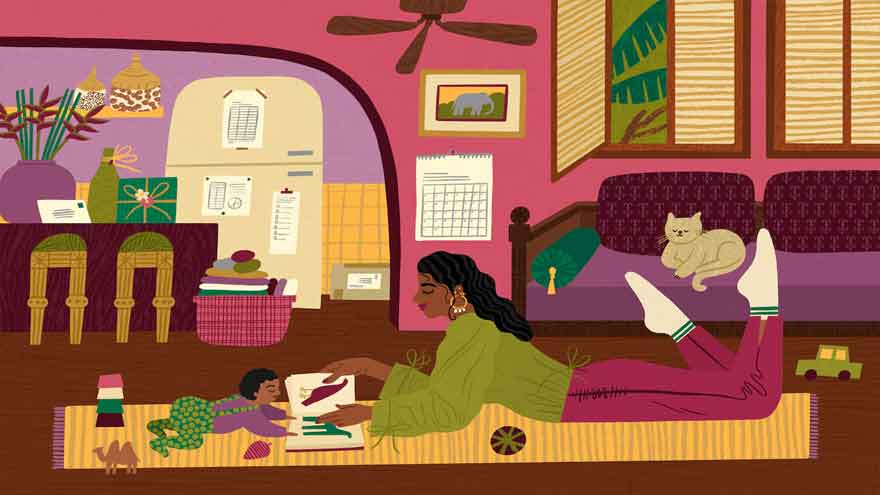
Reuters interviews with three experts and three women in cities across the country illustrate how the shift to AI is having a profound impact on India’s urban working women who — according to government data — tend to shoulder more of the household and caregiving work than their male counterparts.
“These tools have become companions, not just conveniences,” says Payal Arora, an Amsterdam-based digital cultures researcher who studies how women improvise with tech. “They help women sustain themselves in a system that still expects them to manage family, in laws, and professional work without missing a beat.”
For Stuti Agarwal, a 37-year-old Mumbai-based content creator and mother of two, the mental load felt like “having too many browser tabs open; close one, another pops up.” AI gave her a way to batch decisions: summarize a school circular, draft a polite message to a teacher, or generate a grocery to meal plan in one click.
In the north Indian city of Lucknow, Galaxy Arora Seth, a 35-year-old maternity and baby photographer, uses generative tools to plan age appropriate activities for her six year old, brainstorm branded content scripts, and calibrate balanced meals for her toddler. “I feel calmer, more creative, and more in control since using AI,” she says.
Urban Indian women turning to AI to lighten the mental load at home is a new trend, and there’s no public data tracking it yet, according to Arora. But for those women who do use AI tools at home, the technology is filling gaps that policy and social norms leave wide open. “I like ChatGPT because it doesn’t judge,” Agarwal says.
“You can tell it you’re feeling low and then ask how to bake a cake for your son’s birthday the next moment.”
Divija Bhasin, a Delhi based counseling psychologist, says outsourcing low stakes cognitive tasks can ease cumulative stress and preserve time for women, which is linked to better well-being.
But in a country as ethnically diverse as India, AI tools have their limitations. “AI can’t capture the cultural nuances of my cooking, the regional flavors and family recipes I grew up with,” Durbha says, recalling how she once prompted ChatGPT to give her recipes using leftover cucumbers, only for it to give her various salad recipes she didn’t want. “If I was not relying on ChatGPT I would have whipped up the dish my mom makes with them.”
By OpenAI’s own November assessment, AI models, including top performers like GPT-5, “still have substantial room for improvement” on tasks requiring cultural understanding in India, including food traditions and languages.
There are privacy risks, too. As Arora notes, some women often use chatbots in a quasi therapeutic way, sharing intimate details about household dynamics, children’s routines, health, or location. While India’s 2023 Digital Personal Data Protection Act gives people rights to access, correct, and erase their digital personal data and requires companies to obtain valid consent, minimize collection, and report breaches, it exempts “personal or domestic” use and relies on platforms to enforce safeguards.
“The moment you type your child's name, their school timings, or a health concern into ChatGPT, that exemption doesn't apply anymore,” Vijayant Singh, a Delhi-based data privacy lawyer, says, noting that while you may be able to gain rights to access, correct, and delete your data, "in practice, pulling information back out of a trained model can pose its own challenges."
Striking a balance between caution and curiosity when it comes to engaging with AI is the real task, says Arora. "What would be very damaging is for us to underestimate the value (AI has) for these women and disproportionately focus on the harms and risks,” she says.