Summary Dunya Group chairman says governments must be closer to citizens and businesses
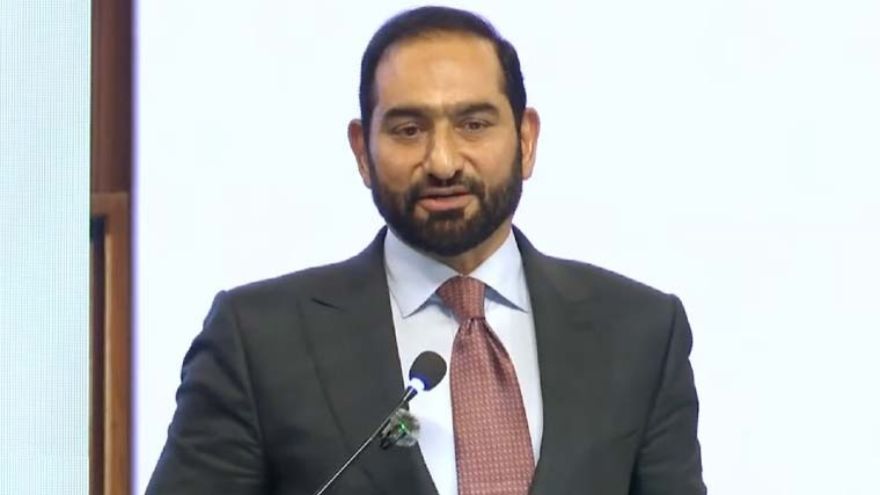
ISLAMABAD (Dunya News) – Dunya Group Chairman Mian Amer Mahmood has proposed a comprehensive restructuring of Pakistan's administrative system, including the creation of new provinces on administrative rather than ethnic grounds, arguing that the country's governance model has failed to keep pace with population growth and development needs.
Speaking at the Economic Summit 2026 in Islamabad, Mian Amer Mahmood said many of the concerns raised by the business community stem from one core issue: governments are too far removed from the people they serve. He argued that policymakers would be better placed to resolve public and business issues if governance structures brought them closer to citizens.
Opening his address with a Quranic prayer attributed to Prophet Musa (AS), Mahmood said the proposal was intended to initiate a national debate on improving governance across Pakistan.
GOVERNANCE MODEL
Mian Amer Mahmood said Pakistan has continued to operate with only four provinces since independence despite its population reaching nearly 250 million. He argued that while governments had increased the number of districts and divisions over the years, these measures had not delivered the expected improvements in governance.
Rejecting the perception that provincial boundaries cannot be altered, he noted that Pakistan had already changed provincial boundaries after independence. He cited the integration of the former princely states of Bahawalpur into Punjab, Khairpur into Sindh, Swat, Dir, Chitral and Amb into Khyber Pakhtunkhwa, and Kalat, Lasbela, Kharan and Makran into Balochistan.
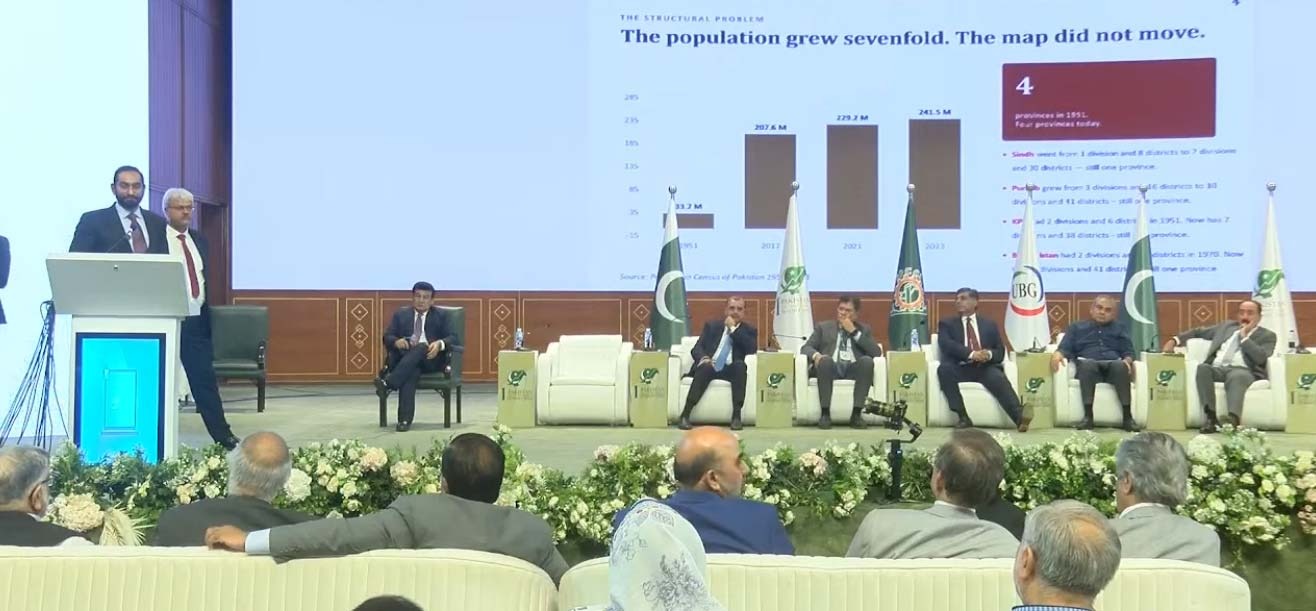
Mian Amer Mahmood said provincial boundaries should not be regarded as untouchable if reforms could improve governance, service delivery and economic performance. He also compared Pakistan's administrative structure with those of other countries, saying the average population per province in Pakistan is around 60 million, compared with around 45 million per province in China, 37 million in India and 6.6 million per state in the United States.
DEVELOPMENT CHALLENGES
Mian Amer Mahmood linked weak governance to shortcomings in education, healthcare and human development.
He said surveys showed schools located near provincial capitals and major cities generally performed better than those in remote districts. According to him, schools around Lahore, Rawalpindi, Jhelum and Chakwal were in comparatively better condition, while districts such as Rajanpur, Dera Ghazi Khan, Muzaffargarh and Rahim Yar Khan lagged behind. He said the same pattern could be seen across all four provinces.
Referring to education data presented during his address, Mian Amer Mahmood said Pakistan has around 25 million out-of-school children, describing it as the highest number in the world. He also cited survey findings which, according to him, showed that only 7 percent of Grade 3 students could read a Grade 2 text, while only 8 percent could perform basic two-digit addition. Among Grade 5 students, he said only 51.4 percent could read a Grade 3-level story.
He further stated that literacy rates stand at 66 percent in Punjab, 57 percent in Sindh, 51 percent in Khyber Pakhtunkhwa and 42 percent in Balochistan.
On healthcare, Mian Amer Mahmood said Pakistan spends around 0.8 percent of GDP on health. He noted that Pakistan and Afghanistan remain the only two countries where polio has not been eradicated. Citing provincial vaccination figures, he said immunisation coverage reaches around 80 percent of children in Punjab, 55 percent in Khyber Pakhtunkhwa, 49 percent in Sindh and only 29 percent in Balochistan.
.jpeg)
Mian Amer Mahmood also referred to neonatal mortality, poverty, pending court cases and delays in the justice system, saying these indicators reflected broader governance challenges. He reiterated the principle that "justice delayed is justice denied", arguing that an efficient judicial system is fundamental to economic activity and investment.
ADMINISTRATIVE PROPOSAL
Comparing Pakistan with other countries, Mian Amer Mahmood said the United States had expanded from 13 states to 50, while India had repeatedly reorganised its administrative structure after independence. He argued that Pakistan was among the few countries that had not significantly restructured its administrative units over the past eight decades despite rapid population growth.
He noted that several proposals for new provinces, including South Punjab (Saraiki Province), Bahawalpur, Hazara, Potohar, FATA, Karachi and a Pashtun province, had been discussed for years.
Read also: Mian Amer Mahmood calls for 33 provinces and academic vision for Pakistan's future
However, Mian Amer Mahmood said his proposal differed from those movements because it was based solely on administrative efficiency rather than ethnic or linguistic considerations. He proposed creating provinces by upgrading divisions into administrative units to improve governance and public service delivery.
Addressing concerns over the financial implications of creating new provinces, Mian Amer Mahmood claimed that the proposal would not increase government expenditure. He said calculations presented during his study suggested that, even while retaining the existing workforce and salary structure, the reforms could generate annual savings of around Rs350 billion while improving education, healthcare, infrastructure, justice and administrative efficiency.
He concluded by saying the proposal was aimed at building a governance system capable of delivering better services, strengthening institutions and supporting Pakistan's long-term economic and social development.