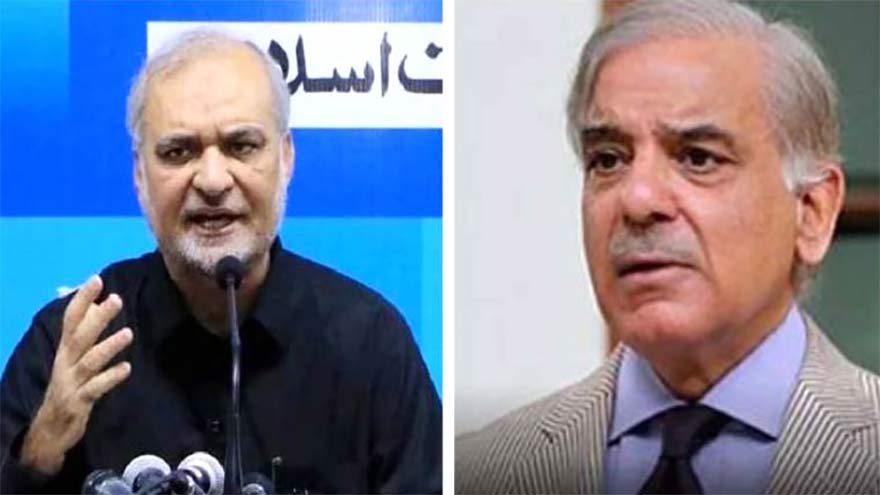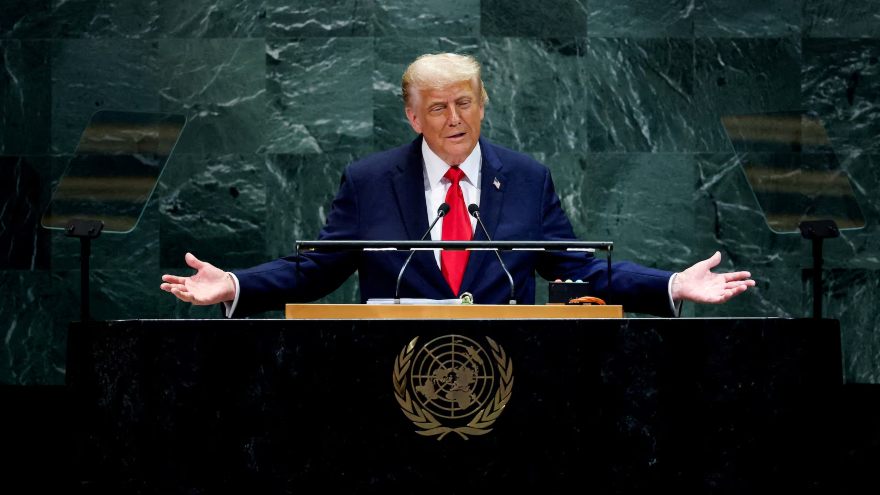
Summary PM Shehbaz Sharif is called a “terrific man” by Donald Trump at UNGA, as the US president discusses Pakistan, Iran, AI and the ICC.
NEW YORK (Agencies) – US President Donald Trump gave Prime Minister Shehbaz Sharif a special mention during his address to the United Nations General Assembly on Tuesday, calling him a “terrific man” while again claiming a role in ending the 2025 military conflict between Pakistan and India.
Trump also described Pakistan as a “great country” as he recounted what he said were eight conflicts he had helped settle since returning to office. His wide-ranging 37-minute speech focused heavily on Iran, while also covering artificial intelligence, the International Criminal Court, the United Nations and conflicts involving other countries.
“Since I took office, it has been my honour to help settle eight wars, and in so doing, become friendly with the leaders of many of those countries,” Trump said.
He listed Pakistan and India alongside Thailand and Cambodia, Armenia and Azerbaijan and the Gaza conflict, among others, saying that leaders from many of the countries had written to thank him.
“The prime minister of Pakistan — terrific man — said that Donald Trump was responsible for saving 30 million lives and probably many more than that,” Trump said.
Trump has repeatedly claimed that his intervention helped end the military escalation between Pakistan and India in May 2025. The two nuclear-armed neighbours exchanged strikes after tensions escalated in April, before a ceasefire was announced in May. Trump has since repeatedly highlighted the episode as part of his foreign-policy record.
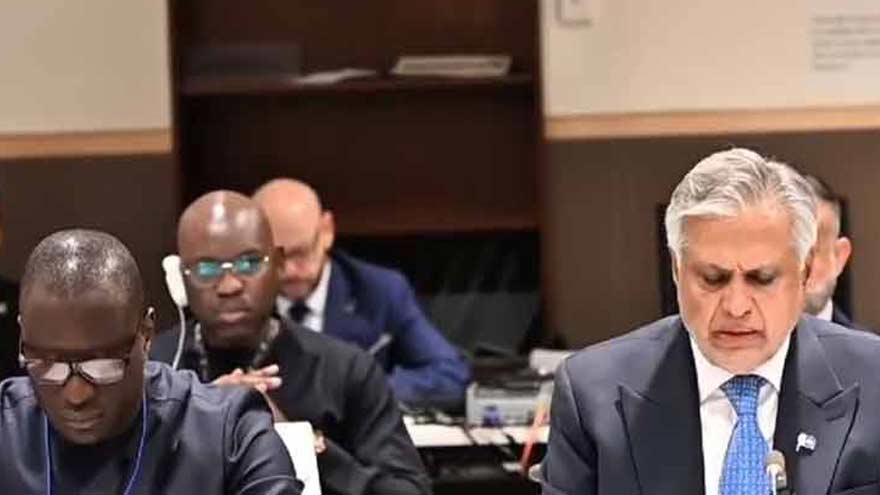
The reference came as PM Shehbaz Sharif was in New York for the 81st UN General Assembly. He is scheduled to address the General Assembly on September 25, with Pakistan expected to present its position on regional and global security, while emphasising dialogue, diplomacy and peaceful resolution of conflicts.
Iran ultimatum
Trump devoted a substantial part of his address to the conflict with Iran, arguing that US military action had prevented Tehran from obtaining a nuclear weapon.
He warned that the United States could “annihilate the Islamic Republic” if no agreement was reached to end the conflict, while predicting that a deal could be struck after the November 3 US midterm elections.
“I have a big decision to make. Will a deal be made with Iran that lets them rebuild and create a far greater country than it ever was before?” Trump asked.
“Or do I annihilate the Islamic Republic and do it quickly, never giving them a chance to kill and destroy people and countries again?”
Trump also asked whether he should “drive them into hell” with no prospect of survival or future generations, before saying he believed a deal would ultimately be reached after the election.
“I believe we’ll make a deal right after the election because it doesn’t make sense for them not to. They’re waiting to see how I do in the midterm election,” he said.
Trump called on other countries to support “complete economic isolation” of Iran and put pressure on Tehran to return to negotiations.
Iran has consistently denied seeking nuclear weapons. A senior Iranian official separately told Reuters that Tehran could reopen the Strait of Hormuz to Gulf shipping within seven days if the United States eased military pressure and lifted its blockade on Iranian ports.
The official described the UN General Assembly as a potential opportunity to revive diplomacy, while Iranian Parliament Speaker Mohammad Baqer Qalibaf said Tehran would not surrender to US pressure.
US Secretary of State Marco Rubio has said Washington remains open to talks if there is a realistic prospect of reaching a positive outcome.
ICC criticism
Trump also renewed his attack on the International Criminal Court, urging countries that are members of the tribunal to withdraw.
“The United States is equally opposed to the out-of-control institution known as the International Criminal Court,” he said.
“I call on all nations that are members of the ICC to officially resign from this rogue institution immediately.”
Trump said the United States would not allow its military personnel to be investigated by what he described as an “anti-American tribunal” with no jurisdiction over the country.
The United States is not a member of the ICC and has never ratified the Rome Statute that established the court. Washington has also imposed sanctions on ICC officials following the court's actions involving Israeli Prime Minister Benjamin Netanyahu.
Trump's comments came less than a week after a UN fact-finding mission said it had reasonable grounds to believe US forces committed war crimes in two strikes on Iran, including one that hit a primary school in the southern city of Minab. Trump rejected the authority of international institutions that he said could act as a check on US power.
AI battle
Artificial intelligence was another major theme of the address, with Trump rejecting calls for international regulation of the technology.
He described international efforts to oversee AI as a “globalist scheme” and said the US government would use the term “super intelligence” instead of “artificial intelligence” in its communications.
“It sounds much better” and “it’s much more accurate,” Trump said, while suggesting that other countries could adopt the terminology.
Trump also dismissed warnings about potential dangers from increasingly powerful AI systems, comparing such concerns with past warnings about climate change.
“Every major new technology brings challenges, and super intelligence is no exception,” he said.
Ahead of the UNGA week, leaders from more than 20 countries had called for binding safety measures for advanced AI, warning that technological development could outpace efforts to control associated risks. China and the United States are not among the signatories to that initiative.
UN Secretary-General Antonio Guterres has called on the world's leading AI powers to establish channels for dialogue, transparency and cooperation, comparing the need for communication over AI risks with strategic engagement between the United States and Soviet Union during the Cold War.
China and the United States are also discussing the creation of a communication channel for AI-related concerns as Washington and Beijing prepare for a meeting between Trump and Chinese President Xi Jinping.
Wider agenda
Trump used the remainder of his address to defend his broader foreign-policy approach and highlight conflicts and disputes involving Venezuela, Cuba and Mexico.
He described Mexico as an “epicentre of cartel violence” and said Washington was pursuing what he called a fundamental change in its approach to Cuba.
Members of the Cuban delegation walked out during his remarks on the US pressure campaign against the country.
Trump also renewed criticism of the United Nations, pointing to his administration's efforts to reduce what he described as unnecessary bureaucracy. Unlike his 2025 appearance, however, he did not announce any new moves to withdraw the United States from additional UN agencies.
The address opened a day of high-level diplomacy in New York, with Trump scheduled to meet more than a dozen world leaders as conflicts in the Middle East and Ukraine continued to shape discussions at the UN.
PM Shehbaz, meanwhile, is due to address the General Assembly on September 25 and is expected to highlight Pakistan's position on regional and global developments, including its emphasis on diplomacy, dialogue and peaceful conflict resolution.