Summary Security situation in Afghanistan is deteriorating, says Lt. General John Nicholson.
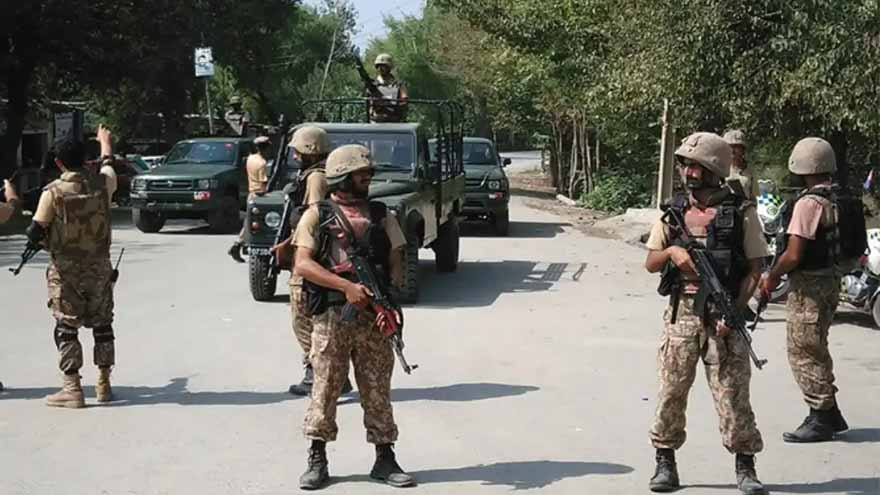
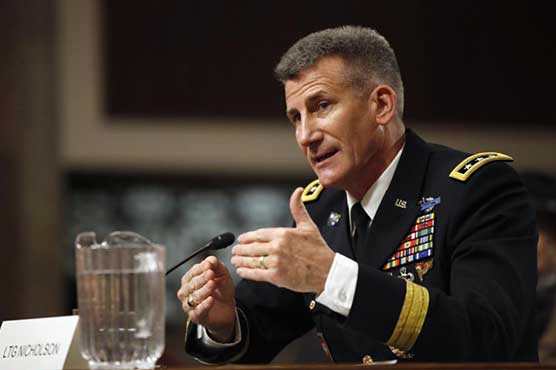
WASHINGTON (Dunya News/Agencies) – US Lieutenant General John W. "Mick" Nicholson Jr. on Thursday stated that terrorists were on the run and were entering Afghanistan after an operation against them was launched by Pakistan’s military. Addressing the members of the Senate Armed Services Committee, General Nicholson stated that security situation in Afghanistan was deteriorating.
Lt. General Nicholson stated that terrorist organizations such as Islamic State (IS) and Al-Qaeda are tyring to create hideouts in Afghanistan. General Nicholson warned that a more effective stance needs to be taken by the US.
Expressing doubt over intelligence reports on IS and escalation in Taliban’s activities, Nicholson stated that the US will not sit idly under such circumstances.
Nicholson stated that he would encourage the security forces of both Pakistan and Afghanistan so that they may mutually combat their enemies.
Nicholson stated that the security situation in the war-torn Afghanistan is deteriorating and assured senators he will do a thorough review of American troop levels needed to stabilize the nation.
He told the Senate Armed Services Committee he will have a better sense of conditions in Afghanistan within a few months if he is confirmed by the Senate.
Nicholson would succeed Gen. John F. Campbell, who is expected to retire.
There are about 9,800 U.S. troops in Afghanistan. At Campbell s urging, Obama decided last October to abandon his plan to reduce troop levels to near zero by the end of 2016. Instead, he said they would shrink to 5,500 by the end of the year. His advisers could press Obama to maintain the current level of 9,800 troops until he leaves office in January 2017.
During an exchange with Sen. Lindsey Graham, R-S.C., Nicholson said he would be concerned that the military would not be able to perform counterterrorism operations if the number of American troops fell to a hypothetical 1,000 suggested by Graham.
Nicholson said he supported the decision to retain the 9,800 American troops and he agreed with Campbell s approach. But the general also said at numerous points during the hearing that he would conduct his own assessment.
Although American forces are no longer engaged in direct action missions against the Taliban, Nicholson said he could not envision U.S. troops remaining on the sidelines if the strategic city of Kandahar were at risk. Kandahar, in southern Afghanistan, is the spiritual birthplace of the Taliban.
"We need to prevent Kandahar from falling into the hands of the Taliban," Nicholson said.
The committee chairman, Sen. John McCain, R-Ariz., opened Nicholson s confirmation hearing with a blistering assessment of Obama s handling of the war in Afghanistan and the president s adherence to a "calendar-based withdrawal."
"By now, we should have learned from the precipitous withdrawal from Iraq and the disaster that ensued that wars do not end because politicians say so," McCain said. "Nor will any politician be able to schedule an end to the threat of radical extremist terrorism emanating from Afghanistan or the region more broadly."
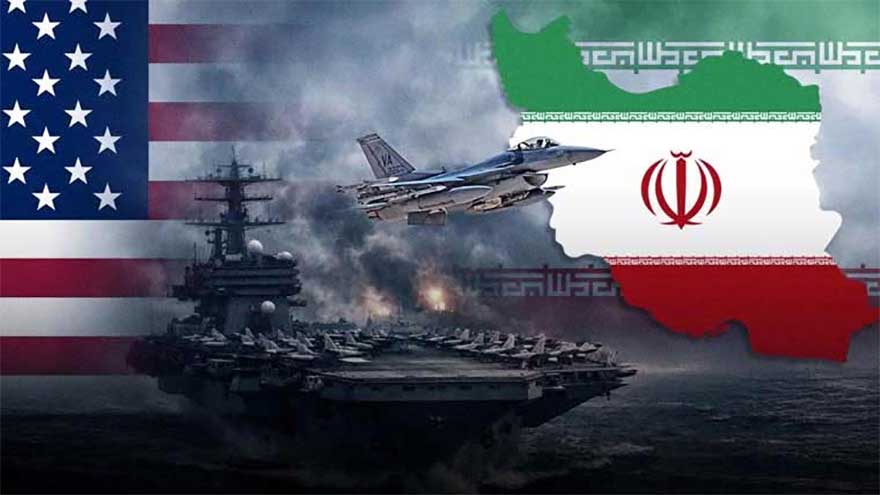
McCain prefaced a question to Nicholson about the security situation in Afghanistan with his own stark appraisal of the conditions there. He cited recent battlefield successes by the Taliban, who he said are being aided with weapons from Iran, and the presence of the Islamic State extremist group in Afghanistan.
"The view of many of us is that the security situation in Afghanistan has been deteriorating rather than improving," McCain said.
"Sir, I agree with your assessment," Nicholson said. Later, he added, "This is Afghanistan. There will always be some level of violence in Afghanistan."
Nicholson, a 1982 graduate of the U.S. Military Academy at West Point and a career infantry officer, is currently commander of NATO s Allied Land Command, headquartered at Izmir, Turkey. Among numerous tours of duty in Afghanistan starting in 2006, he served as deputy chief of staff of operations for the international military command and for U.S. forces in 2010. Before that he spent 14 months as director of the Pentagon s Afghanistan-Pakistan coordination cell.