Summary US President Barack Obama arrived in Afghanistan Sunday on a surprise visit.
BAGRAM AIR BASE (AFP) - US President Barack Obama promised a decision on post-2014 US troop numbers "fairly shortly," after he flew into the country on a surprise night time visit Sunday.
Obama is deliberating on the size of the force that will be left behind after the longest US war to continue to train Afghan forces, who will shoulder the burden of confronting the Taliban and preventing an Al-Qaeda resurgence.
Obama told the top US General in Afghanistan Joseph Dunford and the US ambassador to Kabul James Cunningham that he was facing tough decisions on the US posture after the end of the year when all combat troops pull out.
He promised an announcement "fairly shortly."
US officials said as Obama flew into Afghanistan aboard Air Force One that they believed that both candidates in Afghanistan's run-off election, Ashraf Ghani and Abdullah Abdullah, would sign a bilateral security agreement that would allow US troops to stay.
But Washington has also warned that without the agreement -- which Afghan President Hamid Karzai has refused to sign -- it may be forced to go to a "zero option" of no troops."
Obama also said that the recent first round of the Afghan election had been a success, and praised the work of building up Afghan forces. "I will be honest with you, it has gone better than I might have expected a year ago."
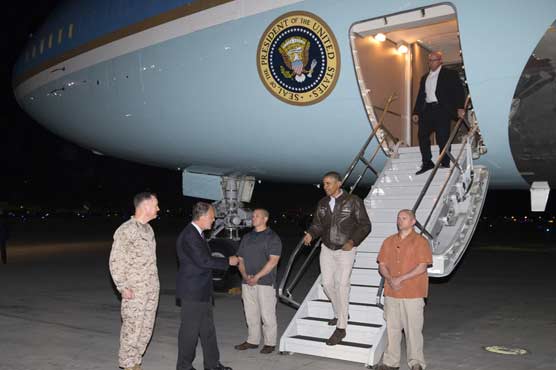
President Barack Obama swooped out of the night sky into Afghanistan Sunday on a surprise visit, to honour the sacrifices of the soldiers of America's longest war, seven months before he ends the combat mission for good.
Obama, who normally brings cities to a standstill when he moves around, slipped out of the White House and boarded a darkened Air Force One after night fell on Saturday and flew unannounced across the globe, before making a high-speed landing at Bagram Air Base outside Kabul on his fourth visit to Afghanistan as president and his first since 2012.
His trip was purely devoted to spending time with troops as the United States honours its war dead on Memorial Day on Monday.
But it also came with Obama under intense political pressure at home amid allegations that possible misconduct and poor administration in the Veterans Affairs department had left retired warriors waiting months for treatment. Some are said to have died as a result.
The president had no plans to meet outgoing Afghan President Hamid Karzai, with whom he has a tense relationship, nor Abdullah Abdullah or Ashraf Ghani, the two candidates in Afghanistan's run-off election to find his successor in June.
"We didn't want to get in the middle of election season," Ben Rhodes, a deputy US national security advisor, told reporters travelling with Obama.
No announcements were expected on the size of a possible post-war NATO training and stabilisation force for Afghanistan but Rhodes said Obama was keen to hear from his top commander on the ground, General Joseph Dunford, head of the International Security Assistance Force (ISAF) and the US ambassador to Kabul James Cunningham.
"It is important for him to come before he articulates a decision," said Rhodes.
Obama will also tour an operations centre and visit a hospital at Bagram before making a speech to US troops and civilians.
He brought along a treat from home for US soldiers -- country music star Brad Paisley traveled aboard Air Force One and will whip up the crowd before the president speaks.
- Uncertain future -
US plans to retain a small garrison in Afghanistan after 51,000 international combat troops withdraw at the end of 2014 are in limbo over Karzai's refusal to sign a bilateral security agreement governing their mission.
After months of delays and diversions, Karzai said that it should be up to Afghanistan's next president to sign the pact, as he will have to live with its implications.
The standoff deeply frustrated Washington, which has warned that it has no choice but to prepare a full withdrawal -- the so-called "zero option" -- as a contingency, even though it remains open to the idea of a residual force.
US officials also note however that both Ghani and Abdullah have indicated a willingness to sign the agreement, which defines the training and anti-terror mission of a residual US force and provides legal protections for American troops.
Afghanistan faces an uncertain future after NATO forces leave, amid an upsurge of violence and suicide bombings masterminded by the Taliban, 13 years after Washington launched its war on the Islamic movement for harbouring Al-Qaeda as it planned the September 11 attacks in 2001.
An International Crisis Group analysis earlier this month warned that "the overall trend is one of escalating violence and insurgent attacks".
The president promised to invigorate the war effort in Afghanistan when he ran for president in 2008. He surged thousands of troops into the war on a mission to disrupt, defeat and dismantle Al-Qaeda.
His administration argues that the terror group has been decimated in Afghanistan and in Pakistan border regions but earlier US hopes of rebuilding Afghanistan's society and economy fell short.
Obama has also sometimes appeared something of a reluctant warrior in Afghanistan. Former defense secretary Robert Gates wrote in his memoir "Duty" that the president had soured on his troop surge strategy launched in 2009 by early 2011 and lost confidence in his troop commanders and Karzai.
But Obama said in January that he "continued to have faith" in his Afghan strategy, and has "unwavering" confidence in the young men and women he had sent to war.
The White House took elaborate security precautions to stop word of Obama's trip from leaking out. The president ditched his normal motorcade and reporters travelling on his plane were forbidden to tell editors and family members where they headed and had phones and computer equipment sequestered by the Secret Service before they boarded the plane.