Summary Multiple lines of evidence show that water once flowed abundantly, from water-carved landscapes to minerals that could only have formed in the presence of liquid water.
(Web Desk) - Far away, alone in a crater on a planet inhabited only by robots, NASA's Perseverance rover explores a dry landscape that was once a river system billions of years ago.
According to a new discovery, however, the Jezero Delta on Mars is not the sole remnant of abundant water that once flowed across the surface.
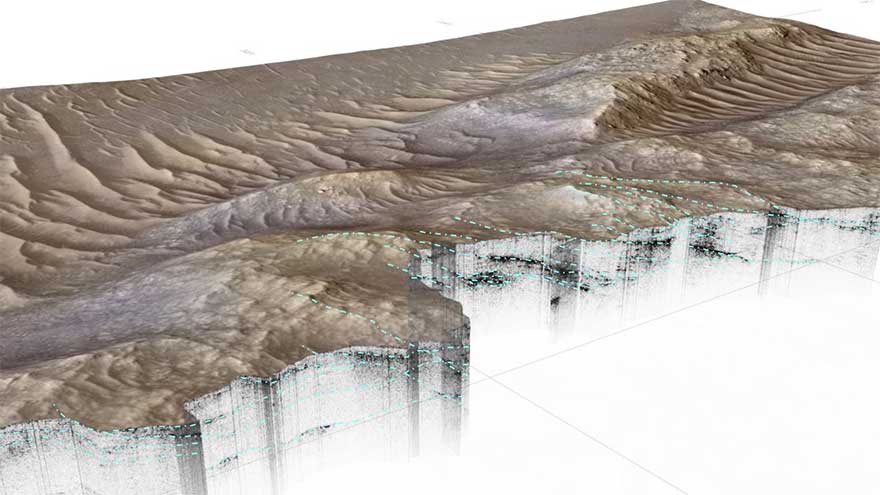
Perseverance's RIMFAX instrument has now probed deeper than ever beneath the Jezero crater, revealing a vast delta system fed by flowing water that existed long before the one the rover now explores.
In turn, this indicates that water flowed across the surface of Mars for much longer than the surface alone implies – a finding with important implications for the planet's past habitability.
"Overall, RIMFAX elucidates a broader fluvial system than what was observed from orbit, and indicates an extended window of fluvial deposition, aqueous alteration, and habitable conditions than previously envisioned at Jezero crater," geomicrobiologist Emily Cardarelli of the University of California, Los Angeles told ScienceAlert.
"RIMFAX has revealed an earlier subsurface deltaic environment under the present-day delta, thereby extending the period of potential habitability for Jezero back further in time."
After many years of dedicated exploration, it has become clear that Mars wasn't always the arid, rusty dustball of a planet it is today.
Multiple lines of evidence show that water once flowed abundantly, from water-carved landscapes to minerals that could only have formed in the presence of liquid water.
This raises other questions. One of the most pressing for habitability is how long liquid water persisted on the surface of Mars.
A longer timespan offers a larger window for the emergence of microbes that scientists think are the most likely form of life that could have existed on Mars.