Summary Even more harrowing than pondering the distance from now to 1985 is recalling the flying-car future of the 1989 sequel.
NEW YORK (AP) — Michael J. Fox has been living with “Back to the Future” for a long time.
“I’ll be on the street and some kid will go, ‘There’s Marty McFly!’” Fox says. “No, this is an old man.”
It’s been 40 years since “Back to the Future” debuted in theaters, but neither time, nor Parkinson’s disease has done much — regardless of what he says — to diminish Fox’s boyish good nature. For Fox, traveling through time with “Back to the Future” has been part of life. It’s the film that strapped a flux capacitor to his career and has, ever since, stayed in his rear view.
“Sometimes I look at it and think about my family,” Fox, 64, said in a recent interview by Zoom from his apartment in New York. “I think about how I have a 37-year-old son who wasn’t born yet. It’s a long time ago.”
On Friday, “Back to the Future” is, again, back in theaters. The anniversary celebration also includes a new 4K trilogy gift set that comes complete with an OUTATIME license plate. Fox, himself, has just released “Future Boy: ‘Back to the Future’ and My Journey Through the Space-Time Continuum,” a book he penned with Nelle Fortenberry.
While anniversary re-releases are commonplace for cherished classics, the occasion is a little different for Robert Zemeckis’ sci-fi landmark. On the one hand, the movie’s turn-back-the-clock nostalgia is indelibly linked to its 1980s moment. After its release on July 3, 1985, “Back to the Future” was the No. 1 movie in theaters for 11 of its first 12 weeks. Then-President Ronald Reagan was among its biggest fans.
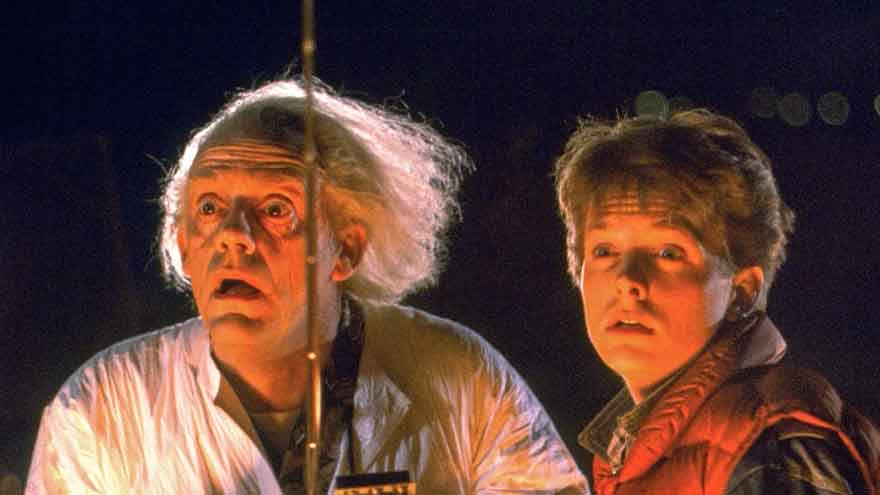
But what was once so firmly lodged in the space-time continuum has, over the years, turned curiously timeless. Watch “Back to the Future” now and you might be astonished at how effects-free most of it is, despite its director’s predilection for pushing film technology. Instead, “Back to the Future” conjures its magic with a DeLorean, some Calvin Klein briefs and its most special effect: Christopher Lloyd’s eyebrows.
“The distance between now and 1985 is greater than the distance between 1985 and 1955,” Fox says. “In a way, that makes it more accessible. People aren’t locked into their time period. They’re not saying: This is real, this isn’t real. It’s all fantasy.”
Even more harrowing than pondering the distance from now to 1985 is recalling the flying-car future of the 1989 sequel. That movie was set in the faraway time of 2015. Say it with me now: Doc, this is heavy.