


Army officer faces discharge over Afghanistan accusations
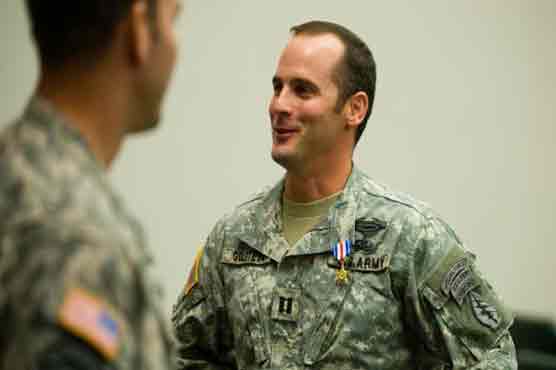
In February, the Army initiated the process to kick Golsteyn out of the active-duty military.
RALEIGH, North Carolina (AP) - An Army officer stripped of a medal for heroism under fire is fighting for his military career after accusations he tracked down and killed a suspected bomb-maker in Afghanistan.
Though a criminal investigation failed to find remains of his alleged victim and didn t result in charges against Maj. Mathew Golsteyn, he s been targeted for possible dismissal from the Army with a less-than-honorable discharge.
A hearing before three, higher-ranked Special Forces officers could meet later this month to weigh arguments from Golsteyn s attorney why he should remain on active duty.
"My hope is that Golsteyn will receive a fair and impartial hearing. Based on the Army s actions and decisions thus far, I regret to say this won t be the case," one of the soldier s defenders, U.S. Rep. Duncan Hunter, wrote Wednesday to Army Secretary John McHugh.
Others believe the Army is obligated to act because the Geneva Conventions governing warfare forbid arbitrary killings by troops, said Jeffrey K. Walker, a St. John s University criminal law professor.
Golsteyn s military career from battlefield hero to whispers of a war crime is rooted in the deadly month of February 2010, when American-led allied forces seized the Taliban stronghold of Marjah in Afghanistan s Helmand province.
Insurgent snipers unleashed fire on Forward Operating Base McQueary. A patrol of about 80 troops headed out across poppy fields to find the gunmen. Over a four-hour firefight, Golsteyn repeatedly exposed himself to enemy fire as he helped evacuate a wounded Afghan soldier, according to the Army s narrative of why he was awarded a Silver Star medal.
Then, about two months before being promoted from captain to major in November 2011, he had an interview with the CIA. He talked about something he d done during the 2010 deployment before the battle near Marjah.
Golsteyn "claimed to have captured and shot and buried a suspected IED bomb maker. He further went to comment that he went back out with two others to cremate the body and dispose of the remains," according to a memo summarizing the case. "Capt. Golsteyn stated that he knew it was illegal but was not remorseful as he had solid intelligence and his actions protected the safety of his fellow teammates."
The Army s Criminal Investigative Division, acting on the CIA s tip, could find no one who corroborated Golsteyn s claim to have hunted the bomb-maker after an attack that killed two Marines. Nor could they find any cremated remains of the Afghan.
Despite that, investigators said "Golsteyn committed the offenses of murder and conspiracy based on the interview provided by the CIA," according to the Sept. 29 memo first published by the web site The Intercept. Lt. Col. Christopher Kasker, a spokesman for McHugh, confirmed the memo is authentic.
But the American legal system requires witnesses, a body or some evidence that a crime occurred, Walker said, so Golsteyn s statement isn t enough to prosecute him.
In February, the Army initiated the process to kick Golsteyn out of the active-duty military.
Army regulations for discharging officers list potential reasons as substandard performance, national security interests, misconduct, moral or professional dereliction, or "derogatory information contained in the officer s records combined with other known deficiencies." Army Special Forces Command spokeswoman Maj. Allison Aguilar said she was barred from describing which reasons were given in Golsteyn s case.
An inquiry board is scheduled to decide whether Golsteyn can stay in the Army or be discharged, and whether a discharge would be honorable or something less.
Golsteyn s lawyer, Phillip Stackhouse, said the soldier is simultaneously being evaluated for medical retirement due to combat-related spine and "mental health issues." But the inquiry board s decision and potential discharge "could eviscerate the retirement," Stackhouse said.
