Summary Barely two months later, Rahman is widely seen as the front-runner in Thursday’s election. He restated his ambitions at a campaign rally in Dhaka on Monday, arriving at the podium under heavy security
DHAKA, Bangladesh (AP) — When Tarique Rahman, the son of a former prime minister of Bangladesh, returned to the country in December after 17 years of self-imposed exile, he declared to his supporters: “I have a plan.”
Rahman returned at a time of upheaval. Bangladesh was seemingly adrift under an interim administration as it inched closer to a nationwide poll. Many Bangladeshis felt his return offered the country a new chance. His fiercest rival, the former Prime Minister Sheikh Hasina, would be absent from the election after being toppled by a violent student-led revolt in 2024.
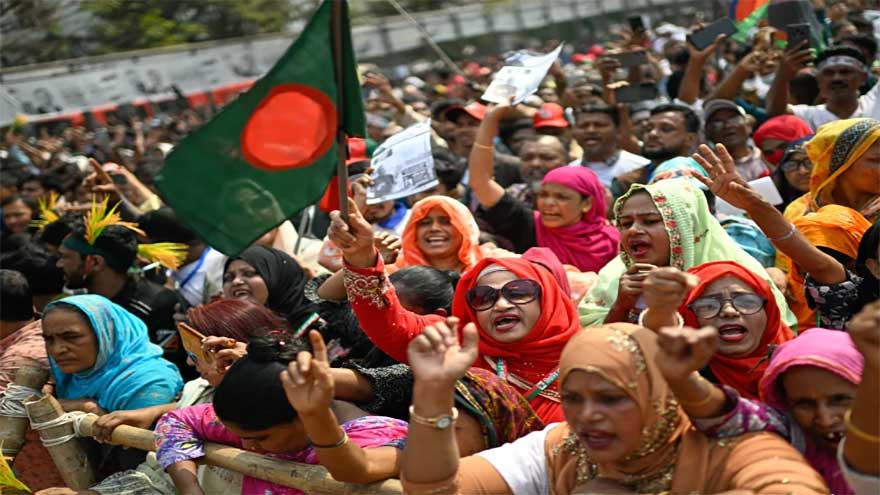
Barely two months later, Rahman is widely seen as the front-runner in Thursday’s election. He restated his ambitions at a campaign rally in Dhaka on Monday, arriving at the podium under heavy security as supporters spilled into a public park, dancing and cheering.
“The main goal and objective of this plan is to change the fate of the people and of this country,” he told the crowd.
That task will not be easy for whoever wins.
The election in Bangladesh follows a tumultuous period that has been marked by mob violence, rising religious intolerance, attacks on the press, the rise of Islamists and the fraying of the rule of law. A fair election will be a major challenge. Governing in its aftermath may prove an even sterner test for democratic institutions weakened by more than a decade of disputed polls and shrinking political space.
Election will be a two-way contest
Tarique Rahman, the son of former Prime Minister Khaleda Zia and chairman of the Bangladesh Nationalist Party (BNP), attends an election rally ahead of national election in Dhaka, Bangladesh, on Feb. 8, 2026. (AP Photo/Anupam Nath)
“An election with relatively little violence in which people are able to vote freely and all sides accept the outcome would be a significant step forward,” said Thomas Kean of the International Crisis Group, a think tank devoted to resolving conflicts. Yet he cautioned that the restoration of democracy, after facing severe strains under Hasina’s rule, would be a long-term challenge.
That process, Kean said, has “only just started.”
Rahman — the 60-year-old son of former Prime Minister Khaleda Zia — has been promising job creation, greater freedom of speech, law and order, and an end to corruption. His campaign seeks to portray him as a bulwark of democracy in a political landscape long dominated by entrenched parties, military coups and vote rigging.
Though Rahman never held office in his mother’s governments, many Bangladeshis saw him as wielding considerable influence within her Bangladesh Nationalist Party until her death in December.
BNP’s main opponent is an 11-party coalition led by Jamaat-e-Islami, the country’s foremost Islamist party, still shadowed by its collaboration with Pakistan during the 1971 war of independence. On Monday, its chief Shafiqur Rahman told supporters at a rally that the alliance has come together “with the dream of building a new Bangladesh.”
With Hasina’s Awami League party absent from the poll and calling on its supporters to stay away, Jamaat-e-Islami is seeking to expand its reach. The conservative party claims it would govern with restraint if elected to power, but its ascent has sparked unease, particularly over its views on women. The party chief has said women are biologically weaker than men and should not work eight hours a day like men, raising fears it could restrict the fundamental rights of women.