Summary African nations and institutions have strongly reacted to the capture of Venezuela's leader Nicolas Maduro by the United States at the weekend.
ABUJA, Nigeria (AFP) - African nations and institutions have strongly reacted to the capture of Venezuela's leader Nicolas Maduro by the United States at the weekend, calling for respect of international law and sovereignty.
The African Union said in a statement it would be "following with grave concern the recent developments in the Bolivarian Republic of Venezuela, including reports of the abduction of the President of the Republic, Nicolas Maduro, and military attacks on Venezuelan institutions."
It also reaffirmed its steadfast commitment to the fundamental principles of international law, including respect for the sovereignty of States, their territorial integrity, and the right of peoples to self-determination, as enshrined in the Charter of the United Nations.
In a statement released Sunday evening, the Economic Community of West African States (Ecowas) denounced the situation without directly attacking the United States.
It wrote that it "recognises the right of states to combat international crimes, including terrorism and drug trafficking," arguments invoked by US President Donald Trump to justify the kidnapping of the Venezuelan president, but reminded "the international community of its obligation to respect the sovereignty and territorial integrity of each member state".
Ecowas echoed the African Union's call for "inclusive political dialogue among Venezuelans themselves."
The UN Security Council has said it will hold an emergency session on Monday at Venezuela's request.
Individually, heads of states and foreign ministers also reacted to show support to Venezuelans and their right to sovereignty.
CLEAR VIOLATION OF THE UN CHARTER
South Africa took a firm stance, with Pretoria pointing to a clear violation of the UN Charter.
"History has repeatedly demonstrated that military invasions against sovereign states only produce instability and exacerbate crises," the government said, adding that "the illegal and unilateral use of force […] undermines the stability of the international order."
South Africa has reiterated that international law does not authorise external military intervention in the internal affairs of a sovereign state. It calls on the Security Council to convene urgently alongside Venezuela.
Namibia took a similarly firm line, expressing its "deep shock" at the "violation of Venezuela's sovereignty and international law," and reaffirming its "solidarity" with Venezuela, based on "a shared history of anti-colonial struggle for self-determination and independence." Namibia added it supports all multilateral initiatives to ensure respect for international law and the sovereignty of nations.
Ghana expressed its "strong reservations against the unilateral use of force" and condemned the statements by Trump, after he announced that the United States intended to govern Venezuela and exploit its oil during a transitional period.
These statements are reminiscent of "the colonial and imperialist era," Accra declared. "They set a dangerous precedent for the world order. Such colonial ambitions have no place in the post-World War II era." Ghana advocates for "immediate de-escalation and the release of President Maduro and his wife."
Chad's Foreign Minister indicated that he had spoken with his Venezuelan counterpart on Saturday, before expressing "Chad's commitment to respecting international law, on which the existence of a just world order depends" and "the importance of preserving the peace, stability and territorial integrity of Venezuela".
REJECTION OF FOREIGN INTERFERENCE
Meanwhile, the Venezuelan Foreign Minister Ivan Gilles said he has held numerous discussions with African leaders, and had received messages of solidarity from Namibia, Burkina Faso and Liberia, whose foreign minister assured that her country, a non-permanent member of the Security Council, will demand action and condemnation of the 3 January attacks.
Caracas also said it has spoken with the foreign ministers of Chad, Angola, Niger, and The Gambia, who are committed to respecting the UN Charter and rejecting any foreign interference.
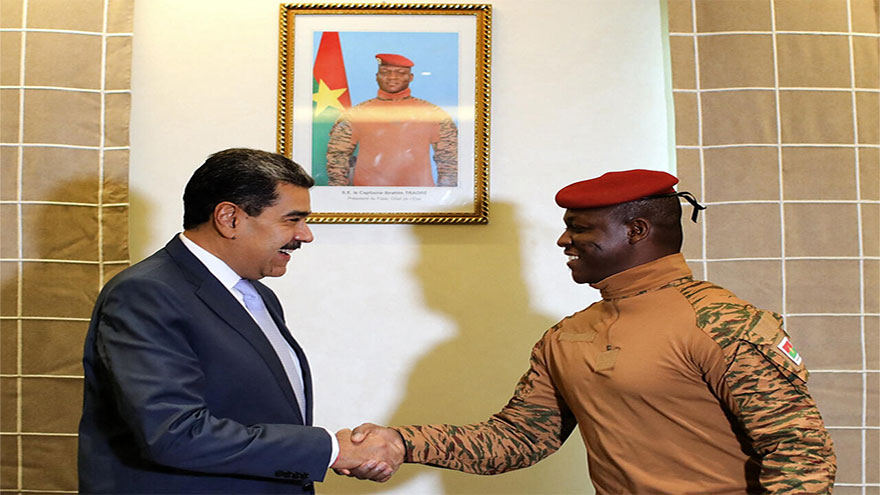
So far there hav been no official statement from the Sahel authorities of Mali, Niger, or Burkina Faso. The Malian, Nigerien and Burkinabe juntas maintain excellent relations with the regime of Nicolas Maduro.
When questioned by RFI's regional correspondent Serge Daniel, a Nigerien official responded: "We are consulting with each other because, in matters of foreign policy, the AES countries speak with one voice."
Daniel added that observers believe that the three countries are currently playing it safe in the face of this new situation, since Trump recently stated: "What happened to Maduro could happen to others."