


A father returns from Israeli detention to find Gaza and his family shattered
World
A father returns from Israeli detention to find Gaza and his family shattered

DEIR AL-BALAH, Gaza Strip (AP) — Amid the joy of being released after 20 months of suffering in Israeli prisons, Mohammed Abu Moussa could tell something was wrong.
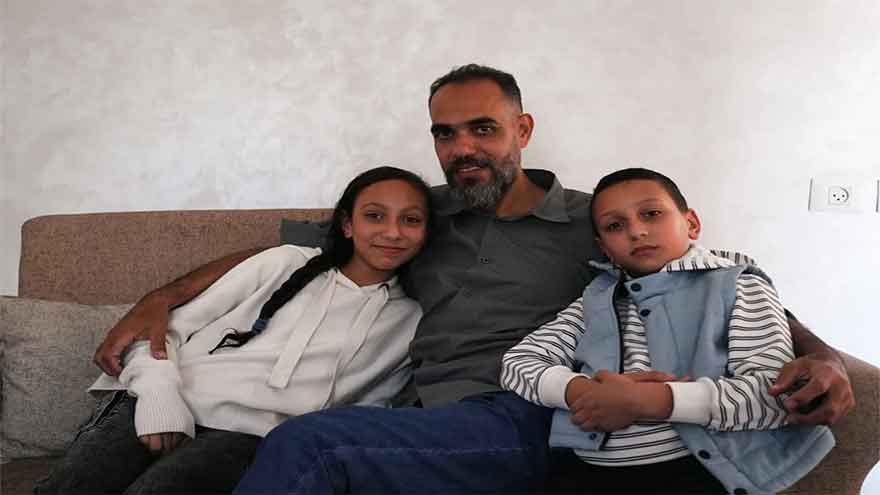
Descending from the bus that brought him and other released Palestinian detainees to Gaza last week, the 45-year-old medical technician was reunited with his wife and two young children. But when he asked about his mother, his brother wouldn’t look him the eye.
Finally they sat him down and told him: His mother, his younger sister Aya, Aya’s children and his aunt and uncle had all been killed by an Israeli airstrike that hit their shelter in central Gaza in July.
More than 1,800 Palestinians seized from Gaza by Israeli troops during the two-year war were freed this week under the ceasefire deal that brought Hamas’ release of the last living hostages. Israel also freed around 250 Palestinian prisoners convicted over the past decades, who mainly returned to the occupied West Bank or were exiled abroad, though a few were sent to Gaza.
Those released back to Gaza were met by the shock of how their homeland had been destroyed and families shattered by Israeli bombardment and offensives while they were locked away, with little news of the war.
Recounting his return, Abou Moussa said the grief hit even before the freed detainees got off the bus on Monday. Some shouted out the bus windows to people they knew in the cheering crowd welcoming them and asked about brothers, mothers and fathers.
Abu Moussa suffered his first loss soon after Israel launched its campaign aiming to destroy Hamas after the militants’ Oct. 7, 2023, attack on Israel.
Eight days later, an airstrike hit his family’s home in the city of Khan Younis in southern Gaza, while he was on duty in Nasser Hospital, where he worked as a radiology technician. Video circulating online at the time showed him and his wife, Rawan Salha, rushing around the hospital in search of their son, Youssef, among the casualties. “He’s 7 years old, curly hair, fair-skinned and beautiful,” Salha cried.
The boy had been brought in dead. Also killed in the strike were the wife of one of Abu Moussa’s brothers and their two children.
In the next months, Abu Moussa worked constantly as wounded flowed into the hospital, where Salha and his two surviving children were also sheltering along with hundreds of others driven from their homes. In February 2024, Israeli forces surrounded the hospital, preparing to storm the facility to search for suspected militants. They demanded everybody leave but staff and patients too critical to move.
But Salha refused to leave without Abu Moussa, he said. So they set out walking with their children. At a nearby Israeli military checkpoint, Abu Moussa was called aside with others for interrogation in a nearby stadium.
It was the start of his long separation from his family.
Abu Moussa says his months in Israeli prisons were filled with abuse. Like the other detainees released back to Gaza on Monday, he was never charged.
It began in the stadium, where he said he was beaten with sticks and fists during interrogation. All those taken from the checkpoint were kept with their hands bound in zip ties for three days, given no water and not allowed to use a bathroom. “Almost all of us soiled ourselves,” Abu Moussa said.
He was taken to Sde Teiman, a military prison camp inside Israel, where he would be held two months. Every day, he said, detainees were forced to kneel for hours without moving – “it’s exhausting, you feel your back is broken,” he said. Guards would pull some aside for beatings, said Abu Moussa, adding that his rib was broken in one beating.
He was moved to Negev Prison, run by civilian authorities. There, he said, beatings were less frequent, taking place mainly when guards conducted weekly searches of the cells, he said.
But conditions were harsh, he said. Nearly all the detainees had scabies, an infestation by mites that dig into the skin. “People were rubbing themselves up against the walls trying to get rid of the itching,” he said. Despite requests, prison officials did not give detainees creams to treat it until a few weeks before his release, he said.
Bedding was filthy, and detainees were allowed no change of clothes. Cuts often became infected, he said. When they washed their one set of clothing, they had to strip naked and wrap themselves in a blanket – but if guards saw, “they took away the blanket and made you sleep without it,” he said.
Sick detainees or those with chronic conditions asked for medicines but were refused, he said. One man, Mohammed al-Astal, suffered a colon blockage that worsened and he eventually died, Abu Moussa said.
“They treated us like animals,” he said.
Asked about Abou Moussa’s account, the Israeli Prison Service, which operates Negev Prison, said it was not aware of it. It said it operates in accordance with the law and that prisoners’ rights to medical care and proper living conditions are upheld.
