



Officer who shot Michael Brown resigns in Ferguson
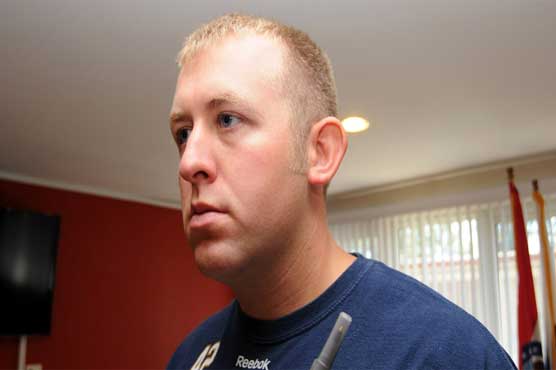
White officer, who shot Michael Brown, resigned from his job with the Ferguson Police Department.
FERGUSON (AP) - A white officer resigned from his job with the Ferguson Police Department after learning of threats of violence against other officers and the department, his lawyer said Sunday.
Darren Wilson, a 28-year-old white officer, had been on administrative leave since Aug. 9, when he shot and killed 18-year-old Michael Brown, who was black and unarmed. A grand jury decision not to indict Wilson was announced Monday night, setting off protests in the predominantly black St. Louis suburb of 20,000 residents that included looting, violence and fires that destroyed about a dozen businesses in the Ferguson area. The announcement also led to weeklong protests nationwide.
Wilson s attorney, Neil Bruntrager, told The Associated Press that Wilson decided to step aside after Ferguson Police Chief Tom Jackson personally told him of the threats. Bruntrager declined to go into detail about the alleged threats, and Jackson, didn t immediately respond to a voicemail and email seeking comment.
"The information we had was that there would be actions targeting the Ferguson (police) department or buildings in Ferguson related to the police department," Bruntrager said. He said Wilson and the city were already discussing an exit strategy, acknowledging that staying on as an officer there would be impossible.
Once Wilson learned of the threats, Bruntrager said, he decided to go ahead and resign.
"Under the circumstances, nothing else was important other than safety," Bruntrager said.
Wilson, who had been with the department for less than three years, told the St. Louis Post-Dispatch on Saturday, "I m not willing to let someone else get hurt because of me."
Ferguson s mayor said Sunday that Wilson did not receive any severance package when he resigned. Wilson won t receive any further pay or benefits, and he and the city have severed their ties, Mayor James Knowles told reporters a day after Wilson tendered his resignation, effective immediately.
When asked Sunday whether there were any changes planned in Ferguson s leadership, Knowles said there were not.
Many critics of how the Brown case has been handled have called on Jackson to resign, but the police chief told reporters that he doesn t intend to do so.
Earlier Sunday, Benjamin Crump, an attorney for Brown s family, said Wilson s resignation was not a surprise.
"It was always believed that the police officer would do what was in his best interest, both personally and professionally," Crump said. "We didn t believe that he would be able to be effective for the Ferguson community nor the Ferguson Police Department because of the tragic circumstances that claimed the life of Michael Brown Jr."
Crump said the family is still considering civil litigation such as a wrongful death lawsuit, "but don t let that get confused with the fact that they really wanted the killer of their child to be held accountable."
Brown s parents were attending a church service Sunday where a leading civil rights activist, the Rev. Al Sharpton, was scheduled to preach.
Wilson s resignation meant little to activists and protesters.
On Saturday night, more than 100 protesters gathered near Ferguson police headquarters, where they were outnumbered by officers. Two people were arrested. Another protester burned an American flag. By midnight, only about two dozen protesters remained. Many seemed unfazed by Wilson s resignation. Several merely shrugged their shoulders when asked what they thought.
Wilson fatally shot Brown in the middle of a Ferguson street after the two scuffled inside Wilson s police SUV. Brown s body was left for more than four hours as police investigated and angry onlookers gathered.
Some witnesses have said Brown had his hands up when Wilson shot him. Wilson told the grand jury that he feared for his life when Brown hit him and reached for his gun.
In the days after the shooting, tense and sometimes violent protests occurred in and around Ferguson, a predominantly black community patrolled by a mostly white police force. Missouri Gov. Jay Nixon called in the National Guard to help.
It isn t clear what the future holds for Wilson, who has spent his adult life in police work and never wanted to do anything else, Bruntrager said.
"In terms of what it (the resignation) means, it means at this point he doesn t have a paycheck," Bruntrager said. "He has no income so he ll have to make some decisions pretty quickly."
