


Narendra Modi takes oath as 15th Prime Minister of India
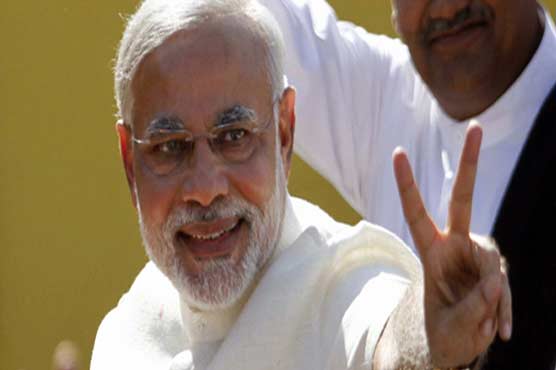
Pakistan's PM Nawaz Sharif and leaders of other South Asian countries attended the ceremony.
NEW DELHI (AFP/ Web Desk) - Hindu nationalist Narendra Modi on Monday took oath as 15th Prime Minister of India.
Indian President Pranab Mukherjee administered the oath of office and secrecy to Narendra Modi and his Council of Ministers in the presence of a host of leaders, including outgoing Prime Minister Manmohan Singh, Congress president Sonia Gandhi and party vice president Rahul Gandhi, besides leaders of various other parties and Chief Ministers of a number of states.
Pakistan’s Prime Minister Nawaz Sharif attended the ceremony on the special invitation by Narendra Modi.
Besides Sharif, Sri Lankan President Rajapaksa, Afghanistan President Hamid Karzai, Bhutan Prime Minister Tshering Tobgay, Nepal Prime Minister Sushil Koirala and Maldivian President Abdulla Yameen Abdul Gayoom were among the foreign dignitaries attending the ceremony.
Bangladesh was represented by Speaker Shirin Chaudhury as Premier Sheikh Hasina would be traveling to Japan at the time of the swearing-in ceremony.
This is the first time that the heads of states of SAARC nations have been invited to attend the swearing-in ceremony of the Indian Prime Minister.
Narendra Modi, the 63-year-old hardliner, won a landslide election victory, handing him a powerful mandate to revive India's stagnant economy and implement more assertive foreign policy after 10 years of left-leaning Congress party rule.
Modi, leader of the right-wing Bharatiya Janata Party, invited Pakistani counterpart Nawaz Sharif to Monday's ceremony in a first bold step aimed at mending strained ties between the nuclear-armed neighbours.
Sharif, who has hailed Modi's "impressive victory", accepted the invite which was extended to all heads of government from the South Asian Association for Regional Cooperation (SAARC) which includes Pakistan.
"Great having leaders from SAARC nations & Mauritius join us during the ceremony. Their presence will make the occasion more memorable," Modi said in a tweet on Sunday.
Modi, the son of a tea-stall owner, secured the biggest majority in 30 years at the election, trouncing the scandal-plagued Congress on a promise of reviving manufacturing and investment to create millions of jobs.
His pledge to overhaul the flagging economy won over voters, along with his rags-to-riches story and reputation as a clean and efficient chief minister of prosperous western Gujarat state.
Critics claimed Modi would favour the Hindu majority at the expense of the country's 150 million Muslims and other religious minorities, but the warnings failed to dent his rise.
Many Muslims remain deeply suspicious of Modi, who is tainted by communal riots in Gujarat in 2002 that killed more than 1,000 people, mostly Muslims. Modi has denied he failed to stop the bloodshed and a court investigation found he had no case to answer.
Ordinary Indians and business leaders have sky-high expectations of what Modi will deliver in a chaotic and still poor country that is home to a sixth of humanity. With the economy growing at under five percent, analysts warn bold reforms are needed.
In a rare sign of emotion last week, Modi choked back tears as he promised to try to live up to the expectations of all Indians including "our weakest and poorest" during a speech in parliament.
Modi and his yet-to-be-announced cabinet will be sworn in at the Rashtrapati Bhavan or president's mansion in New Delhi amid tight security in a ceremony starting at 6pm (1230 GMT) with 3,000 guests.
Along with Sharif, other national leaders attending include Afghanistan's outgoing President Hamid Karzai, Sri Lankan President Mahinda Rajapakse and Nepal Prime Minister Sushil Koirala.
Modi will hold bilateral talks with Sharif on Tuesday with hopes the two can thaw ties and even take steps towards improving trade.
India and Pakistan have fought three wars since independence in 1947 and bilateral ties broke down after the 2008 attacks by Pakistani gunmen on Mumbai in which 166 people were killed.
Relations warmed slightly toward the end of the term of outgoing Prime Minister Manmohan Singh but still remain frosty, with mutual distrust and regular skirmishes along their disputed Kashmir border.
Sharif has cited his working relationship with Atal Bihari Vajpayee, India's last BJP prime minister, as a reason for optimism, according to diplomatic sources.
In 1999, during Sharif's second term in power, Vajpayee rode a bus to the Pakistani city of Lahore to sign a peace accord and raise hopes of normalised ties. But three months later, the neighbours embarked on the Kargil conflict in Kashmir that almost became a full-fledged war.
