


Drifting 'lost planet' growing by six billion tons a second in bizarre phenomenon
Technology
Scientists revealed where the strange planet is lurking

(Web Desk) - A rogue planet was spotted growing at a mind-bending rate of six billion tonnes a second.
The lost world doesn't have a home star, which means it's drifting through space – and furiously feeding as it goes.
It's called Cha 1107-7626 and it's about five to 10 times the mass of Jupiter.
And it's roughly 620 lightyears away in the constellation of Chamaeleon.
Astronomers say the rate at which it was spotted growing is record-breaking, calling it a "growth spurt".
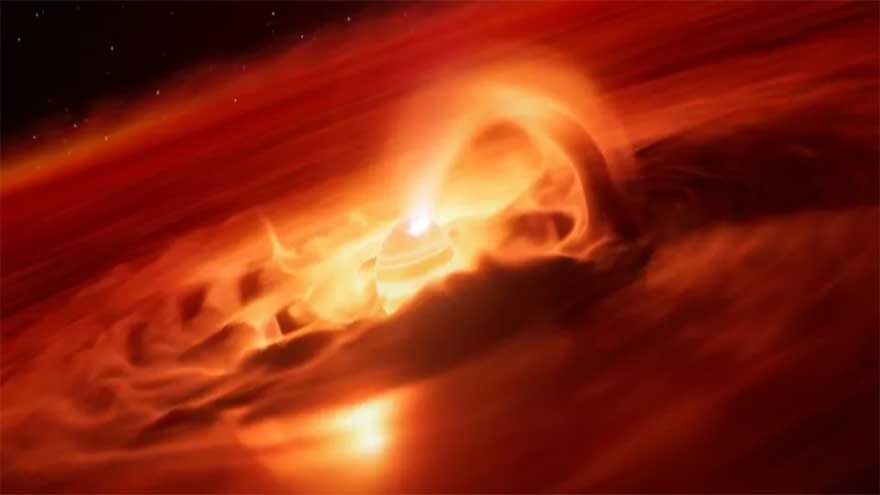
The free-floating "rogue planet" was detected feeding on gas and dust from its surroundings at "six billion tonnes a second".
"This is the strongest growth rate ever recorded for a rogue planet, or a planet of any kind," the astronomers noted.
The planet is surrounded by a massive disc made up of gas and dust.
And this material is constantly falling onto the alien world, which is a process called accretion.
The rate of growth has changed over time.
And scientists say that by August 2025, is was accreting roughly eight times faster than a few months earlier – reaching the mind-bending six-billion-tonnes-per-second.
"This is the strongest accretion episode ever recorded for a planetary-mass object,” lead author Víctor Almendros-Abad.
"People may think of planets as quiet and stable worlds," astronomer Almendros-Abad, of Italy's National Institute for Astrophysics, continued.
"But with this discovery we see that planetary-mass objects freely floating in space can be exciting places."
The discovery was made using the European Southern Observatory's VLT, or Very Large Telescope, which is located in Chile's Atacama Desert.
The team also used some data from the James Webb Space Telescope to make their findings.
And it might change the way that we think about rogue planets.
"The origin of rogue planets remains an open question," said co-author and astronomer Aleks Scholz, of the University of St Andrews.
"Are they the lowest-mass objects formed like stars, or giant planets ejected from their birth systems?"
And fellow St Andrews astronomer Belinda Damian said: "This discovery blurs the line between stars and planets.
"And gives us a sneak peek into the earliest formation periods of rogue planets."
To make the discovery, astronomers compared the light emitted before and during the burst.
And they were able to gather clues about how the accretion process worked.
They think that magnetic activity played a role in "driving the dramatic infall of mass" – a process normally only observed in stars, the scientists said.
They added: "The team also found that the chemistry of the disc around the planet changed during the accretion episode, with water vapour being detected during it but not before.
"This phenomenon had been spotted in stars but never in a planet of any kind."
Rogue planets – officially termed free-floating planets – are usually very difficult to detect.
Often spotting a planet involves looking for a "transit", which is when it passes in front of the face of its host star, dimming its light briefly.
