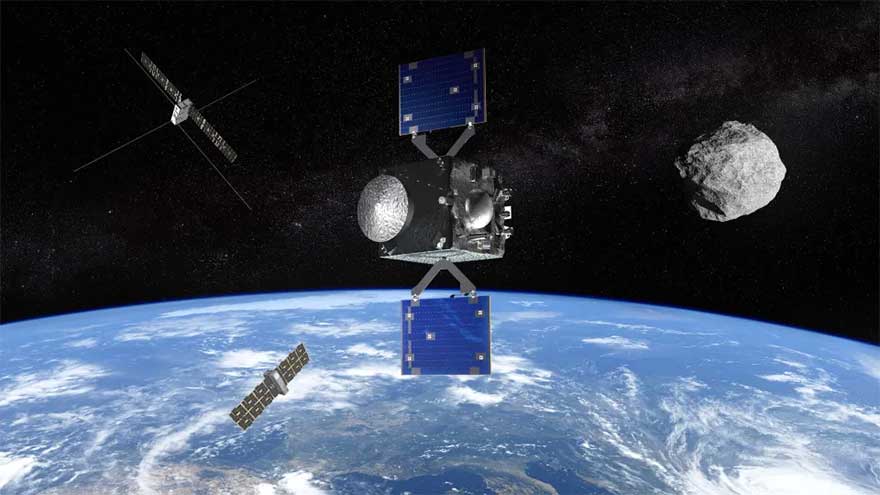
Summary Scientists have now predicted that this once-in-a-millennium event will occur on April 13, 2029
(Web Desk) - Scientists have revealed the exact date an asteroid the size of the Eiffel Tower will fly past Earth.
A once-in-a-millennium mega asteroid will be visible to billions without the need for any equipment as it glides past Earth.
Scientists have revealed that the historic planetary event will be easily visible to the unaided eye.
Asteroid Apophis is on track to make a breathtakingly close flyby past Earth, reports LiveScience.
More than two billion people across Africa and Western Europe will be able to watch it soar through the sky.
Under clear skies, the rock will appear as a faint star gliding steadily overhead.
Scientists have now predicted that this once-in-a-millennium event will occur on April 13, 2029.
In a keynote address delivered earlier this week, Richard Binzel, a professor of planetary sciences at MIT, said the flyby will mark "the first time in space history that a potentially hazardous asteroid is visible to the naked eye."
Speaking at the Europlanet Science Congress in Finland, he emphasised: "Apophis will safely pass the Earth."
Astronomers estimate that a close approach by an asteroid of this size only occurs once every 7,500 years.
The size of the rock has been likened to the height of the Eiffel Tower, measuring a staggering 340 metres.
It's passing will mark a once-in-a-lifetime spectacle for the billions of onlookers.
Scientists also hope to conduct a planetary experiment during the asteroid's flyby.
The event presents the opportunity for scientists to watch in real time how Earth's gravity reshaped a massive asteroid.
Binzel added: "We don't know. And we won't know until we look."
Apophis was first discovered in 2004, and was named after the Egyptian god of the underworld, earning it the nickname the "god of chaos" asteroid.
Early calculations suggested a 2.7 per cent chance of impact of April 13, 2029, placing it at Level 4 on the Torino scale.
This rating is the highest ever given to a near earth object.
Since its first discovery, scientists have tracked and monitored the asteroid, and by 2021, it was removed from all risk lists.
However, last September, a study noted that there is still a very small possibility that an unknown asteroid could nudge it onto a collision path before its 2029 flyby.
The odds are over one in a billion and astronomers remain confident that Apophis poses no danger for the next century at least.
Binzel continued: "It's been a lot of work by a lot of people to make sure we can say totally confidently that Apophis will safely pass the Earth - absolutely no doubt."