


Contacts let you see in dark with your eyes closed
Technology
These lenses work very differently from bulky night vision goggles

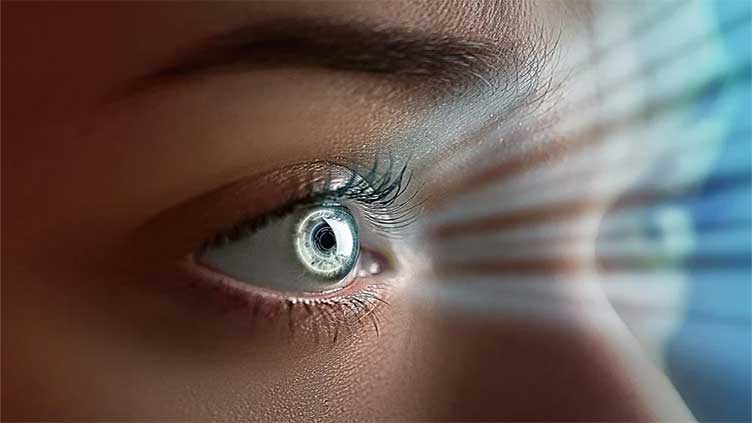
(Web Desk) - Scientists have developed futuristic contact lenses that let both humans and mice see infrared light by converting it into visible light.
These lenses work very differently from bulky night vision goggles. They don’t need any power source and allow users to view multiple types of infrared wavelengths at once. Because they’re transparent, you can see both regular light and infrared light together. Amazingly, the infrared vision actually worked better when users had their eyes closed.
“Our research opens up the potential for non-invasive wearable devices to give people super-vision,” says senior author Tian Xue, a neuroscientist at the University of Science and Technology of China. “There are many potential applications right away for this material. For example, flickering infrared light could be used to transmit information in security, rescue, encryption or anti-counterfeiting settings.”
The lenses use specially engineered nanoparticles that absorb invisible infrared light and convert it into light our eyes can see, typically in the 400 to 700 nanometer range. More specifically, the technology targets near-infrared light, which lies just beyond human vision, in the 800 to 1600 nanometer range.
In earlier studies, the team showed these particles could give mice infrared vision when injected directly into the eye. This time, they’ve achieved similar results using a much less invasive approach—by building the particles right into soft contact lenses.
To create the contact lenses, the team combined the nanoparticles with flexible, non-toxic polymers that are used in standard soft contact lenses. After showing that the contact lenses were non-toxic, they tested their function in both humans and mice.
They found that contact lens-wearing mice displayed behaviors suggesting that they could see infrared wavelengths. For example, when the mice were given the choice of a dark box and an infrared-illuminated box, contact-wearing mice chose the dark box whereas contact-less mice showed no preference. The mice also showed physiological signals of infrared vision: the pupils of contact-wearing mice constricted in the presence of infrared light, and brain imaging revealed that infrared light caused their visual processing centers to light up.
In humans, the infrared contact lenses enabled participants to accurately detect flashing morse code-like signals and to perceive the direction of incoming infrared light. “It’s totally clear cut: without the contact lenses, the subject cannot see anything, but when they put them on, they can clearly see the flickering of the infrared light,” said Xue.
“We also found that when the subject closes their eyes, they’re even better able to receive this flickering information, because near-infrared light penetrates the eyelid more effectively than visible light, so there is less interference from visible light.”
