Summary The Indus Conclave 2025, organised by the Punjab Group, concluded at Lahore’s Alhamra Arts Council after three days of dynamic intellectual discourse and cultural dialogue
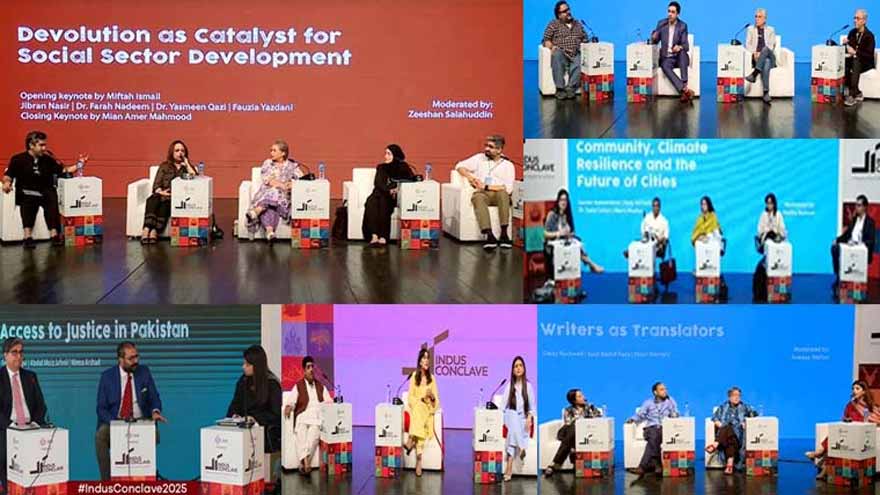
LAHORE (Dunya News) - The Indus Conclave 2025, organised by the Punjab Group, concluded at Alhamra Arts Council, wrapping up three days of vibrant intellectual discourse, cultural dialogue, and creative debates.
The thought-provoking gathering brought together scholars, writers, intellectuals, and journalists from across Pakistan and abroad to engage in conversations shaping today’s socio-cultural and intellectual landscape.
The final day began with the session titled "Rereading Empire: Western Classics Through Postcolonial Eyes", featuring Maryam Wasif and international scholar Luke Soucy.
The speakers delved into colonial narratives, power structures, and academic imperialism, emphasising how colonial thought has left a lasting impact on literature and social consciousness — an influence still crucial to examine today.
Another major session, "Language as Freedom", featured renowned writer Mohammed Hanif, Najam Shahbaz, and other experts, who explored the intrinsic link between language, freedom, and expression.
Speakers stressed that language is not just a tool of communication but a symbol of intellectual freedom.
Writers and journalists, they said, are the true guardians of social dialogue.
Journalists reflect on satire, censorship, and hope at Indus Conclave 2025
Deep political and societal discussions continued in "Do Raaye: A Look Back at Pakistan", where Zarrar Khuhro, Fasih Zaka, Mubashir Zaidi, and Asad Rahim Khan reflected on Pakistan's political evolution, the role of media, and narrative-building.
The panel highlighted that dissent is the cornerstone of democratic societies.
Literary conversations progressed with the session "Recentering the East: Literary Futures from the Global South", where Bilal Tanveer and Hayden Kho discussed the resurgence of Eastern narratives and the future of Global South literature. Participants regarded this session as a key intellectual reference point for the "future of literature."
Technology and public health converged in the engaging session "From Data Chaos to Healthcare Revolution", where Dr Maryam Mustafa, Dr Suleiman Shahid, Dr Athar, and Daniel Scharff discussed how AI is revolutionising public health.
Speakers noted that Pakistan has the potential to become a regional hub for health innovation.
Book launches also added colour to the event, with the unveiling of "A Knife of the Tide" and "Forty Days of Mourning". The authors shared insights into themes of human emotion, spirituality, and creative expression.
In the closing session, "Townhall", participants and speakers shared reflections and recommendations. Organisers announced that Indus Conclave will return next year on an even larger scale to continue promoting knowledge and dialogue.