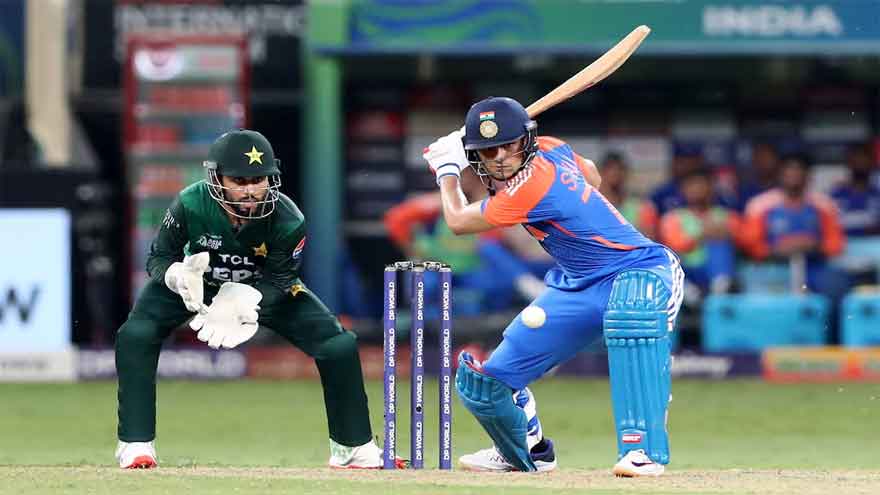
Summary Pakistani fans are left wondering when their team will finally rise to its true potential.
By Anees-ur-Rehman
The Asia Cup 2025 concluded with India emerging victorious, defeating arch-rivals Pakistan in a last-over thriller to claim the title for a record ninth time.
From dramatic collapses to questionable team selections, every big match seems to end in bitter disappointment. Pakistani fans are left wondering when their team will finally rise to its true potential.
Key factors behind Pakistan’s defeat
The main factors behind Pakistan’s defeat in the final include their collapse from 113/1 to 146 all out, losing 9 wickets for just 33 runs. Key lapses were Haris Rauf’s poor performance, Hussain Talat’s dropped catch of Sanju Samson, Mohammad Haris missing a run-out chance of Tilak Varma, and questionable captaincy decisions by Salman Ali Agha.
Pakistan began the Asia Cup final with a promising start, building a strong platform at 113 for 1. However, the middle and lower order failed to capitalise, suffering a dramatic collapse that saw the team bundled out for just 146. What looked like a commanding position quickly turned into a modest total, leaving the bowlers with little to defend.
India’s bowling dominance
India’s bowling proved decisive in this turnaround. Kuldeep Yadav led the charge with a brilliant four-wicket haul, while tight spells from the supporting bowlers choked the scoring rate and broke partnerships at crucial moments. Their disciplined attack ensured Pakistan did not regain the momentum they had built early on.
At one stage, Kuldeep Yadav conceded 24 runs in his first two overs but he came back strongly, held his nerves and ended up his spell with 4-30 in four overs. Jasprit Bumrah, Axar Patel and Chakaravarthy picked up two wickets each.

Composed Indian chase
Despite losing three early wickets in the chase, India displayed great composure and temperament. Tilak Varma anchored the innings with a mature, unbeaten knock, guiding his team steadily over the line. This calm and calculated approach highlighted India’s ability to handle pressure in big matches.
Pakistan’s lack of depth in both batting and bowling was also exposed. While India’s varied bowling attack found breakthroughs at key intervals, Pakistan struggled to respond with the same intensity. Once the collapse began, the psychological advantage shifted firmly to India, making the run chase considerably easier.
Tilak Varma’s heroics
Unlike the Pakistani batters, India’s middle-order batsman Tilak Varma, who normally scores at a strike rate of around 150, smartly read the conditions and played with patience, finishing with a strike rate of 130. Coming in under pressure at 10/2, and soon after India slipped to 20/3, he showed remarkable maturity. Varma first built a solid 57-run stand with Sanju Samson and then added another crucial partnership of 60 runs with Shivam Dube, finishing unbeaten on 69 runs to steer India to a memorable victory.

Poor team selection and questionable strategy
It is not hard to see the menace of cronyism, which is said to be one of the reasons for Pakistan’s defeat. Dropping a world-class batsman like Babar Azam, who has a strike rate of 130, to play Salman Ali Agha, who has a strike rate of 110 - and even making him captain - or replacing a top player like Mohammad Rizwan with a slogger like Mohammad Haris, inevitably leads to repeated batting collapses, as seen in the Asia Cup final.
The game strategy also makes no sense. Recently, Pakistan head coach Mike Hesson called Muhammad Nawaz the best spinner in the world, yet over three matches, he was given only one over to bowl, while part-timer Saim Ayub was relied upon. There is no substitute for a specialist in any format of the game.
Meanwhile, Saim Ayub continues to play despite failing in the last 10 matches, while Hasan Nawaz, who has performed consistently for a year, is benched after a couple of failures.
It is clear that either Farhan scores or the lower order rescues the team, while the middle order comprising Salman, Mohammad Haris and others fails to perform when the team needs them the most.
Salman Ali Agha is completely unfit for T20 cricket. His limited skills make him unsuitable for the team, and despite captaining at the domestic level, he is not capable of leading the national side.
Naseem Shah could have been a better option than Haris Rauf for this tournament, but he was not included in the squad.
Haris Rauf’s costly spells continue to haunt Pakistan
This is not the first time Haris Rauf has failed in crucial moments and leaked runs. In last year’s T20 World Cup, he couldn’t defend 15 runs in the final over against the USA in Dallas, allowing them to take the game to a Super Over, which they eventually won.
Earlier, in the 2022 T20 World Cup in Australia, he was hit for two consecutive sixes by Virat Kohli when India needed 28 off 8 balls, a turning point that led to Pakistan’s defeat.
In the Asia Cup 2025 final, Haris was again expensive, conceding 50 runs in just 3.4 overs while the rest of the bowlers gave away only 100 runs in 16 overs. He kept bowling length deliveries and occasional slower balls in the hitting zone, which the Indian batters repeatedly dispatched into the stands.
Modern-day intent not enough
Modern-day T20 cricket demands a perfect blend of skill, fitness, and smart strategy. Batters must possess explosive power-hitting with a wide range of shots such as reverse sweeps, ramps, and switch hits, along with the ability to score quickly during power plays and finish strongly in the death overs while adapting to different pitch conditions.
Bowlers are required to bring variety to their attack, mastering yorkers, slower balls, cutters, and clever changes of pace, while spinners need to balance attacking intent with tight economy and death-over specialists must stay composed under pressure.
Equally important is sharp fielding, where lightning reflexes can turn half-chances into match-winning moments.
In modern T20 cricket, intent alone is not enough when a team like Pakistan lacks genuine power hitters who can shift gears as required. Once again, the middle and lower order collapsed, with batsmen failing to read the match situation or conditions, playing reckless shots and ultimately getting bowled out for 146 after being 113 for 1.
Trophy row
Although India won the match, they lost grace and respect by refusing to receive the trophy from Asian Cricket Council (ACC) Chairman Mohsin Naqvi, who is also the Pakistan Cricket Board (PCB) Chairman, amid recent tensions between Pakistan and India.
Trophy-less celebrations by India
A rare scene unfolded at the Dubai International Cricket Stadium when India celebrated their Asia Cup 2025 win without the trophy.
The Indian players refused to accept the silverware during the delayed presentation because it was to be handed over by ACC president Mohsin Naqvi.
Officials from Bangladesh, the Emirates Cricket Board, and tournament sponsors were also on stage, but the Indian team chose to celebrate their own way. Skipper Suryakumar Yadav jokingly pretended to lift the trophy while his teammates joined in, holding up an imaginary cup to mark their victory.

Modi drags politics into cricket
The matter didn’t end there, as Indian Prime Minister Narendra Modi faced backlash over a controversial tweet linking politics with cricket. He wrote, “#OperationSindoor on the games field. Outcome is the same – India wins! Congrats to our cricketers.”
Social media users from both Pakistan and India slammed him for bringing military conflict into a gentleman’s game.
Naqvi’s response to Modi
PCB Chairman Mohsin Naqvi gave a fitting reply to Narendra Modi, reminding the Indian prime minister that wars aren’t won on cricket fields and calling the statement a disgrace to the spirit of the game.
Taking to X, the ACC chairman said, “If war was your measure of pride, history already records your humiliating defeats at Pakistan’s hands,” in an apparent reference to Pakistan’s success during the conflict. He added that “no cricket match can rewrite that truth”.
“Dragging war into sport only exposes desperation and disgraces the very spirit of the game,” he said.
Unusual toss interviews
In an unusual setup, separate presenters interviewed the captains of Pakistan and India after the toss at the Asia Cup final.
Indian captain Suryakumar Yadav was interviewed by Ravi Shastri, while Pakistan captain Salman Ali Agha had a word with Waqar Younis.
This happened because India insisted that their captain be interviewed only by an Indian presenter, instead of a neutral one offered by the organisers. As a result, Pakistan’s captain was also interviewed by a Pakistani presenter.
The same arrangement was followed for the post-match presentations, with each captain answering questions only from a presenter of their own country.
Handshake controversy continues
In a repeat of past encounters, Indian captain Yadav once again refused a customary handshake with Pakistan skipper Salman Agha at the toss, marking the third such snub as the arch-rivals locked horns in the high-pressure final of the Asia Cup.
Cricket lost in crossfire
The match fees were donated to war victims on both sides after the final, but nothing was given to the biggest casualty of all – cricket itself.
Somewhere between the memes, trending hashtags, nationalism, and ego, cricket lost its spirit during this epic clash.
Another 'surgery' on the cards?
Last year, PCB Chairman Mohsin Naqvi stated that the team needed “major surgery” after a six-run defeat to arch-rivals India in the T20 World Cup in the USA. Following that, star players Babar Azam and Mohammad Rizwan were dropped as part of the overhaul — but the results have turned out even worse.
Will Pakistan need another “surgery” after three losses to India in the Asia Cup 2025? Only time will tell.