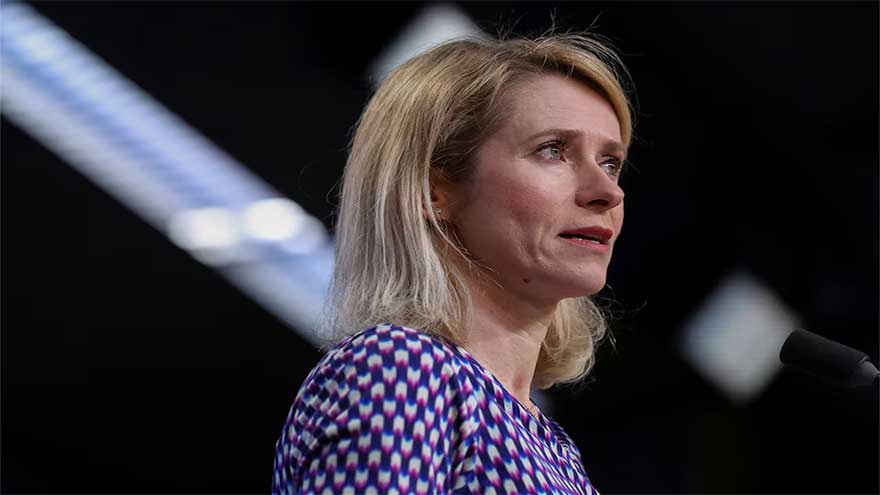
Summary "Of course, we are allies with America, but we don’t really understand their moves recently," Kallas told Reuters in an interview
BRUSSELS (Reuters) – The European Union has started taking the unpredictability of the United States into account one year after President Donald Trump returned to the White House, EU foreign policy chief Kaja Kallas said on Tuesday.
"Of course, we are allies with America, but we don’t really understand their moves recently," Kallas told Reuters in an interview.
"I think it is pretty clear after this one year that the word that we have to take into account is unpredictability. So we are now more calm because we are expecting the unpredictable things to happen all the time, and take it as it is, put some ice in our hats and be calm and stay focused," she added.
Seeks diplomatic solution for Hormuz Strait
Kallas called for diplomatic ways in order to keep the Strait of Hormuz open, as President Trump stressed allies to send warships there to secure transit amid the war in Iran.
"Nobody is ready to put their people in harm's way in the Strait of Hormuz. We have to find diplomatic ways to keep this open so that we don't have a food crisis, fertilizers crisis, energy crisis as well," she said.
On Monday, Kallas told reporters that European nations are unwilling to engage militarily in a war they didn’t initiate.
Foreign ministers gathered in Brussels after Donald Trump warned that NATO’s future would be jeopardized unless European countries help secure the Strait of Hormuz, a vital global shipping route that Iran has effectively blocked.
“Nobody wants to actively enter this war,” Kallas said, summarizing the ministers’ debate over whether to expand the EU’s purely defensive naval operation in the region, known as Aspides. “This is not Europe’s war,” she added.
Her comments followed Germany and Italy’s public reluctance to authorise the Aspides mission — a small contingent of European warships — to fire on vessels.
While the EU’s Aspides operation has the legal authority to engage in the Red Sea to defend tankers against the Iran-backed Houthis, this mandate does not extend to the Strait of Hormuz, where its ships cannot take proactive military action.
Kallas acknowledged a “clear desire” to enhance the operation but emphasized there was “no appetite” to extend its mandate to the Strait of Hormuz.
Europe’s hesitation to join the US militarily risks aggravating the White House. Trump had called on countries like Germany and France to help secure the Strait of Hormuz.
French Foreign Minister Jean-Noël Barrot avoided the issue during his brief appearance on Monday.
Trump reiterated his stance in an interview with the Financial Times, warning NATO would face a “very bad” future if his demand went unheeded. Kallas responded by calling Trump’s objectives “unclear” and cautioning that the conflict could spiral out of control, with devastating global consequences, including a potential “famine” next year due to disrupted fertilizer exports.
The EU remains focused on diplomacy and hopes the United Nations will play a central role in resolving the conflict.
Kallas mentioned her discussions with Indian Foreign Minister Subrahmanyam Jaishankar, who was in Brussels for the meeting, on strategies to engage with Iran.
She also noted a call with UN Secretary-General António Guterres, where they discussed the possibility of a UN-backed agreement to reopen the Strait of Hormuz, similar to the Black Sea Grain Initiative established after Russia’s invasion of Ukraine.
‘US seeks to divide Europe'
In a Financial Times interview published Friday, Kallas accused the US of wanting to "divide Europe" and said it does not “like the European Union.”
“What I think is important for everyone to understand is that the US has been very clear: they want to divide Europe. They don’t like the European Union,” Kallas remarked.