Summary Trump approved operation four days ago, but intelligence planners suggested he wait for better weather
WASHINGTON (Reuters) - At 4:21 on Saturday morning, US President Donald Trump sent a message on his Truth Social platform: the United States had carried out a daring mission to capture Venezuelan President Nicolas Maduro and his wife.
The action came as a surprise, but according to sources familiar with the matter, planning for one of the most complex US operations in recent memory had been in the works for some time and included detailed rehearsals.
Elite US troops, including the Army's Delta Force, created an exact replica of Maduro's safe house and practiced how they would enter the strongly fortified residence.
The CIA had a small team on the ground starting in August who were able to provide insight into Maduro's pattern of life that made grabbing him seamless, according to one source familiar with the matter.
Two other sources told Reuters the intelligence agency also had an asset close to Maduro who would monitor his movements and was poised to pinpoint his exact location as the operation unfolded.
With the pieces in place, Trump approved the operation four days ago, but military and intelligence planners suggested he wait for better weather and less cloud cover.
In the early hours of Saturday, the mission to capture Maduro started. Trump, surrounded by his advisers at his Mar-a-Lago club in Palm Beach, Florida, watched a live stream of the operation.
How the hours-long operation unfolded is based on interviews with four sources familiar with the matter and details Trump himself has revealed.
"I've done some pretty good ones, but I've never seen anything like this," Trump said on Fox News just hours after the mission was completed.
'Massive' operation
The Pentagon has overseen a massive military build up of forces in the Caribbean, sending an aircraft carrier, 11 warships and more than a dozen F-35 aircraft.
In total, more than 15,000 troops have poured into the region for what US officials have long described as anti-drug operations.
According to one of the sources, Trump senior aide Stephen Miller, Secretary of State Marco Rubio, Defence Secretary Pete Hegseth and CIA Director John Ratcliffe formed a core team working on the issue for months with regular - sometimes daily - meetings and phone calls. They often also met with the president.
Late on Friday night and into early Saturday, Trump and his advisers huddled as a number of US aircraft took off and carried out strikes against targets inside and close to Caracas, including air defence systems, according to a US military official.
Trump told Fox News Channel's "Fox & Friends" the number of US aircraft involved was "massive".
"We had a fighter jet for every possible situation," Trump said.
Sources have told Reuters that in addition to fighter jets, the Pentagon had also quietly moved into the region refuelling air tankers, drones and aircraft specializing in electronic jamming.
US officials told Reuters that the airstrikes hit military targets. Images taken by Reuters at the La Carlota air base in Caracas showed charred military vehicles from a Venezuelan anti-aircraft unit.
With the strikes taking place, US Special Forces made their way into Caracas heavily armed, including with a blowtorch in case they had to cut through steel doors at Maduro's location.
Officials did not say how the troops entered the city, but video posted on social media by residents showed a convoy of helicopters flying over Caracas at a low altitude.
Once they reached Maduro's safe house the troops, along with FBI agents, made their way into the residence, which Trump described as a "very highly guarded... fortress."
"They just broke in, and they broke into places that were not really able to be broke into, you know, steel doors that were put there for just this reason," Trump said. "They got taken out in a matter of seconds."
Maduro in custoday
It is unclear how US forces were able to capture Maduro and his wife once they entered the house, but Trump said the Venezuelan leader had unsuccessfully tried to get to a safe room.
"He was trying to get into it, but he got bum rushed so fast that he didn't get into that," Trump said.
Some US forces were hit, Trump said, but none were killed.
As the operation unfolded, Rubio started to inform lawmakers that it was underway. The notifications only began after the operation started and not before, as is customary for key lawmakers who play an oversight role, officials told Reuters.
Little is yet known about Maduro's extraction from Caracas. Trump said that one helicopter was hit "pretty hard" but was able to make it back.
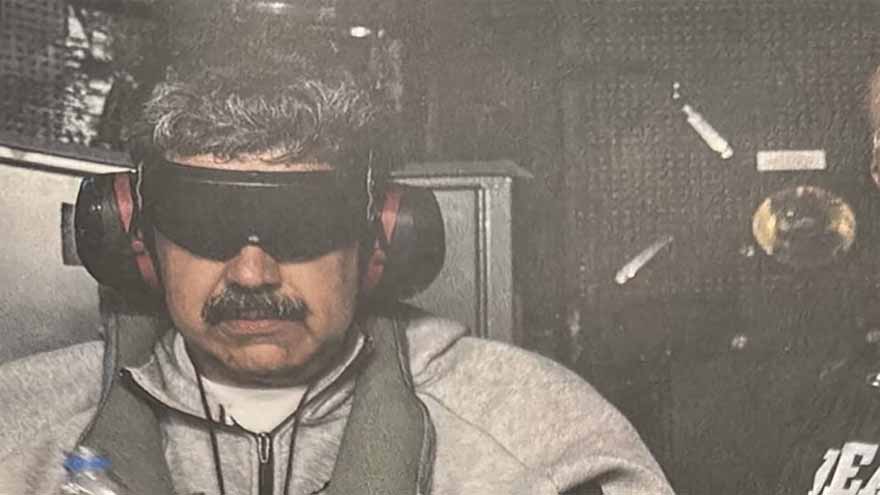
The Venezuelan leader was flown to the USS Iwo Jima, an amphibious assault ship, and will be transferred to New York to stand trial.