Summary Over the past three decades the country has been ravaged - by war and U.N. sanctions.
Baghdad (Web Desk) - Hesham Abdullah says he quit his job, sold his house and all the family’s valuables to pay for cancer treatment for his son.
With no medical insurance, Abdullah estimates he has spent at least $120,000 on black market medicines and trips to overseas clinics. His family of five had to move in with his brother.
Abdullah is an Iraqi citizen. His son, Mostafa, was initially misdiagnosed with joint inflammation. By the time the tumour was detected, his health was worse.
Doctors determined he was suffering from sarcoma, a cancer of the connective tissue.
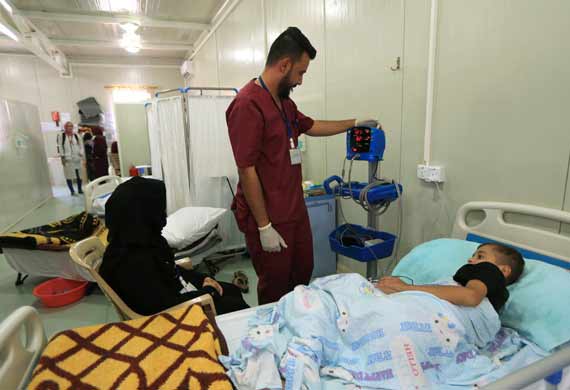
Iraq’s healthcare system is in crisis. There’s a shortage of drugs and medical staff. Doctors fleeing in their thousands, and life expectancy and child mortality rates are far below average for the region.
This year, a new threat has emerged: across the border in Iran, coronavirus has killed more than 50 people and infected many more, including a deputy health minister, prompting the Iraqi government to close the border.
Iraq reported its first cases in recent days.
Mass protests broke out in Baghdad and across much of southern Iraq, including in Basra, late last year as thousands clamoured for an overhaul of a political system they say has plundered state resources and pushed ordinary people into poverty.
Poor healthcare is among the core grievances, and a lack of access to cancer treatment is a flashpoint.
To understand the collapse of Iraq’s healthcare, Reuters spoke to dozens of doctors, patients, officials and private investors and analyzed government and
World Health Organisation data. The story that emerges is complex. Over the past three decades the country has been ravaged - by war and U.N. sanctions, by sectarian conflict and the rise of Islamic State. Yet even in times of relative stability, Iraq has missed opportunities to expand and rebuild its healthcare system.
"The government budget didn’t give priority to the health sector, and so now when we compare Iraq to other countries, we come last," Alaa Alwan, Iraq’s health minister, told Reuters in August.
Alwan, who has also served in senior roles at the World Health Organization, resigned as minister the following month, after just one year in office, citing insurmountable corruption and threats from people opposed to his reform efforts.
Between 2015 and 2017, the government spent an average of $71 per citizen on healthcare in Basra, Reuters found, half the national average.
Basra is desperately short of vital medical equipment, with just three CT scanners and one MRI unit per million residents, a fraction of the average rate of 34
CT scanners and 24 MRI units for developed countries.Abdullah worries about the quality of care at the Basra children’s cancer centre.
The hospital’s chief administrator, Ali al-Eidani, said the clinic needed more than four times the funds it received from the health ministry in 2019 to operate effectively.
The hospital does not have a PET scan machine, used to help detect and diagnose certain cancers, or enough cancer drugs.
In 2018, more than 85 percent of drugs on Iraq’s essential medicines list were either in short supply or completely unavailable, former health minister Alwan told Reuters. Cancer drugs are among the scarcest and most smuggled, partly because of their high cost.
International companies have been scared off doing business directly with the Iraqi government by corruption and instability, regulators and private importers say.
Former health minister Alwan acknowledged that "the issue of administrative corruption that exists in Iraq is a major roadblock on this front."
The Abdullah family was middle class before Mostafa fell ill. His first surgery cost 12 million Iraqi dinars, about $10,000, a sum his father described as "back breaking." Then came the injections, one for $500, a second for $400, a third for $300. Scans the next day cost $1,000.
Still, the family had enough money saved to fly Mostafa to India eight months later, when his health took a turn for the worse. The trip cost about $16,000 and yielded no improvement.
A later trip to Lebanon - the only time Mostafa received proper treatment, said his father - was possible only after a generous donor paid for it out of charity.
The trip cost $7,000. The family couldn’t afford to send him again.
"I just want him to rest from the pain, even if he remains ill," Abdullah said. "I just want him to get relief from pain."
In the early days of February, Mostafa passed away. His picture has not gone up on the Basra hospital wall. Only survivors’ photos are added now.