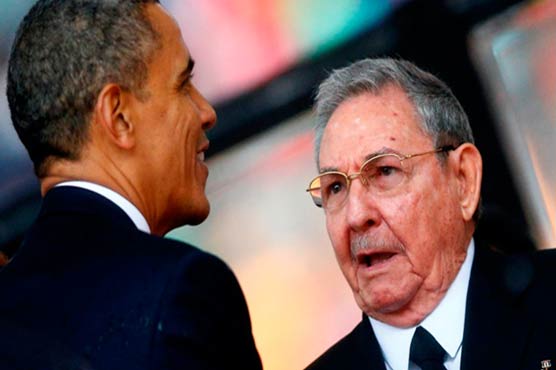
Summary US President Barack Obama has urged Congress to put an end to the US embargo.
WASHINGTON (AFP) - The Obama administration s surprise move to restore ties with Cuba came under the spotlight Tuesday from a combative Republican-led Congress.
Potential 2016 White House hopeful Marco Rubio, the son of Cuban immigrants who has been loudly critical of the change to the decades-old policy, presided over the packed meeting of a Senate subcommittee.
"I have deep reservations and in many instances direct opposition to many of the changes... for the simple reason that I believe that they will not be effective in bringing about the sort of political opening on the island of Cuba that all of us desire," Rubio told the committee.
He pointed out that Cuba was the only country in the Western hemisphere that has not had a free election in the past 15 years, with power passing from Fidel Castro to his brother Raul.
"The notion that somehow we should be more patient with Cuba than all these other societies is quite frankly unfair and offensive," Rubio said.
US President Barack Obama has urged Congress to put an end to the US embargo, imposed in 1962. The measure has been a major source of tension between the Cold War-era rivals.
President Raul Castro and Obama simultaneously announced on December 17 their intention to end half a century of animosity and normalize ties that broke off in 1961.
But some US lawmakers say Obama conceded too much to Castro without securing guarantees of political change on the island.
No illusions
"This administration is under no illusions about the continued barriers to internationally recognized freedoms that remain for the Cuban people," insisted the top US diplomat for Latin America, Roberta Jacobson.
"Nor are we under illusions about the nature of the Cuban government."
But she maintained that the half-century freeze in ties and the US economic embargo "though rooted in the best intentions, failed to empower the Cuban people, and isolated us from our democratic partners in this hemisphere."
Instead, the Cuban authorities had used it "as a rationale for restrictions on its people. As a result, unfortunately and unintentionally, those most deprived were the Cuban people," Jacobson said.
Jacobson, who led the first negotiations on restoring diplomatic ties last month in Cuba, stressed the initiative was aimed at promoting change in Cuba to bring about democracy.
Therefore, Washington would refuse any Cuban demands to stop meeting with rights activists in return for reopening a US embassy in Havana.
"We could not accept not meeting with democracy activists and with the broadest swathe of Cubans possible, that s the point of this policy," she told lawmakers.
The negotiations are due to resume this month in Washington.
"We have only begun the official talks on normalizing relations -- which will take considerably longer than the first step, which is the re-establishment of diplomatic relations," Jacobson said.