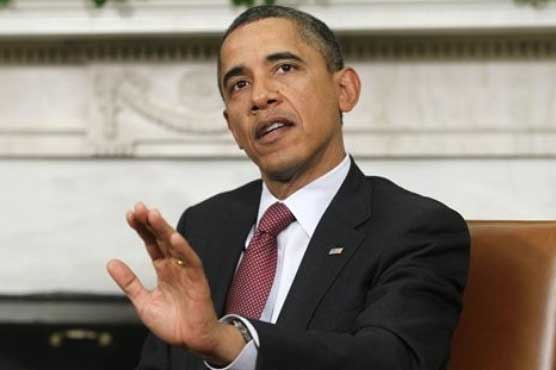
Summary US President Barack Obama has accused Moscow of being on the "wrong side of history”.
KIEV (AFP) - Ukraine accused Russia on Monday of pouring more troops into Crimea and giving its forces an ultimatum to surrender as US President Barack Obama accused Moscow of being on the "wrong side of history" in Europe's worst standoff since the Cold War.
Both Washington and the European Union said they were looking at a range of sanctions against Russia for its threat to use force against an ex-Soviet neighbour for the first time since a brief 2008 conflict with Georgia.
Russia's Black Sea Fleet however denied it had issued an ultimatum to Ukranian forces and the country's parliament speaker said there was no need yet for Moscow to use its "right" to launch military action in Ukraine.
But world markets plunged and oil prices spiked on fears of an all-out offensive that would pit nuclear-armed Russia against its Western-backed neighbour of 46 million.
Obama used some of his toughest language yet on the escalating crisis on the eastern edge of Europe, where three months of protests culminated in a week of carnage that claimed nearly 100 lives and led to the ouster of pro-Russian president Viktor Yanukovych -- now sheltering in Russia.
The US leader said the Kremlin had put itself "on the wrong side of history" by mobilising forces on the strategic Black Sea peninsula of Crimea, which has housed the Russian Black Sea Fleet since the 18th centry and whose pro-Moscow population looks on the new pro-EU leaders in Kiev with disdain.
"I think the world is largely united in recognising the steps Russia has taken are a violation of Ukranian sovereignty... a violation of international law," Obama said.
Obama said he had told Russia that "if in fact they continue on the current trajectory, that we are examining a whole series of steps -- economic, diplomatic -- that will isolate Russia."
US State Department spokeswoman Jen Psaki said there was no time-frame yet for when the US could impose sanctions but stressed that it was working "in lockstep" with its European allies.
EU foreign policy chief Catherine Ashton said ahead of talks with Russian Foreign Minister Sergei Lavrov in Madrid on Tuesday that the 28-nation bloc would also "consider targeted measures" against Moscow.
The measures could include suspending long-running talks with the Russian authorities on easing EU visa requirements for the country's citizens, according to an EU statement.
Kiev's new Western-leaning leadership meanwhile was due to receive a morale boost on Tuesday with a visit by US Secretary of State John Kerry.
The West's warning to Moscow came shortly after Ukrainian defence officials on the flashpoint Crimean peninsula said that Russia had given its forces an ultimatum to surrender or face an all-out assault
"The ultimatum is to recognise the new Crimean authorities, lay down our weapons and leave, or be ready for an assault," regional Ukrainian defence ministry spokesman Vladyslav Seleznyov told AFP in the Crimean capital Simferopol.
But a spokesman for the fleet based in Crimea told the Interfax news agency the claim was "complete nonsense".
The predominantly ethnic Russian region has been under de facto occupation by Moscow-backed forces who have taken control of government buildings and blocked Ukrainians troops inside their barracks across the peninsula.
The tensions set off a flurry of diplomatic activity, with world leaders holding a series of urgent meetings and telephone conversations to try to prevent a conflict and also to help Ukraine avert a possible catastrophic debt default.
In New York, the UN Security Council began a meeting called by Russia to set out in greater detail its position on Ukraine.
In Brussels, the European Union warned Russia that ties with the 28-member bloc were at risk without a "de-escalation" and announced an emergency summit of EU presidents and prime ministers on Thursday.
Hawkish ex-Soviet satellites are pushing hard for sanctions but others -- including heavyweights France and Germany -- have called for soft diplomacy.