Summary John Kerry and foreign ministers of other major powers head to Geneva for Iran nuclear talks.
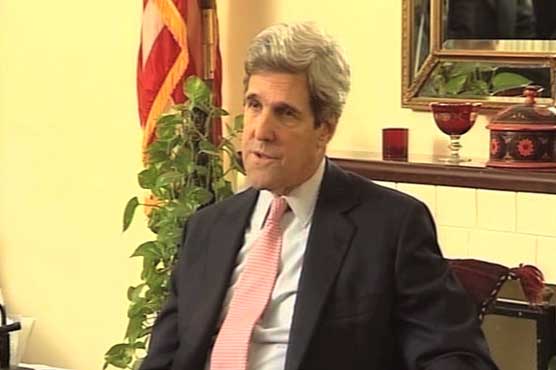
GENEVA (AP) - Secretary of State John Kerry and foreign ministers of other major powers lent their weight to the Iran nuclear talks after envoys reported progress Friday in marathon negotiations to curb the Iranian program in return for limited sanctions relief.
After a third day of talks, State Department spokesperson Jen Psaki said Kerry was en route to Geneva to "help narrow the differences." Russian Foreign Minister Sergey Lavrov arrived in Geneva late Friday.
British Foreign Secretary William Hague announced he would also travel to Geneva. A French diplomat, speaking on condition of anonymity because he was not authorized to release the information, said French Foreign Minister Laurent Fabius would join the others here.
The announcements followed a day in which diplomats appeared more and more optimistic that a deal could be struck.
As talks adjourned, a diplomat said Iranian Foreign Minister and top European Union diplomat Catherine Ashton had made progress on a key sticking point Iran s claim to a right to produce nuclear fuel through uranium enrichment.
Iran s official IRNA news agency quoted Iranian Deputy Foreign Minister Abbas Araghchi in Geneva as saying that Iran s right to uranium enrichment must be part of any deal.
Enrichment is a hot-button issue because it can be used both to make reactor fuel and to arm nuclear missiles. Iran argues it is enriching only for power, and scientific and medical purposes. And it says it has no interest in nuclear arms.
But Washington and its allies point to Tehran s earlier efforts to hide enrichment and allege it worked on developing such weapons.
Iran has insisted on that right throughout almost a decade of mostly fruitless nuclear negotiations. But Zarif last weekend indicated that Iran is ready to sign a deal that does not expressly state that claim, raising hopes that a deal could be sealed at the current Geneva round.
For the U.S. and Iran, the talks represent more than trying to hammer out a nuclear deal. In style and substance they are an extension of the historic dialogue opened during September s annual U.N. gathering, which included a 15-minute phone conversation between President Barack Obama and Iran s new president, Hassan Rouhani.
The nuclear negotiations have included intensive one-on-one sessions between U.S. and Iranian envoys, offering opportunities to widen contacts and begin the long process of reconciliation after more than three decades of estrangement. For Iran, it also gives Rouhani s government a chance to show skeptical hard-liners that dialogue is possible with Washington without putting the country s Islamic system in peril.
Iranian hard-liners are suspicious of talk of nuclear compromise since Rouhani took office in September, fearing his team will give too much at the negotiating table and not get enough in terms of sanctions relief.
On Wednesday, Iran s supreme leader, Ayatollah Ali Khamenei, said his country would never compromise on "red lines." Since then Tehran has publicly reverted to its original stance that the six powers must recognize this activity as Iran s right, despite strong opposition by Israel and within the U.S. Congress.
Still, comments from Iranian officials in Geneva indicated that reverting to tough talk on enrichment may be at least partially meant for home consumption.
In Geneva, a senior Iranian negotiator said the Iranian claim to the right to enrich did not need to be explicitly recognized in any initial deal, despite Khamenei s comment, adding that the supreme leader was not planning to intervene in the talks. He did suggest, however, that language on that point remained difficult and that there were other differences.
Work is proceeding on a compromise along the lines of what the Iranian negotiator said avoiding a direct reference to any country s right to enrich but still giving enough leeway for Iran to accept it, said a diplomat involved in the talks.
Both he and the Iranian envoy demanded anonymity because they were not allowed to discuss the confidential talks and neither offered details.
Senior Iranian analyst Trita Parsi, citing conversations with Iranian and U.S. officials, said the draft includes a reference to the nuclear Non-Proliferation Treaty, which Iran claims is the guarantor of each country s right to enrich by granting signatories the right to pursue nuclear power for peaceful uses.
That argument is rejected by the United States and its allies, which say the treaty does not directly mention such a right.
Parsi said Tehran wants the wording to make clear that Iran is not a "permanent outcast," but has the same rights and responsibilities as all other signatories to the treaty.