Summary Talks between UN peace envoy and US and Russian officials failed to make headway on ending conflict.
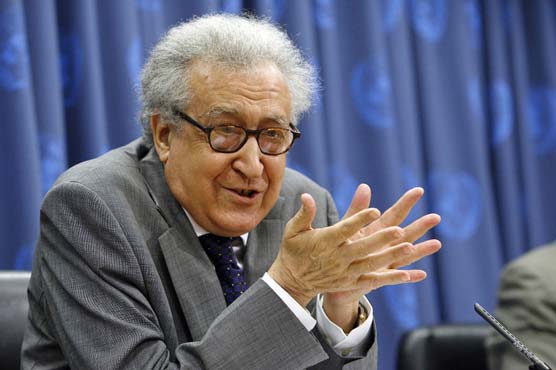
International envoy Lakhdar Brahimi said Friday that Russia seems as determined as the United States to end Syria s civil war, but that he doesn t expect a political solution to emerge anytime soon.
Brahimi, who is the joint U.N.-Arab League envoy for Syria, spent the day at the United Nations European headquarters meeting with Russian Deputy Foreign Minister Mikhail Bogdanov and U.S. Deputy Secretary of State William Burns.
"We are all very, very deeply aware of the immense suffering of the Syrian people, which has gone for far too long. We all stressed the need for a speedy end to the bloodshed, to the destruction and all forms of violence in Syria. We stressed again that in our view, there was no military solution to this conflict," Brahimi told reporters.
But he acknowledged that "if you are asking me whether a solution is around the corner, I am not sure that is the case.
What I am certain of is that there is an absolute necessity for people to continue to work for such a peaceful solution, and that it is the wider international community, especially members of the Security Council, that can really create the opening that is necessary to start effectively solving the problem."
Brahimi s five hours of talks with Bogdanov and Burns on Friday ended without any apparent deal. It was Brahimi s second meeting in as many months with Bogdanov and Burns, who each left without making any public comments. In December, Brahimi also met with Russian Foreign Minister Sergey Lavrov and U.S. Secretary of State Hillary Rodham Clinton to discuss Syria.
At the Security Council, the most powerful arm of the United Nations, Russia has joined China in blocking several resolutions aimed at pressuring Syrian President Bashar Assad, but Moscow says it is not propping up his regime.
Recently, top Russian officials have signaled they are resigned to Assad eventually losing power.
Brahimi defended Moscow s role.
"I am absolutely certain that the Russians are as preoccupied as I am, as preoccupied as the Americans are, by the bad situation that exists in Syria and its continuing deterioration, and I am absolutely certain that they would like to contribute to its solution," he said.
Brahimi, who didn t comment on China s response to Syria s civil war, said the foundation for a political solution continues to be the agreement reached among major powers in Geneva in June, which called for creation of a new governing body for Syria that would "exercise full executive powers" during an unspecified transition period.
"And we agreed that full executive powers means all the powers of state," Brahimi said of Friday s discussions. "I will continue to engage all Syrian parties as well as other stakeholders in the region and internationally."
In Washington, U.S. State Department spokeswoman Victoria Nuland told reporters "it s hard to imagine how you would have a transitional government with Assad still part of it."
The conflict began in March 2011 with peaceful protests against Assad s family dynasty, which has ruled the country for four decades, but the intense crackdown on the uprising and armed rebel opposition soon became a civil war.
"According to our progress today, we said that this transitional government that will be in charge during the transitional period only. It is not a government that will stay for a long time. It will direct the transitional period that will end with the holding of the elections that will be agreed upon. During this transitional period, the transitional government has to enjoy complete powers and these complete powers are those of the whole state," Brahimi said.