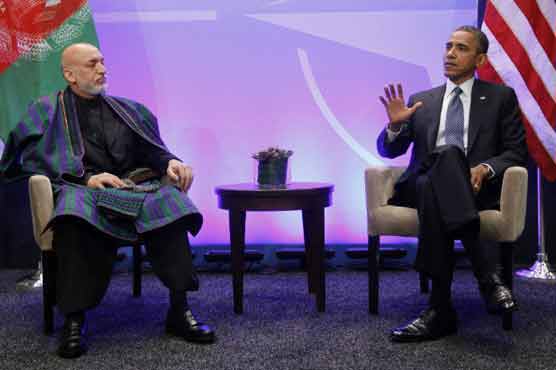
Summary President Hamid Karzai arrived for White House talks with President Barack Obama Friday.
WASHINGTON - President Hamid Karzai arrived for White House talks with President Barack Obama Friday that will shape the post-war US commitment to Afghanistan, and ultimately, how many NATO troops remain behind.
Karzai and Obama were to meet for two hours, have lunch and then hold a short press conference, during a visit which comes as the US president prepares a timetable to bring almost all of the 68,000 American troops home.
The leaders, whose relationship is strained by a grueling war that has exhausted America s military, finances and public patience, will focus on Afghanistan s uncertain future capacity to meet its own security needs.
Obama is currently deliberating the exact size and scope of a US training and anti-terror operation envisaged to equip Afghan troops to repel the Taliban and to prevent the return of an Al-Qaeda safe haven.
The White House has reportedly ordered the Pentagon to come up with plans for a smaller future Afghan presence than the generals expected, perhaps numbering 3,000, 6,000 or 9,000 US troops.
Obama s domestic political opponents, however, charge that the president is in a rush for the exit and warn that a minimal force could squander gains hard won in a war that has killed more than 3,000 coalition troops.
US officials caution that the Obama-Karzai talks will not produce a deal on a specific number of troops but could impact that figure by narrowing down the exact purpose of those who will remain behind.
The White House even suggested this week that Obama would not even rule out the possibility of leaving zero American boots on the ground.
US military officers later privately acknowledged those comments were primarily designed as a tactic in negotiations with Kabul -- and they might also have been part of internal wrangling over troop levels with the Pentagon.
Karzai backs a residual US troop presence but it depends on a yet-to-be concluded security agreement to govern issues like legal immunity for American soldiers and transferring detainees to Afghan custody.
The Obama administration failed to conclude a similar pact for post-war Iraq, prompting Obama to bring every US soldier home.
This has compounded Afghan fears that the country could be abandoned again by the international community -- as it was after the end of the Soviet occupation in 1989.
The power vacuum led to the rise of the Taliban, and a safe haven for Al-Qaeda to plot the September 11 attacks, which drew the United States into an Afghan war in 2001.
Top US officials sought to ease those fears on Thursday, and both sides took pains not to publicly air differences over the quality of Afghan governance, corruption and the price civilians have paid in US military action.
"After a long and difficult past, we finally are, I believe, at the last chapter of establishing a sovereign Afghanistan that can govern and secure itself for the future," US Defense Secretary Leon Panetta told Karzai.
"We ve come a long way towards a shared goal of establishing a nation that you and we can be proud of, one that never again becomes a safe haven for terrorism."
Panetta later told reporters he and Karzai, who met alone for about an hour, made "some very good progress."
Karzai was hopeful that Washington and Kabul would be able to work out a security agreement.
"Afghanistan will, with the help that you provide, be able to provide security to its people and to protect its borders; so Afghanistan would not ever again be threatened by terrorists from across our borders," he said.
Later, Karzai was guest of honor at a dinner for 15 people at the State Department hosted by Hillary Clinton, which she said was meant to repay "some of the hospitality I ve enjoyed over the years."
Karzai is viewed with some suspicion in Washington by officials and lawmakers who doubt the quality of Afghan governance and who fear that US aid is falling prey to corruption in Afghanistan.
Relations have also been strained over the past year by a string of attacks by Afghan soldiers on supposed NATO comrades.