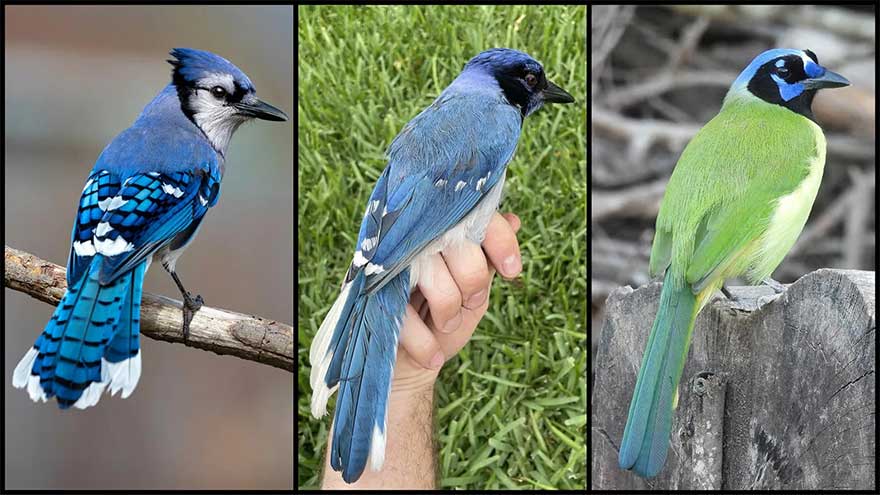
Summary First known case of a hybrid animal arising in the wild because of recent shifts in climate
(Web Desk) - Scientists in Texas confirmed the existence of a rare hybrid bird, the offspring of a green jay and a blue jay.
Biologists at The University of Texas at Austin have documented an unusual bird that appears to be the offspring of a green jay and a blue jay.
They believe this may represent one of the first known cases of a hybrid animal arising in the wild because of recent shifts in climate. Although these two parent species are separated by about 7 million years of evolution, their habitats did not overlap until only a few decades ago.
“We think it’s the first observed vertebrate that’s hybridized as a result of two species both expanding their ranges due, at least in part, to climate change,” said Brian Stokes, a graduate student in ecology, evolution, and behavior at UT and first author of the study.
Stokes pointed out that most previous vertebrate hybrids were linked to human influence, such as invasive species introductions or one species encroaching on another’s territory (for example, polar bears and grizzlies). In this case, however, both parent species expanded their ranges at the same time as weather patterns shifted, creating the opportunity for hybridization.
Back in the 1950s, green jays, which are tropical birds native to Central America, barely reached into southern Texas from Mexico. Blue jays, common across the eastern United States, extended only as far west as Houston. Encounters between the two were almost nonexistent. Over the following decades, though, green jays gradually spread north while blue jays extended west, and today their ranges overlap in the San Antonio area.
While studying green jays in Texas as part of his doctoral research, Stokes regularly scanned birding posts on social media to help locate potential field sites. This allowed him to find birds he could capture briefly, take blood samples from for genetic analysis, and release safely. One day, he came across a blurry photo of a striking blue bird with a black mask and white chest, shared by a woman in a suburb northeast of San Antonio. The bird looked somewhat like a blue jay but also distinctly different. Curious, Stokes accepted the woman’s invitation to visit her backyard and see the bird himself.
“The first day, we tried to catch it, but it was really uncooperative,” Stokes said. “But the second day, we got lucky.”
The bird got tangled in a mist net, basically a long rectangular mesh of black nylon threads stretched between two poles that is easy for a flying bird to overlook as it’s soaring through the air, focused on some destination beyond. Stokes caught and released dozens of other birds, before his quarry finally blundered into his net on the second day.