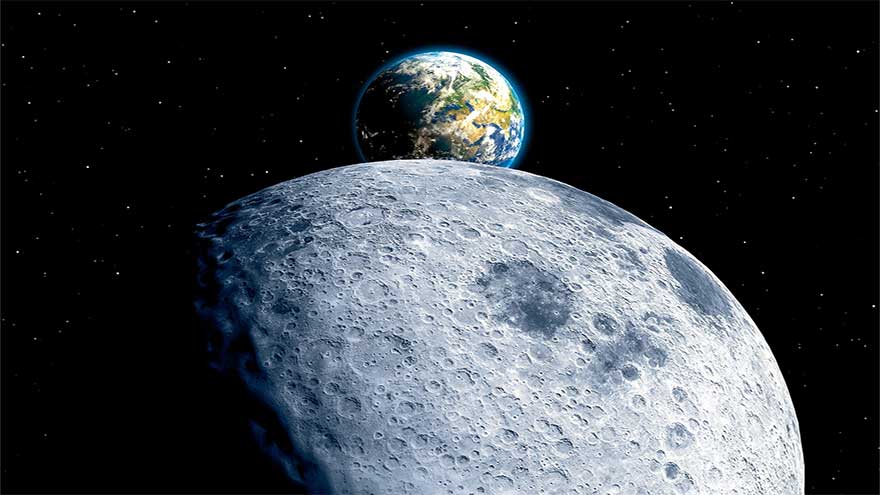
Summary The team examined a wide collection of Apollo lunar regolith samples and measured their triple oxygen isotope signatures with high precision.
(Web Desk) - Oxygen isotope analysis of lunar soil shows meteorites delivered only a limited amount of water to the Earth–Moon system after about 4 billion years ago.
For many years, scientists have proposed that water-rich meteorites striking Earth late in its history may have delivered a significant share of the planet’s oceans. However, new research indicates that evidence preserved on the Moon places strict limits on that idea.
According to the study, even under generous assumptions, meteorites impacting the Earth–Moon system since roughly 4 billion years ago could account for only a minor fraction of Earth’s water.
The research, published in the Proceedings of the National Academy of Sciences, was led by Tony Gargano, Ph.D., of the Lunar and Planetary Institute and the University of New Mexico.
The team examined a wide collection of Apollo lunar regolith samples and measured their triple oxygen isotope signatures with high precision.
Earth itself holds little physical evidence of the intense bombardment that occurred early in its history. Plate tectonics and ongoing recycling of the crust have erased much of that record. The Moon, in contrast, preserves a detailed history in its regolith, a surface layer of loose debris that has been created and repeatedly reworked by impacts over billions of years.
Since the Apollo missions returned samples, scientists have tried to decode this record by examining elements that are common in impacting bodies.
These include siderophile elements, often described as metal-loving elements, which are abundant in meteorites but relatively scarce in the Moon’s silicate crust. Interpreting the regolith is difficult, however, because impacts repeatedly melt, vaporize, and remix materials.
Geological processes after impacts can also separate metal from silicate, making it harder to determine exactly how much meteorite material was added and what kinds of objects delivered it.
“The lunar regolith, which is a collection of loose ‘soil’ and broken rock at the surface, acts like a long-term mixing layer,” said Gargano.
“It captures impact debris, stirs it in, and preserves those additions for immense spans of time. That is why it is such a powerful archive. It lets us study a time-averaged record of what was hitting the Earth–Moon system.”
Instead of focusing on metal-loving elements, the researchers used a different method. They analyzed oxygen, the most abundant element in rocks, and examined its triple-isotope signature.
This isotopic “fingerprint” helps distinguish two signals that often overlap in lunar regolith: (1) the addition of meteorite material and (2) isotopic changes caused by vaporization during impacts.