Summary Pakistan has successfully launched its second indigenous Earth observation satellite EO-2 from China, strengthening national space, imaging and data capabilities.
ISLAMABAD (Dunya News) – Pakistan has successfully launched its second indigenous Earth Observation satellite, EO-2, from China’s Yangjiang Seashore Launch Centre, marking a significant step forward in the country’s national space programme.
The satellite was developed by the Space and Upper Atmosphere Research Commission (SUPARCO) and placed into orbit on Thursday, according to official statements.
The new satellite expands Pakistan’s growing Earth observation fleet and is designed to deliver high-resolution imaging and enhanced monitoring capabilities for a wide range of civilian and strategic uses. Officials described the mission as a key milestone in strengthening domestic satellite engineering and mission readiness.
SUPARCO confirmed that EO-2 was conceived, engineered and integrated in Pakistan at its Satellite Research and Development Centre. The project was completed through in-house research, systems engineering and payload integration, reflecting advances in national expertise across satellite design, testing and operational deployment.
IMAGING POWER
EO-2 is built to significantly improve Earth observation and electro-optical imaging capacity. According to SUPARCO, the satellite will generate critical spatial data to support national development planning, natural resource management, environmental monitoring and urban expansion mapping.
Officials said the satellite will also contribute to governance and institutional planning by providing timely and accurate imagery. Key application areas include disaster assessment, climate analysis, land use tracking and infrastructure development monitoring.
The agency noted that improved image resolution and coverage will support more reliable analysis and faster decision-making for both civilian authorities and planning bodies that rely on geospatial intelligence.
DUAL SATELLITE SYSTEM
SUPARCO stated that EO-2 is designed to operate in coordination with Pakistan’s first indigenous electro-optical satellite, EO-1, which was launched last year from the Jiuquan Satellite Launch Centre in northern China. With two satellites working in tandem, authorities expect stronger continuity, broader coverage and greater analytical precision.
The combined EO-1 and EO-2 configuration allows Earth observation under varying illumination conditions. This improves surface feature interpretation and strengthens change detection across monitored regions, increasing the reliability of long-term data comparisons.
According to officials, the dual-satellite arrangement enhances imaging continuity and ensures more consistent data availability for national users across multiple sectors.
HUMAN SPACEFLIGHT TRACK
The EO-2 launch comes days after another development in Pakistan’s space efforts. On February 7, the Inter-Services Public Relations announced that two Pakistani candidates had been officially shortlisted by the Astronauts Centre of China under the country’s Human Spaceflight Programme track.
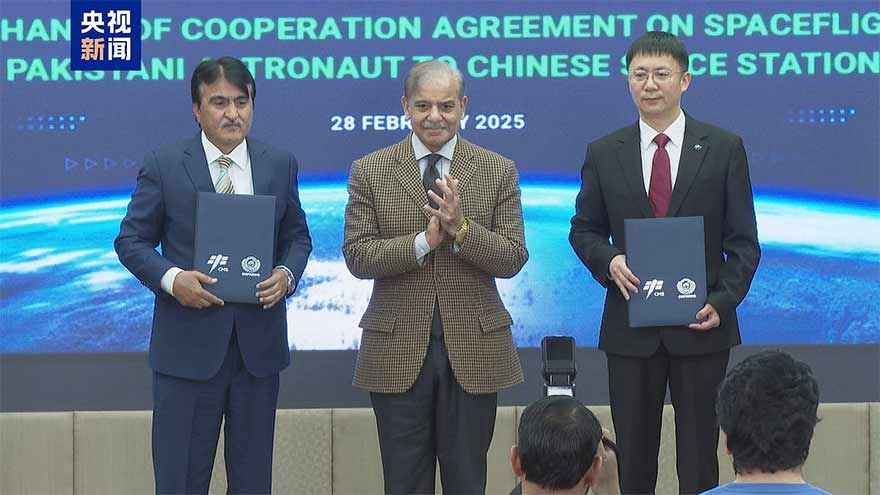
The selection follows a cooperation agreement signed in February 2025 between SUPARCO and the China Manned Space Agency. Under that agreement, two Pakistanis will receive astronaut training in China, with one candidate expected to eventually travel to the Tiangong space station.
Officials say the parallel progress in satellite launches and astronaut training reflects a broader expansion of Pakistan’s cooperation with China in space science and technology, alongside a push for greater indigenous capability in satellite systems.
SUPARCO described the EO-2 mission as evidence of sustained investment in applied research, skilled workforce development and domestic space infrastructure, with the satellite expected to directly support planning, resource management and national monitoring needs through locally engineered technology.