Summary Efforts underway to protect Doaba, Sher Shah flood embankments at Chenab River
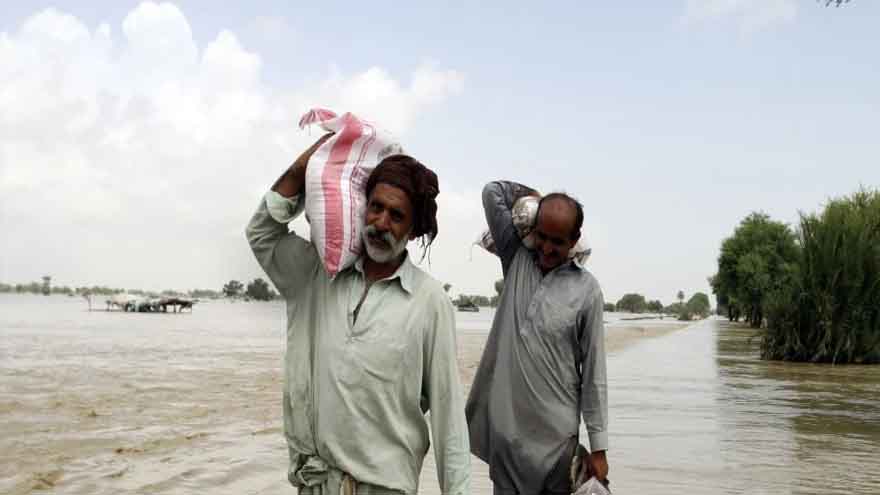
LAHORE (Dunya News) – The devastation caused by flooding in Punjab’s rivers continues, with dozens more villages submerged. The surge in River Sutlej has caused the collapse of the Zamindara embankment in Bahawalpur, while the slow movement of floodwaters in Multan has become a serious concern. Pindi Bhattian remains underwater, and the floodwaters are expected to enter Sindh tonight.
In Bahawalpur, the raging waters of the Sutlej have broken through the embankments, flooding nearby settlements and causing the collapse of many homes. In the village of Sahlan, the embankment breach led to flooding in Hussainabad and surrounding areas, resulting in the destruction of several homes and forcing residents to evacuate.
A new wave of floodwaters emerging from Head Trimmu has prompted another red alert. Over 414,000 cusecs of water are expected to reach Multan's embankments in the next two days. The Deputy Commissioner of Multan expressed concern over the slow discharge of this current wave, which has already damaged several areas in Shujaabad and Jalalpur Pirwala. Due to this slow pace, the expected reduction in water level hasn't occurred even after 36 hours, and authorities are reconsidering the option of breaching the embankments.
River Chenab is currently experiencing high flood levels. Efforts are underway to protect the Doaba and Sher Shah flood embankments. One track of the Muzaffargarh and Dera Ghazi Khan national highway is submerged, and water has accumulated in the villages near Head Muhammadwala. Flooding has affected several villages in Muzaffargarh, Jhang, and Khanewal.
Water levels receding slowly, says PDMA DG
Director General of Punjab Disaster Management Authority (PDMA), Irfan Ali Kathia, stated that no new flood waves have been reported from India, and water levels in Punjab’s rivers are expected to gradually decrease. However, floodwaters will enter the Indus River by tonight.
Many areas in Ahmadpur East are already submerged, and a flood wave between 800,000 to 900,000 cusecs is expected to hit Chacharan in the next 48 hours. In Rahim Yar Khan, 34 villages have been severely affected. In Alipur, floodwaters from the Chenab have entered nearby settlements, damaging hundreds of acres of crops. In Muzaffargarh’s Sher Shah locality, more than 2,000 houses have been caught in the flood’s path.
In Pindi Bhattian, a high flood alert has been issued, with a wave of 557,000 cusecs passing through. In Ahmadpur Sial, a breach occurred in the Sumand Wana embankment, submerging multiple areas. A 35-year-old man, Ghulam Abbas Chadhar, drowned in the floodwaters.
At Jamlera near Burewala, the water flow is 160,000 cusecs. In Saldira, a 16-year-old boy also drowned in the floodwaters. According to the Deputy Commissioner of Burewala, 47,380 acres of standing crops are submerged. Around 67,000 people have been relocated to safer places through rescue operations, and a “clinic-on-boat” service has been launched, with teams of eight doctors providing medical care via boats.
In Toba Tek Singh, although water levels have started to recede, several villages remain underwater and many houses have collapsed.
In Manchanabad, the area is completely inundated. At the Baba Farid Bridge, the water level is recorded at 132,000 cusecs. Fast-moving currents have affected Haji Dad Wali, Noonariya, Gujaranwali, Phool Wali, and 10 other villages. To protect Arainan village and other nearby settlements, residents deliberately breached the road to divert the water. As a result, land access between dozens of villages including Nai Abadi Arainian, Atta Ka Khooh, Moza Behramka Hathar, Lundi, and Dadu has been severed.
According to the DG of PDMA, high flood levels are also being observed at Trimmu, Head Qadirabad, Head Balloki, and Sadhnai. So far, 51 deaths have been reported due to the floods across Punjab.
Additionally, Indian Ministry of External Affairs spokesperson Randhir Jaiswal said that India has been sharing high flood data with Pakistan. He mentioned that the data is being shared through the Indian High Commission in Islamabad and is exchanged through diplomatic channels whenever necessary.
According to the Punjab Flood Forecasting Division, the water flow at Head Ganda Singh Wala is recorded at 353,825 cusecs. Rapid increases in water levels are being observed at other locations along the Sutlej River. At Head Sulemanki, both inflow and outflow are recorded at 132,916 cusecs, and at Jamlera near Burewala, the flow has reached 160,000 cusecs.
Similarly, at Head Islam, the flow is 103,465 cusecs, while at Mailsi Head Siphon, it is 93,343 cusecs. The Lahore Flood Forecasting Division has confirmed high flood levels in the Ravi River as well. At Head Balloki, water flow has increased to 157,000 cusecs, while at Sadhnai, there has been a recorded decrease to 101,000 cusecs.
The situation in River Chenab is also alarming, with a flow of 448,000 cusecs recorded at Chiniot, categorizing it as a high flood.
Meanwhile, the Indus River at Guddu, Sukkur, and Kotri barrages is reportedly experiencing low-level floods. Authorities have instructed local administrations to stay alert and ramp up safety measures.
Situation in Sindh
According to Sindh’s Department of Information, water inflow at Guddu Barrage is 360,976 cusecs, with an outflow of 325,046 cusecs. At Sukkur Barrage, inflow is 329,648 cusecs and outflow is 278,398 cusecs. At Kotri Barrage, inflow is 237,922 cusecs and outflow is 215,567 cusecs.
At Trimmu Barrage, both inflow and outflow are recorded at 375,593 cusecs. At Panjnad, inflow and outflow stand at 206,439 cusecs.
PDMA Sindh has dispatched eight boats with outboard motors (OBMs) to the Sukkur Commissioner’s Office, four to the Larkana Commissioner’s Office, four to Shaheed Benazirabad, and five to Pakistan Navy (Sukkur). One OBM has also been sent to Rescue 1122 in Hyderabad.
According to the Provincial Rain and Flood Emergency Monitoring Cell of Sindh, current water flow at various barrages across Pakistan includes 306,740 cusecs (equal inflow and outflow) at Panjnad, 412,992 cusecs at Trimmu, 238,312 cusecs inflow and 224,872 cusecs outflow at Taunsa, 360,976 cusecs inflow and 325,046 cusecs outflow at Guddu, 329,648 inflow and 278,398 outflow at Sukkur, and 237,922 inflow and 215,567 outflow at Kotri.