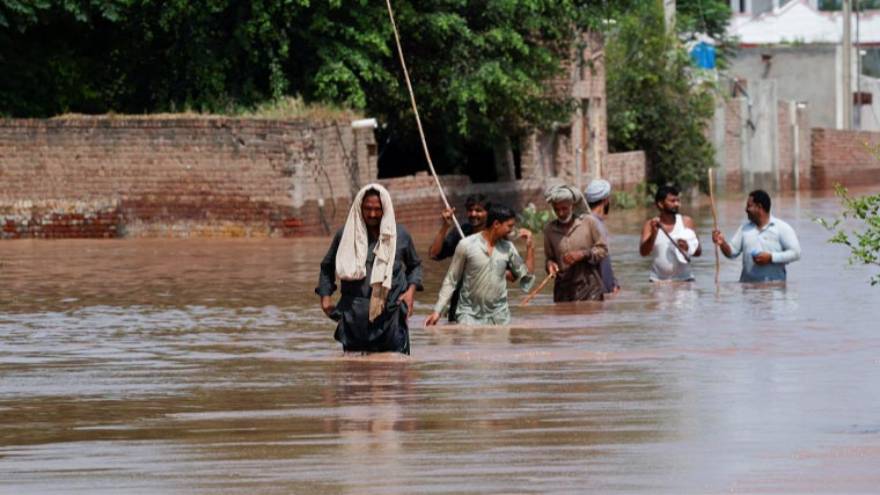
Summary Authorities open spillways, urge evacuations in low-lying areas
LAHORE (Dunya News) – Punjab is grappling with exceptionally high flood levels in major rivers, with authorities issuing urgent alerts to residents along riverbanks.
The Chenab River at Ganda Singh Wala is expected to sustain extreme levels until September 10, while the Indus near Guddu Barrage may see high to very high floods from September 6 to 7.
Ongoing heavy rains have exacerbated the situation, prompting the opening of spillways and widespread evacuations.
پی ڈی ایم اے پنجاب کی جانب سے دریائے ستلج اور دیگر مقامات پر اونچے درجے کے سیلاب کا الرٹ جاری کر دیا گیا ہے۔
— PDMA Punjab Official (@PdmapunjabO) September 3, 2025
عوام سے گزارش ہے کہ احتیاطی تدابیر اختیار کریں اور ضلعی انتظامیہ و ریسکیو اداروں کے ساتھ تعاون کریں۔#PDMAPunjab #FloodAlert #Punjab #StaySafe #EmergencyPreparedness pic.twitter.com/AEb9p69a3y
At Head Marala on the Chenab, water discharge has surpassed 531,000 cusecs, forcing the closure of the river bridge and deployment of police at both ends. Khanki and Qadirabad Headworks are recording flows of 339,470 cusecs and 232,450 cusecs respectively. Meanwhile, Trimmu and Panjnad Headworks are observing 355,744 and 182,107 cusecs. The Sutlej River is swelling, with Ganda Singh Wala reporting 269,501 cusecs and Sulemanki Headworks at 122,736 cusecs.
Over 3,300 villages across Punjab have been impacted, displacing more than 3.36 million people. Relief authorities have established more than 400 relief and medical camps and 385 veterinary camps. In Bahawalnagar alone, approximately 6,690 residents from 124 villages have been forced to evacuate due to flood surges. Nearly 800,000 animals have also been shifted to safety.
High alert
Authorities remain on high alert as floodwaters from the Indian mainland and occupied Kashmir are expected to flow into Pakistan. NDMA officials have warned that free-flooded water from the Sutlej and Beas rivers is heading towards Kasur and Ganda Singh Wala, while rivers in Punjab, including Ravi, Chenab, and Jhelum, are expected to converge at Panjnad in Bahawalpur, Rajanpur, and Muzaffargarh by September 4. Precautionary measures, including evacuation alerts and dam spillway operations, continue to protect communities and agricultural land.
River Situation and Flood Forecast September 03, 2025#FloodAlert #floodwarning #pmdweather #monsoon2025 pic.twitter.com/kZ0mAbgQRV
— Pak Met Department محکمہ موسمیات (@pmdgov) September 3, 2025
Khanpur Dam has reached full capacity, prompting the opening of spillways and advisories for residents and tourists. In addition, explosives were used at Myi Safuran bund near Head Sidhnai to prevent breaches, diverting water to safer channels and reducing potential damage to nearby settlements.
Punjab authorities have urged citizens to remain vigilant, particularly in low-lying areas and along riverbeds, while monitoring continues for further rainfall and flood surges expected until September 10.
Severe flooding at key locations
According to the Punjab Flood Forecasting Division, flood conditions persist in Punjab's rivers.
Extremely high flood levels have been recorded at Head Sidhnai and Ganda Singh Wala.
Chenab River shows very high flood levels at Head Khanki, Head Qadirabad, and Chiniot Bridge.
High flood levels have been observed at Head Marala, Ravi Syphon, Shahdara, Balloki, and Head Sulaimanki, while medium-level floods are reported at Trimmu, Jassar, Islam, and Mailsi Syphon.
Lower-level floods are occurring at Guddu, Sukkur, Kotri, and Panjnad.
Tributaries connected to the Chenab, like Nullah Aik and Nullah Palku, are also experiencing very high and high flood levels respectively.
Water levels in Basantar and Nai Nullah, tributaries of the Ravi, have begun to recede.
Losses and damages
In Kasur, a high 319,000 cusecs flood wave is passing through the Sutlej River at Head Ganda Singh Wala, submerging over 100 villages, including Nooriwala, Bhedian, and Usmanwala.
People are forced to live under open skies, suffering loss of livestock and crops as 132 villages and 18,000 acres of land are underwater.
In the Lodhran area near Luddan, high-level flooding in the Sutlej River broke protective embankments at Mehar Baloch, submerging many settlements. The building of a government elementary school collapsed and furniture were swept away by water current.
In Kabirwala areas like Kund Sargana, Qatalpur, and Barbegi, floodwaters from the Ravi entered villages, breaking through several self-made protective barriers.
Gujrat received 506 mm of rain in 24 hours, causing severe urban flooding. Locations like Kutchery Chowk, Gondal Chowk, Zahoor Elahi Stadium, and Jail Chowk were submerged under four feet deep water. A house was washed away due to flooding in Nullah Bhindar and Nullah Bhimber. Session Court, government offices, and shops were flooded.
In Multan, floodwaters reached the railway bridge, while in Shujabad, more settlements went underwater. People began relocating on self-help basis.
In Lodhran, embankments in five villages broke, disconnecting them from land routes.
In Khanewal, 136 villages and in Toba Tek Singh 75 villages have been affected.
In Kot Momin (Sargodha), the flood wreaked havoc in Ram Diyanah, submerging multiple buildings including a government elementary school.
At Shorkot, the Chenab is again at high flood levels, inundating nearby areas along Jhang-Multan Road. Army and rescue teams are actively carrying out relief operations.
In Multan, river erosion due to flooding has caused land loss. In Pindi Bhattian, floodwaters from the Chenab have entered various areas, flooding the Government Technical College and a police patrol post.
Railway colonies near Jhok Venus were devastated, while in Chishtian, floodwaters engulfed an entire village, forcing residents to seek shelter on rooftops.
Water levels are rising again at Head Islam, submerging more villages. In Vehari, more than 15 government schools have been destroyed by the floodwaters.
3.5 million people affected
Provincial Disaster Management Authority (PDMA) Director General Irfan Ali Kathia reported:
The death toll from floods in Punjab has reached 46.
Over 3.5 million people have been affected.
Nearly 4,000 villages have been submerged.
Around 1.5 million people have been rescued.
Over 1 million livestock have been moved to safer areas.
Chenab would again flow into the affected areas at Qadirabad, increasing threats to Jhang.
A wave of 900,000 cusecs is expected to enter Sindh during the night of September 6 and 7.
Crops destroyed
The floods have destroyed crops on over 1.326 million acres in Punjab:
Faisalabad Division: worst-hit with 323,215 acres damaged
Gujranwala Division: 262,000 acres affected
Gujrat Division: 238,000 acres destroyed
Bahawalpur Division: 145,000 acres
Sahiwal Division: 137,000 acres
Lahore Division: 99,421 acres