Summary Karan Johar says he would never make a film on partition since he didn’t want to discuss history
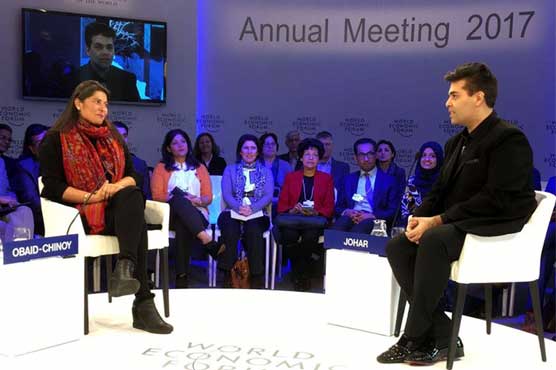
DAVOS: (Web Desk) – In a candid conversation in Davos on the sidelines of World Economic Forum (WEF), Indian filmmaker Karan Johar and Sharmeen Obaid-Chinoy discussed the issues related to the artists and the film industries of the two countries. The two leaders in their respective genres of film discussed how they had to face the hatred of the people from their respective countries for saying things that didn’t sit well with the general narrative.
On one point in the conversation, a person sitting in the audience asked a question from both if they would make a film against the Partition of the Indian subcontinent in 1947. Karan Johar was visibly taken aback by the question. He said that he would never want to recreate something that had already happened. He said that it was impossible to grasp all that had happened back then, even through the history books.
“Nothing in history can be called a mistake. There were so many circumstances that lead to what happened. So it’s very easy for us to get all academic and historian about it today. We weren’t there at that time. We weren’t the ones making those decisions, we weren’t helming those decisions, and we don’t even if we have the accurate facts today. I won’t make any film about that at all”.
“I said that I was trying to be strong but I never said that I was retardedly brave”, said Karan, sending the audience into fits of laughter.
Sharmeen said that this generation would rather want a strong bloc, to have less borders, to have fluidity and exchange. “You know we can’t go back and change the history. But we can change the future, and we must change the future. I would love to work on projects that show collaboration, on projects that show that in the end we are all one people, and that a boundary doesn’t make you the other or an enemy”, she said.
On criticism:
“I was quite young when I started writing and people had a problem with everything I did. Over the years I began to realise that people speak out because they know you have a voice and you have an impact, and so they want to drown out your voice”, Sharmeen said while she discussed the criticism that has come her way over the years.
She said that she hated indifference. “I would rather have people love me or hate me, and not be indifferent. So in Pakistan, either people love me or hate me. I think those criticising are actually misdirecting their criticism. I’m not the one committing those atrocities of course. And these people don’t know they’re criticising the wrong thing. No culture or religion condones or supports acid-throwing on women of course”, she said.
Karan Johar said that it was a normal thing for him now to get abused on social media. “I react very strangely to praise now”, he said. “I say something about a film and I receive a response: Gay. Or something like: Shut up, homo! I mean, how is it a response to something I said about a film”, said Karan.
On Indian films in Pakistan, Pakistani actors in India:
“I don’t ever want to go through what I went through again. Neither the situation or the circumstance nor the apology. None of that is something that made me feel comfortable. I felt weak, I felt vulnerable, I felt victimised, and as a filmmaker I never want to feel any of that again. All I wanted to feel was creatively liberated”, Karan said when Sharmeen asked him the Fawad Khan question.
“Your creative liberation comes from the fact that you’re work is so accepted internationally, whereas my level of impact is purely national. My work has not been international. I want to get the Academy award too and I have prepared a speech for the award too but I may not be able to make it”, Karan told Sharmeen.
Sharmeen said that it was heartbreaking sometimes to not be able to do something that one wants to do creatively, just because there is a boundary between the two countries. “But I hope for a better tomorrow because certainly we are the people who would want to forge forward with a connection”, she said.
When asked by a woman in the audience why it was the films that were banned every time there was some kind of rift between the two countries, Sharmeen said that films were the easiest things to ban. “In Pakistan, it is a self-imposed ban. Government didn’t ban the films. They just decided to be ‘patriotic’. But I think that we need to make a noise so that more generations would not have to endure this self-inflicted hatred that we have”, she said.