Updated on
Summary
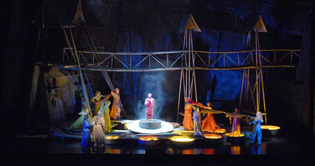
Richard Strauss's Die Frau Ohne Schatten (The Woman Without a Shadow) premieres for the first time in Russia on the Mariinsky stage in St. Petersburg.Considered to be Richard Strauss's favourite, most beautiful and most musically challenging opera, the piece is set to a complex libretto by symbolist and poet Hugo von Hofmannsthal. It contains layers of symbolism and philosophical references from the ideas of Freud, Jung, Shopenhauer and Nietsche, and is rarely staged. Internationally acclaimed British director, Jonathan Kent, after his previous success in 2007 at the Mariinsky with Strauss's Elektra, took on the challenge of staging Die Frau Ohne Schatten.The plot centres on the story of a doe, which is transformed into a woman and marries the Emperor. Her transformation to a human remains incomplete, however, until she can acquire a shadow - a symbol of the ability to bear children. If she does not find a shadow in time, her husband will turn to stone. The heroine faces a difficult choice: in order to save her husband she must agree to a dubious covenant with the dyer's wife - an agreement filled with deceit and treachery. Filled with unexpected twists, the opera eventually ends in sacrifice, grace and triumph for the two couples. The cast has been learning the extremely complex musical material, which features elaborate material for five main characters, for over a year. With elements of magic and symbolism, Die Frau Ohne Schatten even though it is considered to be Strauss's most fascinating work, is far less often staged than his other operas, such as Salome and Elektra, which have already both been performed at the Mariinsky. The sophisticated set designs for Die Frau Ohne Schatten were conceived by designer Paul Brown, intertwining the everyday world of Barak the dyer and his wife, and the magical world of the Emperor and the Empress, and combine contemporary technology with traditional, picturesque sets.Well-known and highly acclaimed Valery Gergiev, general director and artistic director of the Mariinsky Theatre, and principal conductor of the London Symphony Orchestra lends his talent to the production as the musical director and conductor of the premiere.