Summary The Shahi Mosque of Chiniot was built in the 17th century during the reign of Mughal emperor Shah Jahan
CHINIOT (Muhammad Ali) – The city of Chiniot holds a distinguished place in the Subcontinent due to its historic buildings, exquisite woodwork, and ancient architectural style. Located along the banks of the Chenab River, the city is home to several monuments from the Mughal era. Among them, the most prominent and significant structure is the Shahi Mosque of Chiniot.
Construction during the Mughal era
The Shahi Mosque of Chiniot was built in the 17th century during the reign of Mughal emperor Shah Jahan. The mosque is associated with the powerful Mughal leader Saadullah Khan (1595–1655). Historical records suggest that construction began in 1646 and was completed around 1655.
At that time, the Mughal Empire was at the height of its power, and architecture was characterized by beauty, symmetry, and grandeur. These qualities are clearly reflected in the design of the Shahi Mosque.
Role of Saadullah Khan
Saadullah Khan was originally from Chiniot and was one of the most influential figures in the Mughal Empire. Keeping the development and religious needs of his hometown in mind, he commissioned the construction of this magnificent mosque. As a result, the mosque served not only as a place of worship but also as a social and community center.
Location in the heart of city
The Shahi Mosque is situated in the center of Chiniot, on an elevated platform surrounded by old bazaars. Its location was deliberately chosen so that it could serve as a focal point for religious and social activities. The historic markets around the mosque suggest that the area has been a hub of commercial activity for centuries.
During the Mughal period, religious buildings were often constructed in places where people could easily gather, and the Shahi Mosque reflects this tradition.
Architectural Features
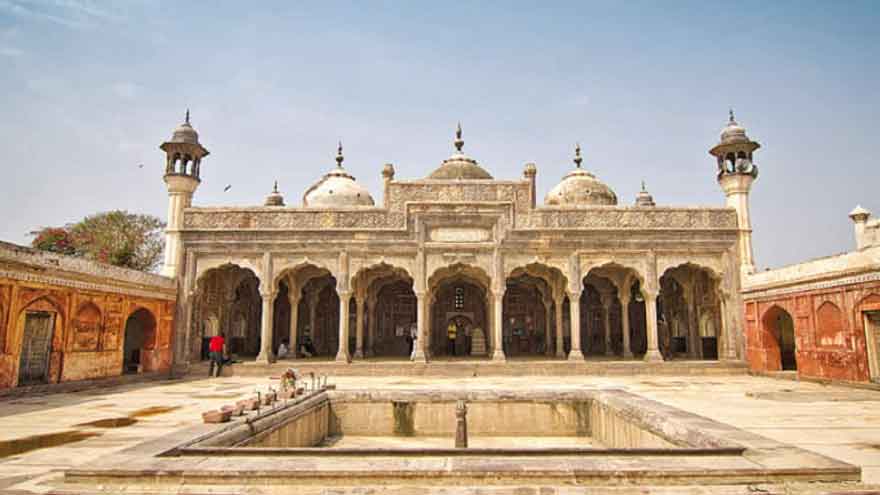
The architecture of the Shahi Mosque is a fine example of Mughal design. The overall structure follows the Seven-Bay architectural style, which was common during the Mughal period. In this layout, a row of arches stands before the main prayer hall, creating balance and elegance.
At the center of the mosque is a spacious courtyard, an essential element in Mughal mosques to accommodate large congregations during Friday and Eid prayers.
Arched verandas surround the courtyard, providing shade and enhancing the aesthetic appeal of the building. These arches reflect the traditional simplicity and dignity of Mughal architecture.
Another notable feature is the mosque’s raised platform, beneath which shops were built. The purpose of these shops was to generate a steady income to cover the mosque’s expenses. In this way, the mosque functioned not only as a place of worship but also as a self-sustaining institution. Such economic arrangements were common in Mughal-era religious structures to support their maintenance.
Unique use of columns
One distinctive aspect of the Shahi Mosque is the use of columns to support the verandas in front of the qibla arch. In most Mughal mosques, roofs were typically supported by walls and arches, so the use of columns here is considered somewhat unusual.
Architectural experts note that a similar style can be seen in the Moti Masjid, which was also constructed during the reign of Shah Jahan. This suggests that architects of that era experimented with new designs and construction techniques.
A blend of simplicity and grandeur
Although the mosque is impressive in design, it features minimal decorative embellishments. This simplicity reflects a key principle of Mughal architecture, where balance and elegance were emphasized over excessive ornamentation.
The arches, domes, and verandas are proportionately designed, and the building was constructed using brick and lime mortar. Even after centuries, the structure remains strong and retains much of its original form.
Historical and cultural significance
The Shahi Mosque of Chiniot is not only a religious structure but also a historical document that reflects the culture, religious life, and urban planning of the Mughal era. For centuries, it has served as a center for worship, education, and social interaction for the people of the city.
The mosque also highlights how influential Mughal officials invested in public welfare projects in their hometowns. Saadullah Khan’s construction of this mosque stands as a prominent example of that tradition.
Today, the Shahi Mosque remains one of Chiniot’s most important historical landmarks. Locals regard it with great respect, while historians and architecture enthusiasts consider it an important site of heritage. With proper preservation and conservation, the mosque could play a significant role in protecting Pakistan’s cultural heritage and promoting tourism in the region.