


'Mass rape' survivors in Indian-occupied Kashmir fight for justice
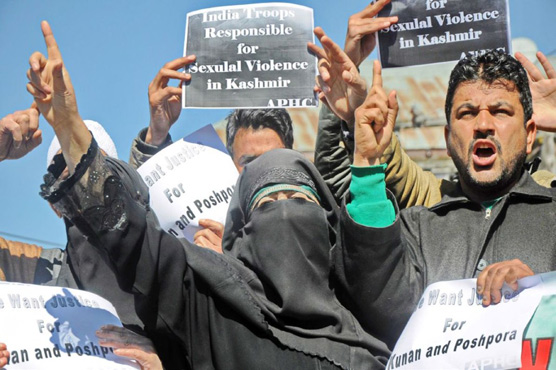
The people of Kunan and neighbouring Poshpora accuse the Indian army of carrying out a planned mass rape of more than 30 women in these villages. Photo: Kashmir Reader
(Web Desk) – It was about 26 years ago when Indian soldiers allegedly raped more than 30 women in the Kashmiri villages of Kunan and Poshpora. According to a report by the BBC, the survivors of the attack are still fighting for justice.
It was the night of 23 February 1991, the people of a tiny village named Kunan, located at Indian administered Kashmir s Kupwara district, were about to retire after a cold winter day.
Zooni and Zarina (not their real names) were also ready to go to bed when they heard impatient knocks, on the door.
At the time, India had been hosting a large scale military operation in order to control a popular armed rebellion against Indian rule in Kashmir. So-called "cordon and search" operations, locally called "crackdowns", were becoming routine and still persist to this day.
In the 90s, this would entail the Indian security forces isolating an area, getting all the men out, and then searching their houses. The men would be marched in front of an informer - and suspected militants or those supposed to be sympathisers would be picked up and taken away.
.jpg) One of the women (right) speaking to BBC reporter on what happened when the soldiers were sent. Photo: BBC
One of the women (right) speaking to BBC reporter on what happened when the soldiers were sent. Photo: BBC
When Zooni and Zareena saw soldiers on their doorstep that night, they thought it was the beginning of another of these so-called crackdowns. The men were picked up and forced to leave the house, while the soldiers stepped in, as was the established practice.
Recalling that day, makes their eyes fill with tears even now.
“We were getting ready for bed when the soldiers came. They took the men away. Some started drinking alcohol. I was holding my two-year-old daughter in my arms when they tried to grab me.”
“I resisted, and in the scuffle she fell out of my arms, and out of the window. She was crippled for life.”
"Three soldiers grabbed me, tore my pheran, my shirt - I don t even know what all happened after that. There were five of them. I still remember their faces.”
Zareena was also in the same house. She was newly married and it had only been 11 days since she became a bride.
“I had returned from my parents house that very day,” Zareena said.
"Some soldiers asked my mother-in-law about all the new clothes hanging in the room, so she told them, here, she is our new daughter-in-law, our new bride . What happened after that, I cannot begin to describe it.”
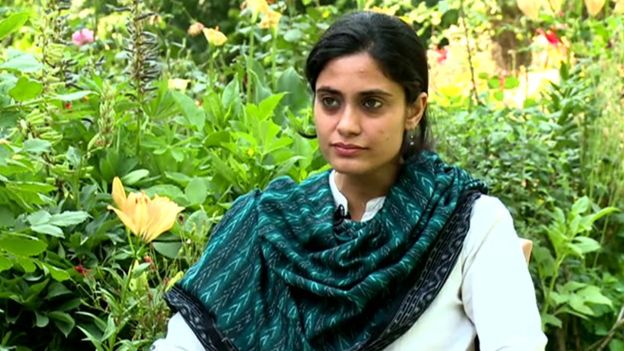
Natasha Rathar and other activists wrote a book about the case. Photo: BBC
“We haven t just been wronged, what we have faced is an infinite injustice. Even today when we see soldiers we start shaking with fear,” she added.
The people of Kunan and neighbouring Poshpora accuse the Indian army of carrying out a planned mass rape of the women in these two far-flung villages. They also claim that while the women were gang-raped, the men were subjected to horrific torture, and that they have been fighting for justice these last 26 years.
Naeem Akhtar, a minister in the state government of Srinagar talked to BBC about these allegations and said that in conflicts like Kashmir truth often gets obscured by the layer of dust that settles on it.
And now, a group of young Kashmiri women is determined to wipe away this dust and stand for their rights.
In 2013 they filed a petition to reopen the case in the state High Court.
A young scholar named Natasha Rathar is one of the women who have put their names on that petition.
Natasha, along with four other young Kashmiri women, has also authored an award-winning book on this case, titled Do You Remember Kunan Poshpora?
Natasha said that their motivation for reopening the case was quite simple.
“This was such a big case of mass rape, in which those affected had actually come forward and had demonstrated so much courage.”
"And there was a huge body of evidence too. So we felt that this case needed to be reopened."
And the case was reopened due to Kashmiri women’ struggles, after a lengthy and difficult process the Jammu and Kashmir High Court directed the state government to pay compensation to those affected.
The state government initially agreed, but then changed its mind, and challenged the High Court s decision in the Supreme Court of India, where the case is still being heard.
The allegations were denied by the Indian army, continuously.
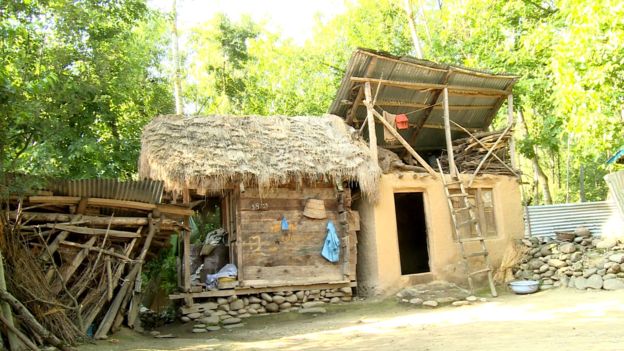
The area was put under lockdown that night by Indian forces. Photo: BBC
When they were requested for an interview, they just sent a statement.
An army spokesperson told BBC that these allegations had been independently investigated three times, and that the case had been closed due to conflicting statements.
In Kashmir most officials seem to speak in what sound like cautious parables. But not all.
Nayeema Ahmad Mahjoor, who heads the state commission for women s rights, told BBC very clearly that she believes that this crime was committed against the people of Kunan and Poshpora, and that this should be proved in court.
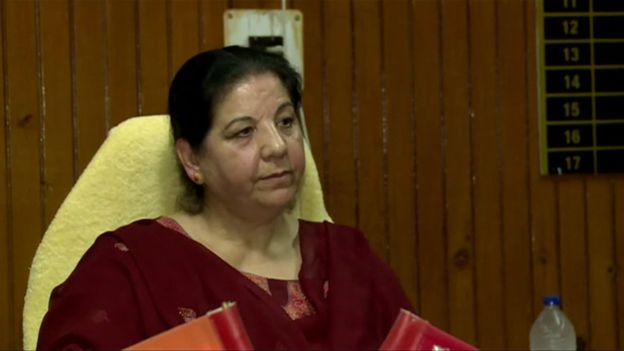
Nayeema Ahmad Mahjoor says the crime should be proved in court. Photo: BBC
She however stressed that the state government cannot interfere in the legal process.
What really happened in Kunan and Poshpora that fateful winter night is something we might never find out.
But a new generation is coming of age here now. The village and its houses are changing, and yet there are some painful memories that continue to haunt the residents.
