


No regrets: The Indian who changed his name to 'Regret'
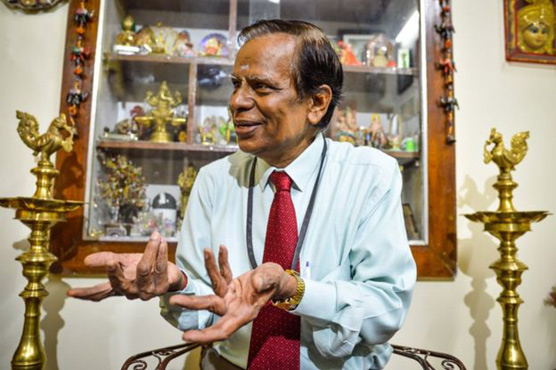
While a few of his works did get published, most were rejected and within a few years, he collected 375 regret letters from all sorts of organisations. Photo: BBC
(Web Desk) – An Indian man with many talents, who once aspired in his youth to be a journalist, changed his given name Sathyanarayana Iyer to ‘Regret Iyer’.
Amongst many other things, Iyer describes himself as a writer, publisher, photographer, journalist, cartoonist and many other things.
In an interview to BBC’s Geeta Pandey, the 67-year-old described his childhood aspiration and one of them was to be a journalist which ultimately led to changing his name. Iyer as a college student in the late 1970s wrote an article asking a philosophical, existential question like many teenagers ask, “Who am I?”
Following this he earned enough confidence to believe that he could be a journalist.
The enthusiastic writer began writing “letters to the editor” – in today’s digital world, they would be similar to a comment on an online article – and many of his work got published. He became more ambitious and sent an article to Janavani, a popular Kannada-language evening newspaper, on the history of Bijapur town.
A few days later, he got it back with a "regret letter". The letter began with the editor thanking him for his interest in the newspaper, but expressing his regret at being unable to carry the story.
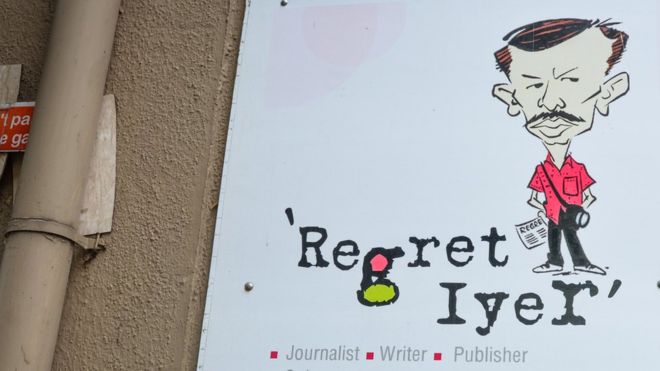
The name plate outside the door with Regret Iyer initials. Photo: BBC
"I was disappointed, but not disheartened," said Iyer to the BBC.
Iyer didn’t give up. He kept sending unsolicited letters, articles, cartoons, photos and even poems to English and Kannada newspapers. He wrote about temples, tourist places and also on topics of news interest. His letters complained about public grievances, poor bus services and garbage pile ups.
Senior local journalists who had dealings with him in the 1970s and 80s say "he was the stuff an editor’s nightmares were made of".
A few of his works did get published, but most of them were rejected and within a few years, he had collected 375 regret letters from all sorts of organisations - "not just Indian, but also international".
"I was bombarded with regret letters," he said. "I had no idea why my material was being rejected.
I began thinking, what is it that I am lacking? But there was no attempt on the part of the editors to tell a writer or a photographer what the problem with his material was."
It was his "shabby" writing, said veteran journalist Nagesh Hegde who is credited with giving Iyer his new name.
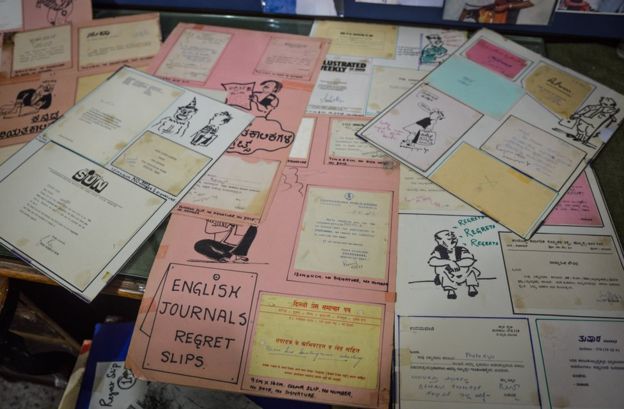
He received hundreds of regret letters from newspapers and magazines. Photo: BBC
"He was a good hunter and gatherer of news - he had a lot of talent for identifying stories, but he had no capability to write in an appealing manner and wrote very shabbily," Hegde explained to Pandey in an interview.
Then one day in 1980, Iyer visited the Prajavani office after another of his submissions was rejected and told Hegde about his collection of regret letters.
"I asked him for proof. The next day he returned with hundreds of regret letters."
So in his column next week, Hegde wrote about "Regret Iyer".
"Anyone else would be embarrassed and hide the letters, but he proudly displayed them," he told me. Ever an optimist, Iyer knows how to turn this adversity into his biggest advantage, using his failures as a stepladder to success.
"The editors said they had considered several names for me and finally zeroed in on Regret Iyer,” Iyer said, adding that when he got the new name, "I realised that pen is mightier than a sword."
So he went to the civil court and got an affidavit done to officially change his name.
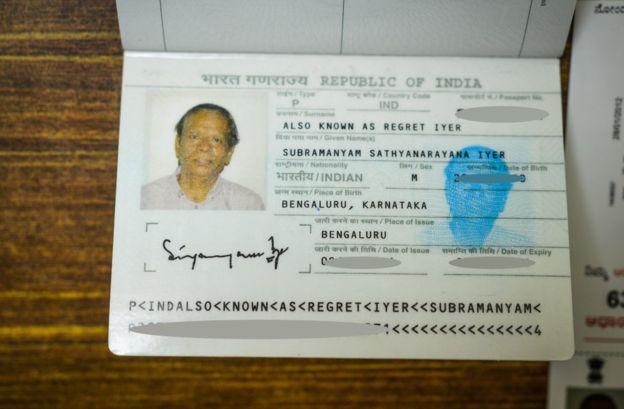
Sathyanarayana Iyer went ahead and changed his name to "Regret Iyer". Photo: BBC
"I also changed my name in my passport and my bank account. In my wedding invitation card too, I used my new name.
"At first people laughed at me. This foolish man, he must be mad, they said. There was humiliation. But my father gave me courage. I feel like I’m the luckiest person to walk the earth because my family supported me whole-heartedly," he said.
Gradually, life turned for him - more and more of his letters and photographs began to be published. He had learnt to do the right things and all the major English and Kannada papers in Karnataka began accepting his submissions.
"I was a one-man army with my camera, pen, scooter, helmet and even shirts marked with a logo that said Regret Iyer."
In time, his wife and two children also adopted Regret as their middle names.
.jpg)
Regret Iyer’s family took Regret as their middle name. Photo: BBC
"For us he was a real pest, but for readers, he was great. People always look first at small quirky items in the papers and magazines, and his reports and photographs were an ideal fit for them and he gained in popularity.
"His biggest strength was his persistence," added Hegde. "Other reporters would do the assignment and return, but he would linger. He’d go to any length to get a story: he’d hide behind dustbins, get a scoop. After he became famous, officials began to dread him.
"He carried his camera all the time - he took pictures of fake beggars, fallen trees, police atrocities, water tap leakages and garbage on the streets."
Despite his long list of failures, Iyer said he never got bogged down by them because he has had a long relationship with rejections.
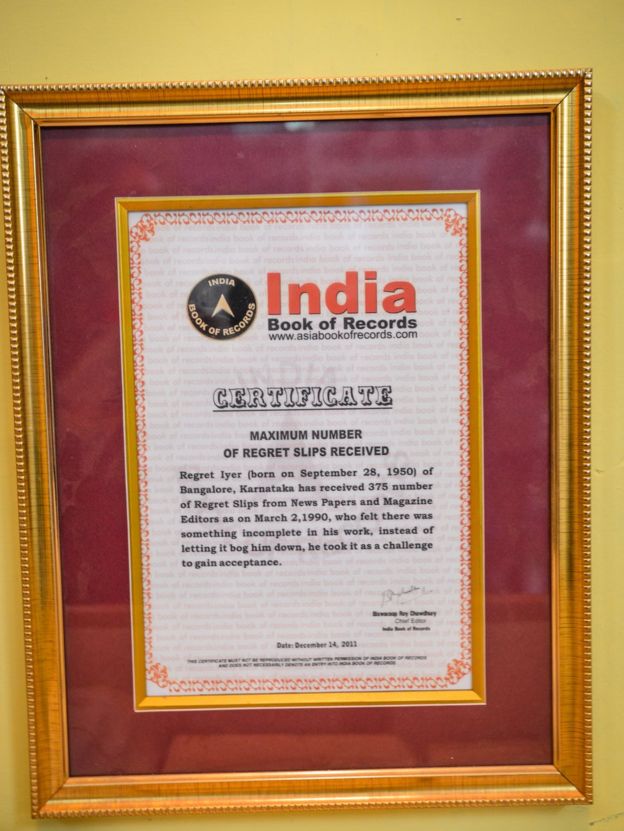
He has made it to the Limca Book of Records for "maximum number of regret slips received". Photo: BBC
At times, he even revels in his failures. "I attempted to create an international regret slip collectors’ association, but no-one came forward to join it. You see, no-one wants to be a failure."
When asked if he has ever regretted the decision to change his name, "No," was his immediate reply, adding that he would go down in history as the collector of regret letters.
"A day will come when there won’t be any regret letters. In today’s digital world, many people already ask me what is a regret letter? But one day, all the computer servers in the world will shut down, but my cupboard with regret letters will remain."
This story originally appeared on BBC.
