


Transgender community dismisses Women Protection Law 2016
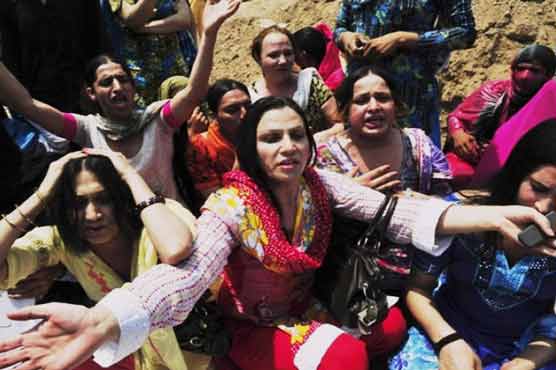
Multan's transgender community rejects Women Protection Bill
Dunya News Report (Humaira Sajid)
ISLAMABAD – Members of the Shemale Association in Multan objected to the Women Protection Bill 2016, terming the bill as against ‘man’s honor’ and demanded the government to review it.
The association members said that the Protection Bill will not provide assistance in cases like “Vani” (forced child marriages) and denied inheritance. Perhaps, the overgrowing resentment of the transgender community against the Women Protection Against Violence Bill emanates because of their often exclusion from the strategies that are structured to curb the disproportionate violence and discrimination.
Unfortunately, the state has solutions to offer but only on paper, as little has been done for the rights of people who are transgender in Pakistan.
The Women s Protection Act, passed by Pakistan s largest province of Punjab last week, gives unprecedented legal protection to ‘women’ from domestic, psychological and sexual violence. It also calls for the creation of a toll-free abuse reporting hot line and the establishment of women s shelters.
However, since it passed in the Punjab Assembly, powerful Pakistani religious bodies as well as a few politicians in cold sweat denounced the new law as being in conflict with the Muslim holy book, the Qur’an, as well as Pakistan s constitution. The transgender association members also speaking against the bill said: “the bill is an attempt to shift towards an adversely liberal society, which would escalate the divorce cases in the future.”
Several terms are used nationally and internationally to refer to people who do not fall in one of the categories of the established gender identities: male or female. However, the most commonly used terms in English language are transgender, eunuch, transsexual, transvestite and hermaphrodite. In Pakistan, khawaja sara, murat, hijra and khusra are widely to refer to such people.
According to a survey conducted by Aurat Foundation, there are estimated 500,000 ‘third-gender’ citizens in Pakistan. In 2012, the Pakistani government recognized the transgender population and a three-member bench of the Supreme Court, headed by former chief justice Iftikhar Muhammad Chaudhry, ruled that the transgender community is entitled to rights guaranteed in the Constitution to all citizens, including the right of inheritance. Prior to this, as transgender did not classify themselves as ‘male’ or ‘female’ on official documents, they were barred from basic rights, such as voting. In the general elections of May 2013, five members of the community also contested polls.
However, while their rights are guaranteed on paper, members of the transgender community say they do not have these rights in practice. While the Supreme Court ordered that free education and free health-care must be guaranteed to the community, provincial departments have yet to implement this decision.
Although they occupy a marginalized space across Pakistan, “hijras” (another term used for transgenders in Pakistan) are probably worst off in Peshawar. In all of the other major cities in the country, they are frequently seen at traffic intersections or in shopping centers where they offer a prayer for a few rupees. Many passersby fear refusing them might mean a nuisance so they either oblige quickly or turn away completely.
The transgender are constantly harassed, threatened and often risk their lives for being the third gender. On 5 January 2015, the transgender human rights defender Adnan (also known as Adnany), a co-administrator of the TransAction Page, an online platform of the TransAction Alliance, was shot and critically wounded near the Pir Zakori Bridge in the city of Peshawar. He was subsequently rushed to Lady Reading Hospital in Peshawar, where before being operated on to have the bullet removed, he was allegedly refused treatment by doctors for approximately three hours, due to being a person of transgender.
Yet again on 6 April 2015, two members of the third-gender community were killed and another abducted and gang-raped by armed men in a predawn attack in the northwest Pakistan. The incident took place in the Swabi district of Khyber Pakhtoonkhwa Province, where a group of third genders was returning home after performing a music-and-dance show at a wedding party, told the investigation officer Sajjad Khan while talking to a private news channel.
The District Police Chief Sajjad Khan said the armed men were waiting for the ‘khawaja sarahs’ in a field and tried to abduct all of them but failed. Khan said the attackers then opened fire, killing two people on the spot and wounding one. However, the armed men successfully abducted one person who was released hours later, after being gang-raped by four men.
The discrimination against the community is evident from the fact that during the flood of 2013 that devastated half of the KPK province, the community was left out of the aid efforts and denied access to Internally Displaced Person camps because of general prejudice, their non-conforming appearance, and their lack of proper identification documents. The court order and ruling had no bearing on the provincial administration that denied the community their right to being treated as equal.
Holistically speaking, societal values, traditions, misrepresentation and misinterpretation of religion not only support, but also reinforce aggression, violence and oppression against khawaja sarahs. The general public considers them sleazy and evil for their inappropriate behavior, vulgar gesticulation, obscene language, sundry jokes and involvement in sex work. Interestingly, intolerance of the general society against khawaja saras based on their actual or perceived gender identity or expression adversely affects their psychological, physical, social and economic well-being.
The society needs to understand that no reason is good enough to exclude these people from the main stream society, or the human race in general.
