Summary Senate Republicans accelerate efforts to confirm Donald Trump's judicial nominees before Democrats take control of the chamber in January.
WASHINGTON (Reuters) - Republicans on the US Senate Judiciary Committee on Tuesday began a push to consider and advance as many of President Donald Trump's remaining judicial nominees as possible before Democrats take control of the chamber in January.
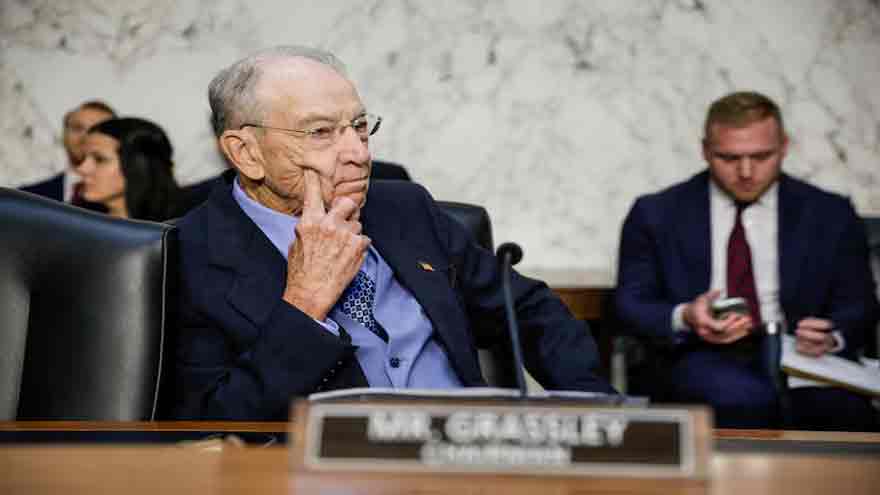
Senator Chuck Grassley, the committee's outgoing Republican chairman, dismissed Democratic complaints that Republicans were bypassing longstanding committee practices to speed nominees toward confirmation, saying, "I know what's coming."
"I want to be very clear: Some Democrats so despise President Trump that for the first time in our nation’s history they’re planning to stonewall a president’s ability to appoint judges," Grassley said.
Committee Democrats undercut that message somewhat when four of them joined Republicans in supporting Kyle Reardon of Alaska, a Trump district court pick whose nomination advanced 16-6.
Three other district court nominees, Daniel Ballou for the Eastern District of Kentucky, Richard Bennett for the Southern District of Texas and Courtney Coker for the Northern District of Texas, cleared the panel on party-line 12-10 votes.
he committee then held a hearing for four additional judicial nominees, including Todd Butler, a partner at Phelps Dunbar in Mississippi who was nominated to a seat on the New Orleans-based 5th US Circuit Court of Appeals.
Several additional judicial nominees are expected to appear on November 18, including two in Texas who were put forward only after Democrats came out on top in the November 3 midterms.
Should they be confirmed by the full Senate, they would add to 56 lifetime judicial appointments Trump has made in his second term. He made 234 in his first stint in office, including three US Supreme Court justices who helped give the high court its 6-3 conservative majority.
Senator Dick Durbin, the panel's top Democrat, accused Republicans of cutting corners post-midterms to jam through Trump's remaining nominees during the lame-duck session.
He said the committee was holding hearings in back-to-back weeks, considering nominees less than 28 days after receiving required paperwork and proceeding even when FBI background checks had not been cleared by Senate staff.
"Why?" Durbin said. "Because Republicans are losing the majority and they are afraid that unqualified MAGA loyalists won’t withstand close scrutiny when Democrats are in the majority."
Butler, the only remaining appeals court nominee who had yet to appear before the panel, faced questions from Durbin and Democratic Senator Cory Booker of New Jersey about his work defending police officers accused of excessive force, including in a lawsuit involving the arrest and prosecution of a 10-year-old Black child for public urination.
Butler stressed that while he had defended a number of "difficult" cases, much of his practice was also focused on training law enforcement officers on how to not violate rights and how to respect people's civil rights.
"I defend them to the best of my ability, but that only tells half of the story of my practice," Butler said.