Summary Iran renewed attacks on US military targets and its regional allies on Monday, saying it had struck a command center near the Al-Tanf base in Syria.
DUBAI (Agencies) - Iran renewed attacks on US military targets and its regional allies on Monday, saying it had struck a command center near the Al-Tanf base in Syria, while Bahrain sounded air raid sirens as the latest escalation sent oil prices above $90 a barrel.
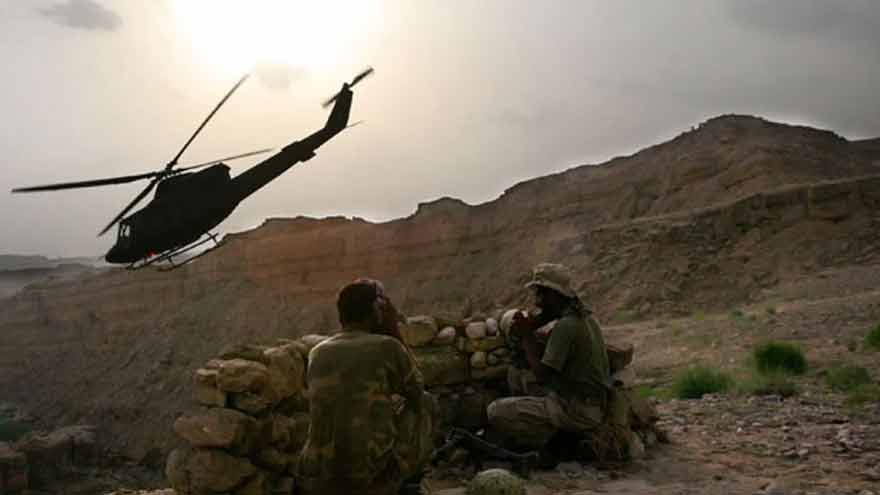
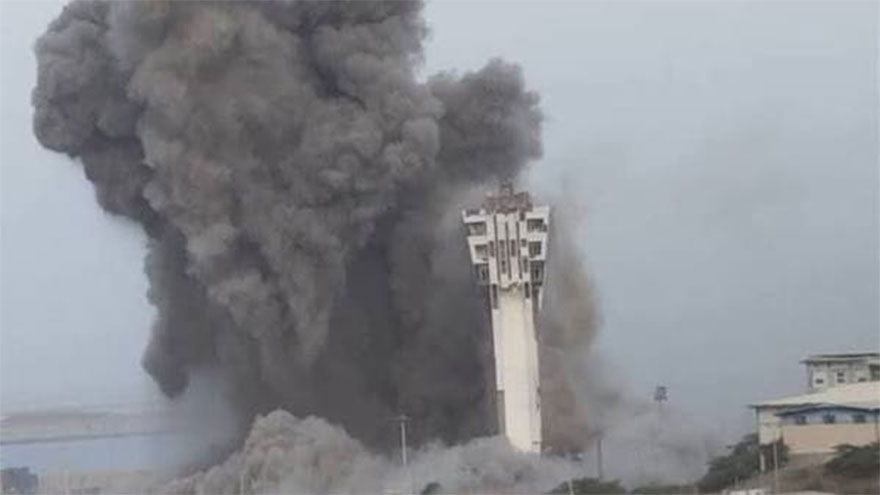
Iran’s Revolutionary Guards said they had launched a “surprise attack” on an enemy special operations command center in the Al-Tanf region of Syria, according to a statement carried by Iranian state news agency IRNA.
The attack was described as retaliation for the deaths of Iranian soldiers from Iranshahr, a city in southeastern Iran.
The Al-Tanf garrison, located near Syria’s borders with Iraq and Jordan, has long been used by US forces and partner groups operating against Daesh.
In Bahrain, the Interior Ministry said air raid sirens sounded overnight from Sunday into Monday and urged citizens and residents to remain calm and seek shelter.
“The siren has been sounded,” the ministry said in a statement posted on X.
Bahrain, which hosts the US Navy’s Fifth Fleet, has been targeted by Iranian strikes in recent days. The kingdom has accused Iran of attacking civilian areas.
Kuwait and Bahrain, both hosts to US military installations, have borne the brunt of Iranian attacks on US allies in the Gulf since fighting resumed this month despite a preliminary ceasefire and a memorandum of understanding between Washington and Tehran.
The renewed attacks also rattled energy markets.
Brent crude futures rose more than 3 percent on Monday to above $90 a barrel, while US West Texas Intermediate crude also gained more than 3 percent, as fighting disrupted energy shipments through the Strait of Hormuz.
The waterway, through which a significant share of the world's oil and gas shipments normally passes, has become the central flashpoint in the confrontation between Washington and Tehran.
Iran closed the strait after the war broke out and has used control over the strategic waterway as leverage in its confrontation with the United States. Washington has meanwhile reimposed its own blockade on Iranian ports.
On Sunday, the Revolutionary Guards said they had stopped two ships attempting to transit the strait, accusing four vessels of trying to use an “unsafe route” with what it called the “mischief and support of American terrorists.”
The Guards said two of the ships had suffered accidents and were stopped, while the other two abandoned their journey.
EARLIER STRIKE ON US FORCES IN JORDAN
The latest escalation follows a series of Iranian attacks on US assets and regional allies.
Jordan said on Sunday that it had intercepted missiles after an Iranian attack a day after the US military reported that two American service members had been killed there and another was missing while defending against Iranian ballistic missile and drone attacks.
The US military said a service member later died in northern Iraq during the controlled detonation of unexploded ordnance from a downed Iranian drone.
US Central Command said it had carried out an eighth consecutive night of strikes against Iran to “swiftly punish Islamic Revolutionary Guard Corps forces who launched attacks against American service members.”
The United States has confirmed 17 military fatalities since the war began with a wave of US and Israeli strikes on Iranian targets on Feb. 28.
Jordan later summoned Iran’s charge d’affaires to protest what it called the “continuation of brutal and unjustified Iranian acts of aggression” against the kingdom.
After air raid sirens sounded in Jordan, Israeli and Jordanian forces said they had intercepted an Iranian missile headed toward the Jordanian port city of Aqaba, near Israel’s resort town of Eilat.
The US Embassy in Amman had earlier warned its citizens of a “specific and credible threat” targeting Aqaba’s port and airport.
Iran did not immediately claim responsibility for that attack.
In the Gulf, Kuwait’s electricity ministry said a power and water plant was attacked for a second consecutive day, causing a fire. Bahrain’s military said its air defenses had intercepted and destroyed several Iranian aerial attacks.
US STRIKES AND NUCLEAR SITE TENSIONS
The renewed fighting followed US strikes aimed at punishing Iran after the deaths of American troops.
The Atomic Energy Organization of Iran said the United States had attacked the unfinished Darkhovin nuclear power plant in southwestern Iran, describing the strike as an aggressive act contrary to international law.
The International Atomic Energy Agency said it was examining the report and noted that the facility contained no nuclear material when it was last visited by inspectors.
IAEA Director Rafael Grossi nevertheless renewed his call for military restraint around all nuclear-related sites.
Iranian Deputy Foreign Minister Kazem Gharibabadi said Tehran would take “appropriate action” to defend its national interests and security.
Iran’s health ministry has said 50 people were killed and more than 500 wounded in the recent fighting.
Hopes for a political settlement have dimmed as both sides continue to fight over control of the Strait of Hormuz, although mediators have sought to bring Washington and Tehran back to negotiations.
Iran’s supreme leader Mojtaba Khamenei has vowed to teach the United States “unforgettable lessons,” while central military commander Ali Abdollahi has warned that further US aggression would trigger a “decisive and devastating response.”