Summary The online campaign gained traction after several issues, including rising living costs, unemployment and repeated exam paper leak scandals
(Web Desk) - A satirical online movement inspired by controversial remarks from India’s chief justice has rapidly transformed into one of the country’s most talked-about social media trends, attracting millions of young supporters frustrated by unemployment, inflation and political discontent.
The movement, called the Cockroach Janta Party (CJP), emerged after Justice Surya Kant compared certain unemployed youths and activists to “cockroaches” during a Supreme Court hearing. His comments triggered widespread criticism online, particularly among Generation Z users, many of whom viewed the statement as insulting and dismissive of young people struggling with economic hardship and limited job opportunities.
Although Justice Surya Kant later clarified that his remarks were aimed at individuals holding fraudulent degrees and not at all unemployed youth, the backlash had already gained momentum across social media platforms.
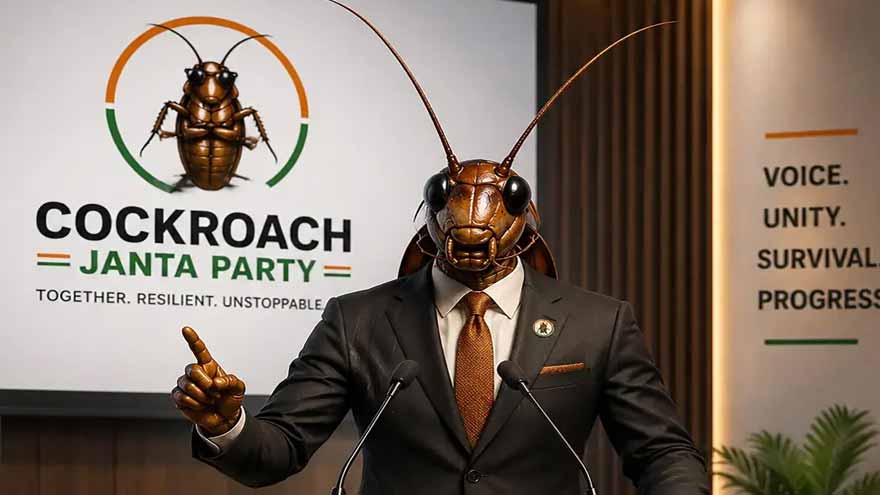
Capitalising on the controversy, political communications strategist Abhijeet Dipke launched the parody movement online, adopting the cockroach as its symbol to represent resilience and survival in difficult conditions. Through memes, satirical campaign slogans and humorous videos, the movement began criticising corruption, political dysfunction, unemployment and growing frustration among young Indians.
The campaign spread at remarkable speed. Within days of launching its website and social media accounts, the movement’s Instagram following surged over 19 million, surpassing the online following of Prime Minister Narendra Modi’s ruling Bharatiya Janata Party, which is over 8 million.
Dipke said the popularity of the movement reflected growing dissatisfaction among India’s younger generation, many of whom feel ignored by the political system and disconnected from economic opportunities.
The online campaign also gained traction after several issues—including rising living costs, unemployment and repeated exam paper leak scandals—sparked anger among students and job seekers across the country.
The CJP’s satirical manifesto openly mocks several sensitive political topics in India, including allegations of voter manipulation, criticism of mainstream media’s relationship with the government and concerns over judicial appointments. The movement’s tongue-in-cheek membership criteria describe supporters as “unemployed, lazy, chronically online and professionally frustrated.”
Although critics—particularly supporters of the ruling government—have dismissed the movement as a temporary internet trend or an opposition-backed digital campaign, its supporters argue that it reflects deeper social and political frustration among India’s youth.
Dipke, who previously worked with the Aam Aadmi Party, insisted the initiative is independent and not officially linked to any political organisation. He said the movement represents changing attitudes among young Indians who are becoming increasingly willing to openly criticise the government.
The movement has already begun extending beyond social media, with some supporters reportedly appearing at demonstrations dressed in cockroach costumes as a form of protest.
Meanwhile, Dipke claimed that one of the movement’s accounts on X, was temporarily withheld in India, though the reason was not immediately known. Shortly afterwards, he announced the launch of a new account, posting a message declaring that the “cockroach” movement had returned.