Summary Nebenzya said Russia would not support any resolution that singles out Iran while overlooking the underlying causes of the ongoing regional crisis
(Web Desk/Reuters) – Russia on Friday strongly rejected a US-backed resolution against Iran, calling it another attempt to inflame tensions in the region.
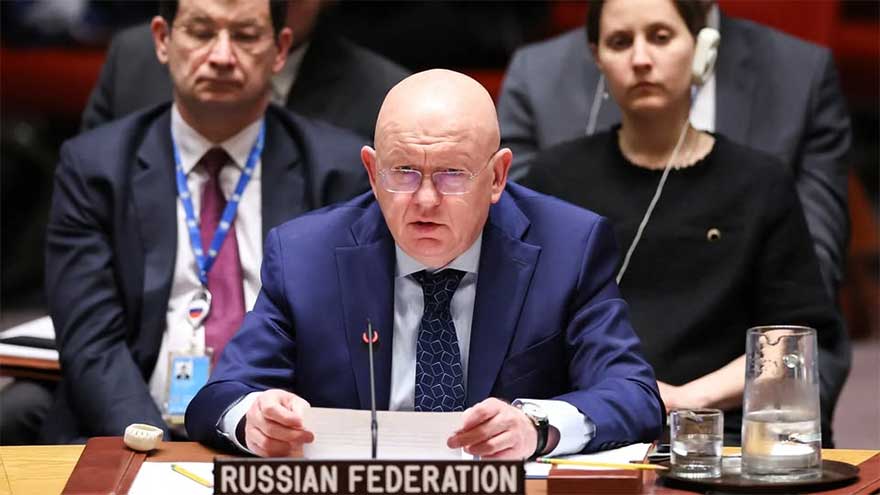
Russia’s Ambassador to the United Nations, Vasily Nebenzya, voiced Moscow’s opposition ahead of a vote during a United Nations Security Council session on maritime security in the Persian Gulf.
Nebenzya said Russia would not support any resolution that singles out Iran while overlooking the underlying causes of the ongoing regional crisis.
“Moscow rejects every attempt to impose a one-sided narrative against Iran,” he said, stressing that the roots and drivers of the conflict must also be addressed.
The Russian envoy warned that adopting what he described as biased resolutions could spark a fresh wave of instability across the Middle East.
He further argued that maritime security in the Persian Gulf cannot be ensured through unilateral condemnations or provocative measures, but rather through ending ongoing conflicts and halting military operations.
Russia also called on all Security Council members to avoid steps that could further escalate tensions and to refrain from introducing confrontational resolutions.
The draft resolution was introduced by the United States with support from Bahrain, Saudi Arabia, United Arab Emirates, Kuwait and Qatar. The proposal urged Iran to halt attacks and remove toll measures in the Strait of Hormuz.
US SEEKS SUPPORT
Earlier on Thursday, the US urged countries to support its United Nations resolution demanding Iran halt attacks and mining of the Strait of Hormuz, but diplomats said China and Russia are likely to veto it.
A Chinese veto would be awkward ahead of US President Donald Trump's trip to China next week, where the Iran war is like to be high on the agenda.
A previous resolution backed by the United States that appeared to open a path to legitimizing US military action against Iran failed last month after Russia and China exercised their vetoes in the 15-member UN Security Council.
Standing alongside envoys of Gulf countries that support the new draft, Washington's UN envoy Mike Waltz told reporters that any countries that "seek to throw it out, are setting a very, very dangerous precedent."
"We have to ask ourselves, if a country chooses to oppose such a simple proposition, do they really want peace?"
The new text was drafted by the US and Bahrain, with support from Saudi Arabia, the United Arab Emirates, Kuwait and Qatar.
Iran’s UN Ambassador Amir Saeid Iravani called the resolution “deeply flawed, one-sided, and politically motivated.”
“The United States has neither the legal, political, nor moral standing to portray itself as a defender of freedom of navigation or maritime security,” he said, referring to the US military’s blockade on Iranian ships.
Diplomats said the resolution ran into strong Chinese and Russian objections when the Security Council discussed it in closed session this week and would likely prompt them to veto this effort.
Bahrain's UN envoy Jamal Fares Alrowaiei said Bahrain looked forward "to working constructively with all council members in the days ahead to finalize this text."
Waltz's comments came as sources and officials said the United States and Iran were edging toward a temporary agreement to halt their war, with Tehran reviewing a proposal that would stop the fighting but leave the most contentious issues unresolved.
While Russia and China have not officially commented, one diplomat said Russia called for the draft to be withdrawn or completely rewritten. The diplomat said China contended the text was biased and criticized its invocation of Chapter VII of the UN Charter, which allows the Security Council to impose measures ranging from sanctions to military action.
The draft condemns Iran's alleged violations of the current ceasefire and its "actions and threats aimed at closing, obstructing, tolling" freedom of navigation through the strait.
It demands Iran immediately cease attacks, disclose the locations of any mines and not impede clearance operations.
On Tuesday, US Secretary of State Marco Rubio called the proposed resolution a test of the utility of the United Nations and urged China and Russia not to veto it.