


The war over US congressional redistricting: How is it playing out state by state?
World
The war over US congressional redistricting: How is it playing out state by state?

(Reuters) - U.S. President Donald Trump's demand that Republican-led states redraw their congressional maps to help his party retain control of Congress in next year's midterm elections has triggered a national battle over redistricting.
The fight began when Republicans in Texas, the most populous Republican state, approved a rare mid-decade new congressional map aimed at flipping five Democratic-controlled House seats. California, the most populous Democratic state, soon responded by initiating their own redistricting effort targeting five Republican-held districts there. Other states, both Republican and Democratic, have followed suit or threatened to do so.
Republicans won a House majority in 2024 by a margin of only three seats. The party appears poised to pick up several seats through redistricting, even if California's effort succeeds. Here is how the conflict is unfolding across the country:
REPUBLICAN GAINS
TEXAS - FIVE SEATS
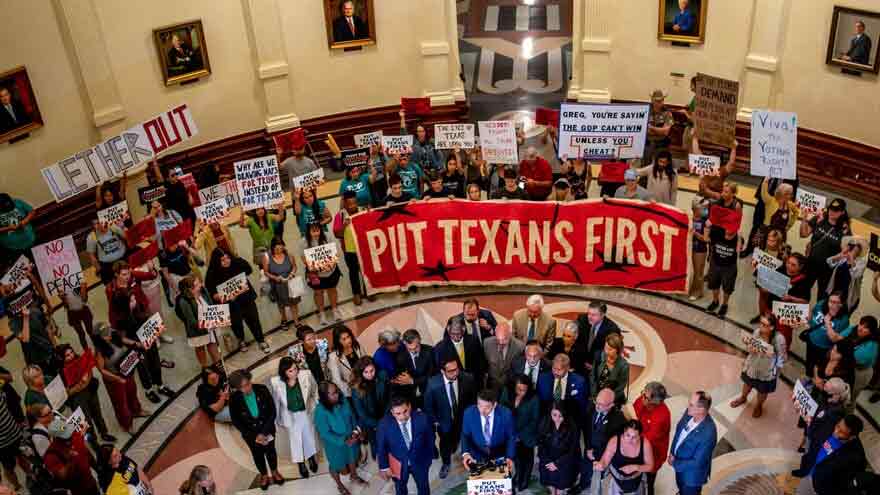
Governor Greg Abbott signed a new Republican-backed map into law on August 29 aimed at flipping five Democratic-held seats. More than 50 Democratic lawmakers had fled the state weeks earlier, temporarily preventing a vote on the map. The missing lawmakers returned after California Democrats announced a retaliatory redistricting effort.
Republicans already control 25 of Texas' 38 seats under a Republican-drawn map from 2021. Civil rights groups have sued Texas over the new map, arguing it illegally dilutes the power of minority voters.
MISSOURI - ONE SEAT
Republican Governor Mike Kehoe signed a new map into law on September 28 that dismantled a Democratic-held seat based in Kansas City, giving his party the advantage in seven of the state's eight congressional seats. Opponents are attempting to force a voter referendum on the map, while several organizations have filed lawsuits challenging its legality.
OHIO - AT LEAST TWO SEATS
A quirk in state law requires the Republican-dominated legislature to pass a new map for 2026, because the previous one, drawn in 2021, was approved with no Democratic votes. Republicans already control 10 of the state's 15 seats and are likely to target at least two incumbent Democrats.
NORTH CAROLINA - ONE SEAT
The state legislature's Republican majority approved a new map in October designed to flip a Democratic seat, which would give Republicans control of 11 of the state's 14 U.S. House seats despite its status as a closely divided swing state. Under state law, Democratic Governor Josh Stein had no say in the process.
INDIANA - POSSIBLY ONE OR TWO SEATS
Republican Governor Mike Braun has called for a special session starting on November 3 to consider redistricting, following a pressure campaign from the White House. Republicans already control seven of the state's nine U.S. House seats.
FLORIDA - POSSIBLY TWO OR THREE SEATS
Republican Governor Ron DeSantis has expressed support for a new map, which analysts believe could take aim at two or three Democratic incumbents. Republicans control 20 of the state's 28 seats, after DeSantis and the Republican-controlled legislature passed a map in 2021 that flipped four Democratic seats in 2022.
The effort would have to overcome a constitutional amendment, approved by voters in 2010, that bars the legislature from drawing districts purely for partisan gain. A majority of justices on the Florida Supreme Court, which upheld the 2021 map, were nominated by DeSantis.
KANSAS - POSSIBLY ONE SEAT
Some Republican lawmakers have advocated for a new map that would take aim at the state's only Democratic House member, Sharice Davids. Republicans have large enough majorities in both legislative chambers to override a veto from Democratic Governor Laura Kelly. Republicans hold the state's other three congressional seats.
DEMOCRATIC GAINS
CALIFORNIA - POSSIBLY FIVE SEATS
Governor Gavin Newsom and Democratic lawmakers have advanced a new map designed to flip five Republican-held seats in direct response to Texas. The plan requires approval from the state's voters in a November special election, due to a state law that gives authority over redistricting to an independent commission. Democrats currently hold 43 of the state's 52 districts.
VIRGINIA - POSSIBLY THREE SEATS
Virginia Democrats launched a special legislative session on October 27 to consider a complicated three-step process to land a new congressional map for 2026. Redistricting is currently overseen by a nonpartisan commission, and only a constitutional amendment can give that authority back to lawmakers.
Under state law, an amendment must first be approved by two consecutive legislatures. With a legislative election next week, Democrats can pass the amendment now and then seek to do so again in January after the new legislature is sworn in. If that happens, voters would then have to approve the amendment before a new map could be installed.
Democrats hold six of the state's 11 seats and would likely try to flip as many as three Republican districts with a revised map.
MARYLAND - POSSIBLY ONE SEAT
Democrats have not ruled out redistricting. Any new map would take aim at the lone Republican among the state's eight House members. Democrats attempted to install an 8-0 map in 2022, but a state judge struck it down as unconstitutionally gerrymandered.
