



India to swap pellet guns for chilli shells in occupied Kashmir
PAVA, also called Nonivamide, is present in chillis and is commonly used to make pepper spray.
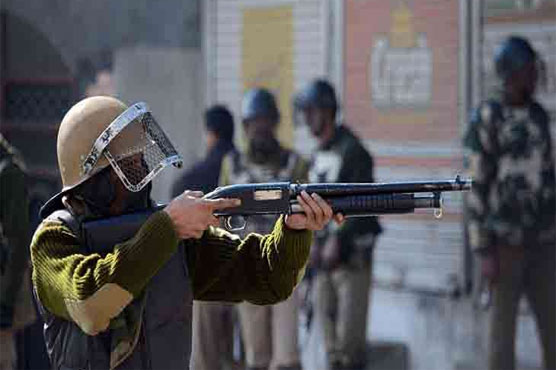
SRINAGAR, India (Web Desk / AFP) - Police and troops in India-held Kashmir will use chilli-based shells instead of pellet guns to quell protests, a minister said Monday, after hundreds of civilians sustained serious eye injuries in weeks of unrest.
The government has been coming under growing pressure over the level of casualties in Kashmir during protests against Indian rule since the death of a popular leader on July 8 in a gunbattle with soldiers.
More than 70 civilians have been killed and thousands injured in the worst violence to hit the Muslim-majority territory since 2010, with many sustaining injuries from metal pellets fired from pump-action shotguns.
Speaking on a visit to the state capital Srinagar, Home Minister Rajnath Singh said an expert panel had recommended the use of Pelargonic Acid Vanillylamide (PAVA) shells as an alternative to the mainly lead-based pellets.
"The expert panel suggested the use of PAVA shells and I understand that no one can die from it," Singh told reporters as fresh violence erupted in parts of the territory.
"Since yesterday, 1,000 shells have already reached Kashmir," he added.
PAVA, also called Nonivamide, is present in chillis and is commonly used to make pepper spray.
The pellet guns are meant to minimise fatalities in protests although the law gives the armed forces a relatively free hand to use lethal force, especially against suspected militants.
But although they rarely result in deaths, the birdshot from the pellets can often blind victims if the fragments hit them in the eye.
Hospitals say they have treated around 600 patients with eye injuries in the last two months, many of whom will never recover full vision.
Authorities lifted a curfew in most parts of the territory late last month, but schools, shops and many banks remain closed while residents struggle with a communications blackout.
Fresh clashes were reported at protests in large parts of held Kashmir on Sunday, with sources putting the number of injured in three figures.
Forceful anti-India and pro-freedom rallies were held across the territory against the visit of Indian parliamentarians. Around 500 civilians were injured when Indian forces subjected the protesters to the worst kind of torture on the fateful day.
Hurriyet leaders also refused to conduct talks with the Indian delegation because their government was not serious on holding a political dialogue.
Despite of all the abhorrence from Kashmiris, Indian Home Minister Rajnath Singh was not reluctant in adding that occupied Kashmir is, has and will be an integral part of India.
Kashmir has been divided between India and Pakistan since the two gained independence from British rule in 1947. Both claim the territory in full.
Several groups have for decades fought Indian soldiers -- currently numbering around 500,000 -- deployed in the territory. They demand independence for the region or its merger with rival Pakistan.
Tens of thousands of people, mostly civilians, have died in the fighting.
