



Clashes as Tunisia police blocks Salafists rally
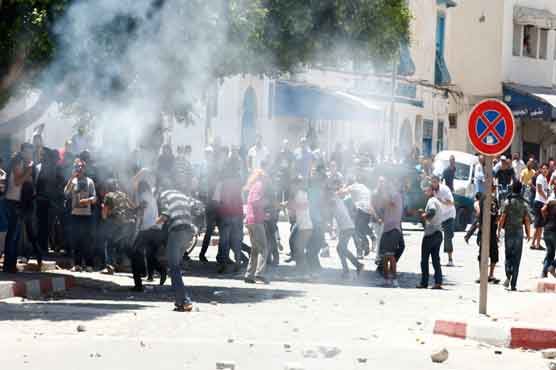
Salafists threw rocks at the police from a mosque who responded with tear gas.
KAIROUAN, Tunisia (AFP) - Clashes erupted between Salafists and police on Sunday in the central city of Kairouan, where security forces prevented Tunisia s main Salafist group from holding their banned annual congress.
The Salafists, who had taken cover behind a wall surrounding a mosque in the city centre threw rocks at the police who responded with tear gas, an AFP journalist reported.
Tunisian Salafist movement Ansar al-Sharia called on its hardline Islamist supporters to defy a government ban on its annual congress, setting the scene for a possible showdown Saturday on the eve of the planned meeting.
Ansar al-Sharia urged its supporters to travel to the venue in the historical central city of Kairouan in groups in a bid to get past police, adding to security concerns.
"We advise our brothers coming to Kairouan to travel in groups and not to be separated because the agents of the tyrant are blocking most intersections and provoking our brothers by showing their weapons," it said on its Facebook page.
With tensions rising, a US embassy travel advisory warned Americans against travelling to Kairouan, saying "large rallies and demonstrations are possible" if the congress goes ahead.
"There is the potential for disruption to traffic in the area of Kairouan and possible confrontations with security forces. The embassy recommends against all travel to Kairouan during this period."
The Salafists have been blamed for a wave of violence across Tunisia, including an attack on the US embassy in September that left four assailants dead.
Ansar al-Sharia is considered the most radical of the extremist groups that emerged after the 2011 revolution that ousted veteran strongman Zine El Abidine Ben Ali.
The group s fugitive leader, Saif Allah Bin Hussein, a former Al-Qaeda fighter in Afghanistan, warned last week he would wage war against the government led by moderate Islamist group Ennahda, accusing it of policies in breach of Islam.
The interior ministry said Ansar al-Sharia posed a threat to public order as it confirmed the ban on the planned congress on Friday.
"We have decided to prohibit this gathering, which would be in violation of the law and because of the threat it represents to public order," the ministry announced.
Ahead of the ministry s announcement, Ansar al-Sharia, which does not recognise the authority of the state, warned that it would hold the government responsible for any violence.
"We are not asking permission from the government to preach the word of God and we warn against any police intervention to prevent the congress from taking place," spokesman Seifeddine Rais said.
Rais said more than 40,000 people were expected to attend, adding: "The government will be responsible for any drop of blood spilt".
The interior ministry retorted that "all those who defy the authority of the state and its institutions, who try to sow chaos, who incite violence and hatred will bear all the responsibility".
It promised a tough response to "anyone who tries to attack the forces of order" and said the police and army are on "high alert to protect the security of citizens and their property".
Interior Minister Lotfi Ben Jeddou accused Ansar al-Islam of seeking a showdown.
A major Tunisian security presence has surrounded the country s main religious center and prevented hardline Muslims from holding their annual gathering.
Police scuffled with rock throwing young men and fired tear gas in Kairouan on Sunday, where the Ansar al-Shariah organization had announced it would gather thousands for its annual conference.
Police also arrested the spokesman for the movement, Seifeddine Rais, who said Thursday the state would bear responsibility for any blood spilled if the conference was banned.
About 11,000 police surrounded the city this weekend and conducted patrols to prevent the conference from taking place because "of the threat it represented to security and public order."
Tunisia has seen a rise in ultraconservative Muslim groups, known as salafis, which have attacked what they call signs of impiety.
