Summary Justice K.K. Agha questioned why the lawyers who filed the case were absent
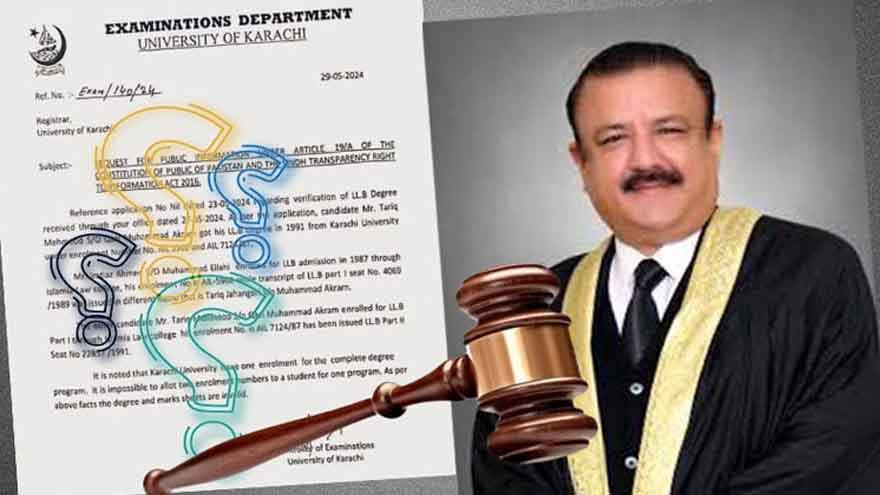
KARACHI (Dunya News) – Justice Tariq Mehmood Jahangiri of the Islamabad High Court (IHC) on Thursday remarked that “for the first time, a High Court judge is standing in the dock like an accused.”
The remarks came during the Sindh High Court’s (SHC) two-member bench hearing regarding Justice Jahangiri’s academic degree. Present in court were Justice Jahangiri himself, Justice Saman Raffat, the Additional Attorney General, the Advocate General Sindh, and the lawyer representing Karachi University.
Justice Jahangiri’s statement
Taking the rostrum, Justice Jahangiri stated that he had filed an application to become a party in the case. He said he was never issued any notice by Karachi University. Justice K.K. Agha observed that the bench would first determine whether the petition was maintainable, to which Justice Jahangiri responded that he was an affected party in the matter.
Lawyers’ objections
Justice K.K. Agha questioned why the lawyers who filed the case were absent. Advocate Faisal Siddiqi argued that the maintainability could not be decided without including the affected person. Following this, counsels from the Islamabad High Court, Karachi Bar, and others raised objections against the bench itself.
Barrister Salahuddin pointed out that Justice Adnan-ul-Karim Memon, a member of the bench, had earlier declined to hear cases of Farooq H. Naek through a judicial order.
Sindh HEC’s petition
The Sindh Higher Education Commission (HEC) had requested an urgent hearing, arguing that its credibility was at stake if no order was passed. However, the urgent petition did not specify any concrete reason. Through an administrative order, the case was transferred from Constitutional Bench 2 to Bench 1.
Justice Adnan-ul-Karim Memon clarified that he had no personal interest in the matter, while Barrister Salahuddin stressed that their objection was legal, not personal. Justice K.K. Agha assured that the bench would issue an order on the objections.
The Advocate General Sindh informed the court that the urgent petition had already been disposed of, adding that if the parties had objections, they could file an appeal. Karachi University’s counsel, Advocate Tahir Ahmed, said the Sindh HEC had misled the court and had itself admitted that it had no role in the matter.
Justice Jahangiri’s position
Justice Jahangiri asserted that for the first time, a High Court judge was being treated like an accused. “My only crime has been loyalty to my oath,” he said. He insisted that his degree was genuine and that he had personally sat for the exams.
He further said that 34 years later, an attempt was being made to cast doubt on his degree, despite no corruption charges against him. “I have never given judgments under anyone’s pressure. At the very least, I should be given a chance to be heard, even if the decision goes against me,” he added.
Outcome of hearing
The lawyers representing petitioners argued that their objections should be decided first before considering the maintainability of the petition. After this, the counsels for all petitioners walked out of the courtroom. Consequently, the court dismissed all petitions due to non-prosecution.