



Two dykes breached to save Multan, Muzaffargarh
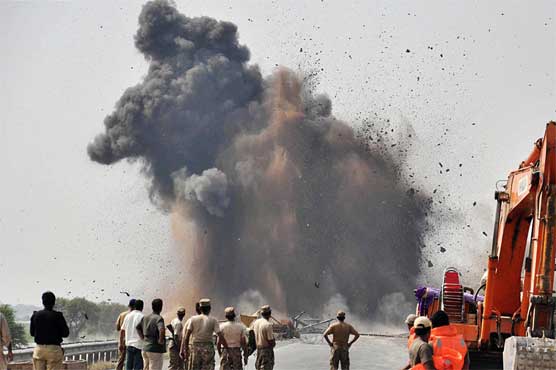
The road link between Multan and Muzaffargarh has been disconnected.
MULTAN (Dunya News/Web Desk) – Authorities have made two breaches at the Head Mohammad Wala Bridge to save Multan from flood water.
First 200-feet wide breach was made in Akbar Bund towards Kot Addu side to protect Head Muhammad Wala Bridge and help minimize flood pressure.
The second 100-foot wide breach was made in the same bund towards Muzaffargarh to decrease water pressure on Muhammad Wala Bridge to save Multan City.
While, Shershah dyke has also been blown up to save Muzaffargarh.
The breach in Akbar Bund, the road link between Multan and Muzaffargarh has been disconnected. However, Multan-Muzaffargarh carriage way via Chenab Bridge is operational for traffic.
A water torrent of 450,000 cusecs is passing through Head Mohammadwala and has reached Sikandri nullah near Multan, inundating several villages including Mamrot Basti Sial, Qasim Bela, Mohammadpur Ghota and Nawabpur.
On the other hand, water level in River Chenab at Head Trimmu has decreased but Athara Hazari and adjoining villages are still inundated.
Water level is continuously rising in Indus River. Nishtar Ghat’s temporary bridge has been swept away, suspending road link between Rajanpur and Rahim Yar Khan.
A massive flood torrent is expected to reach Sukkur between September 16 and 17. Due to flood threat, authorities have ordered evacuation in Ghotki, Kashmore, Khairpur, Shikarpur and Larkana’s rural areas.
There is high flooding in River Ravi at Head Sidhnai. Dozens of areas including Toba Tek Sindh, Kamalia, Sahiwal, Harrapa and Chichawatni are still inundated in floodwater.
On Thursday, the National Disaster Management Authority (NDMA) said more than 1.8 million have been affected by the raging torrents -- a figure that includes both those stranded at home and those who fled after the floods hit.
The floodwaters are moving downstream through Pakistan s Punjab province, inundating huge swathes of farmland in the country’s breadbasket and most prosperous area.
The military, which often plays an important role in disaster relief efforts, said troops had rescued 22,000 people stranded by floodwaters around Punjab and Pakistan-administered Kashmir.
Pakistan has suffered deadly floods around the same time every year since 2010, when the country was hit by the worst inundations in its history.
The waters that year swamped 160,000 square kilometres (62,000 square miles) of land -- an area bigger than England -- and cost the country nearly $10 billion, the equivalent of 6.5 percent of GDP. Around 1,800 people were killed and 20 million affected.
But an analysis this week by Topline Securities, a Karachi-based investment company, said this year’s floods do not appear to be on the same scale.
"Seeing the preliminary numbers... reported by NDMA, magnitude of the flood looks like 2012 and 2013, but much lower than 2010," the report said.
The floods of 2012 killed nearly 600 people and affected 4.6 million, while those in 2013 killed around 300 and affected some 1.5 million.
On the other hand, the Sindh government has put irrigation and other authorities on high alert and evacuated people from Kacho (riverbed) area in Dadu district.
The government has also directed authorities to evacuate people from Sukkur, Ghotki, Khairpur and Dadu districts.
Currently medium flooding is being witnessed at Guddu and Sukkur barrages as peak flood is expected to start passing from Sindh barrages from Monday.
The Guddu barrages is expected to hold up to 700,000 cusecs, Sukkur barrage up to 600,000 cusecs while Kotri barrage over 600,000 cusecs.
Sindh Chief Minister, Syed Qaim Ali Shah, Wednesday visited the Sukkur and Guddu Barrages as well as other protective embankments of River Indus in different areas.
Speaking to media he claimed that all embankments of River Indus are intact and the required precautionary measures have been taken to avoid any untoward situation.
Meanwhile, army relief and rescue operations continue in flood hit areas in Jhang, Multan, Bahwalpur and Rahim Yar Khan.
Army troops have dropped 52.176 tons of rations through helicopters in flood hit areas of Jhang, Multan and Bahawalpur areas.
Since start of flood relief operation 29,295 people have been rescued by army troops through helicopters and boats
Three medical camps established in Jhang, Chiniot and Trimoo are providing medical treatment to the flood affectees.
Four mobile medical Units comprising of army doctors are providing medical treatment to flood affectees in Multan and Bahwalpur areas.
